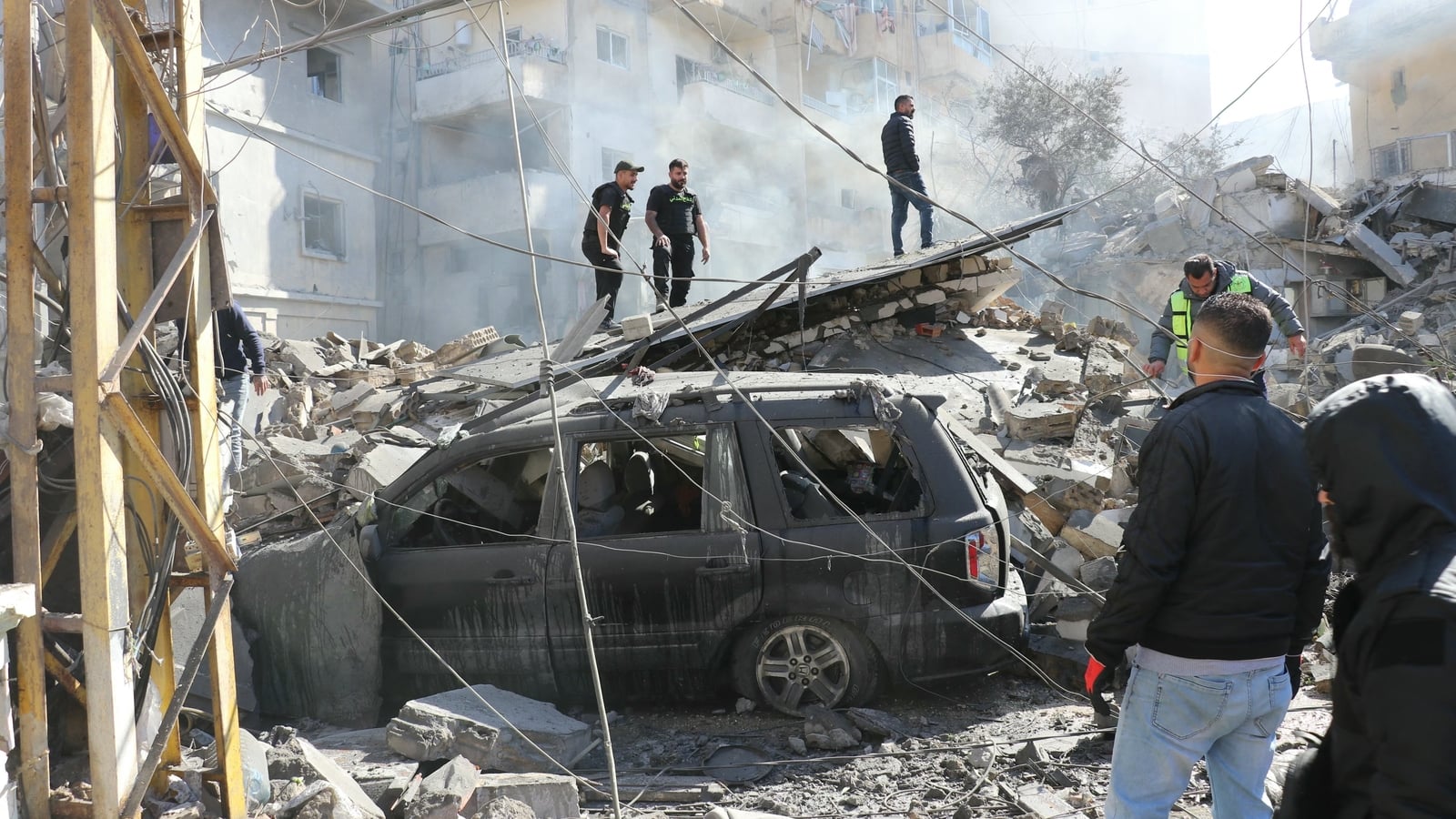
Israel struck the Iranian capital Tehran, Israeli military and Iranian media said, as President Donald Trump said the US was making progress in its efforts to negotiate an end to the war, with reports of a 15-point plan sent to Tehran.
The Israeli Defense Forces said in a Telegram post it has launched a wave of strikes targeting infrastructure across Tehran.
The semi-official Iranian SNN News Agency said the strikes hit a residential area in the city, with rescuers searching the rubble.
Kuwait and Saudi Arabia said they had repelled fresh drone attacks, without stating where they originated.
Drones targeted a fuel tank at Kuwait International Airport, causing a fire but no casualties, Kuwait's Civil Aviation Authority said.
Iran's Revolutionary Guards said it had launched a new wave of attacks against locations in Israel including Tel Aviv and Kiryat Shmona, as well as US bases in Kuwait, Jordan and Bahrain, Iranian state media reported.
Mr Trump said the US was in "negotiations" to end the war, which has already killed thousands and created the worst energy shock in history, leading to global fuel shortages and roiling markets.
Stocks rose and oil prices fell on reports the US is seeking a month-long ceasefire and had sent a 15-point plan to Iran for discussion, raising hopes for a resumption of oil exports out of the Persian Gulf.
Mr Trump told reporters at the White House the US was talking to "the right people" in Iran to end hostilities, adding the Iranians wanted to reach a deal very badly.
Iran's powerful parliament speaker Mohammad Baqer Qalibaf dismissed such reports as "fake news."
15 point plan sent to Iran
The New York Times reported that the US sent Iran a 15-point plan to end the war in the Middle East.
Israel's Channel 12, quoting three sources, said the US was seeking a month-long ceasefire to discuss the 15-point plan.
A source familiar with the matter confirmed that the US had sent a plan to Iran but provided no further details.
The Israeli media outlet said the plan would include the dismantling of Iran's nuclear programme, ceasing support for proxy groups, such as Lebanon's Hezbollah, and the reopening of the Strait of Hormuz.
The US and Israel launched strikes on Iran on 28 February after saying they had failed to make enough headway in talks aimed at ending Iran's nuclear programme, although mediator Oman said significant progress had been made.
Since then, Iran has attacked countries that host US bases, struck Gulf energy infrastructure and effectively closed the Strait of Hormuz, the conduit for a fifth of the world's oil and liquefied natural gas.
Iran has told the United Nations Security Council and the International Maritime Organization that "non-hostile vessels "may transit the Strait of Hormuz if they coordinate with Iranian authorities, according to a note seen by Reuters.
The effective closure of the waterway, where 20% of the world's oil and gas normally transits, has created the worst energy supply shock in history, sent fuel prices soaring, and disrupted global aviation.
Pakistan offers to hold US-Iran talks
Pakistan's Prime Minister Shehbaz Sharif said he was willing to host talks between the US and Iran on ending the war, a day after Mr Trump postponed threats to bomb Iranian power plants after what he called "productive" talks.
Pakistan has long-standing ties to neighbouring Iran's Islamic Republic and has been building a relationship with Mr Trump.
Despite reports of negotiations, the Pentagon is expected to send thousands of soldiers from the US Army's elite 82nd Airborne Division to the Middle East, two people familiar with the matter told journalists, adding to a massive US military buildup.
The forces will add to the 50,000 US troops already in the region and accelerate Washington's massive US military buildup there, fuelling fears of a longer conflict.
Read more:
How the Govt's excise cuts will impact the cost of fuels
'Tech bros are going to war' - Is Iran the world's first major AI conflict?
What Trump's war on Iran has meant for Ukraine
Facts Only
Who: Israel, Iran, United States, Saudi Arabia, Kuwait, Jordan, Bahrain, Pakistan
What: Strikes, attacks, negotiations, ceasefire discussions, 15-point plan, energy shortages, fuel price increases, aviation disruptions
When: May 14th (strikes in Tehran)
Where: Tehran, Israel, Kuwait International Airport, US bases in Kuwait, Jordan, Bahrain, Saudi Arabia
Executive Summary
Full Take
Steelman: The article presents a narrative of ongoing tensions between the United States, Israel, and Iran, with each country taking military actions against the others. The US is reportedly working on a 15-point plan to end the conflict, which includes dismantling Iran's nuclear program, ceasing support for proxy groups like Hezbollah, and reopening the Strait of Hormuz. Pakistan has offered to host talks between the US and Iran.
Patterns detected: ARC-0024 Ambiguity (The article does not clarify the extent of damage caused by the strikes or attacks, nor does it specify who initiated the first military action)
Root Cause: The conflict can be traced back to disagreements over Iran's nuclear program and regional influence. The ongoing violence is a continuation of long-standing geopolitical tensions in the Middle East.
Implications: The escalating violence has resulted in energy shortages, fuel price increases, and aviation disruptions that affect global markets and everyday life. The potential 15-point plan could bring about significant changes in the region if accepted by all parties involved.
Bridge Questions: What motivations lie behind each country's actions? How will the negotiations between the US and Iran unfold, and what are the chances of a lasting peace agreement being reached? Are there alternative solutions to the current crisis that have not been considered? What long-term consequences might result from the ongoing violence in the Middle East?
Sentinel — Human
The text shows signs of a human writer due to its varying sentence length, balanced framing with idiosyncratic emphasis, and lack of matching argumentative templates.