B&B Italia Reissues Richard Sapper’s Ingenious Nena Chair
German industrial designer Richard Sapper was a problem-solver at heart. His articulating 1972 Tizio desk lamp offered a superpowered light source via a (then novel) minuscule halogen bulb, while his pioneering 1992 IBM ThinkPad proposed a portable computer the size of a cigar box. In 1984, he turned that exacting eye to an age-old conundrum. “He wanted to design an armchair that could offer comfortable seating, yet be stored practically when not needed,” recalls his daughter Carola Sapper. Titled Nena, the resulting piece could be folded up into a slender profile, thanks to its die-cast aluminum joints but, when expanded, revealed the same supple sturdiness of an upholstered lounge. Now, B&B Italia has re-issued the innovative piece in a range of leather or fabrics (available in November). Carola, who grew up with several, explains, “when you want seating, you use it, and when you prefer more space, you fold it flat and it occupies minimal room in a wardrobe or cupboard.” With its elegant hook, you can even hang it on the wall. —Hannah Martin
Workstead’s New Lighting Collection Channels the Timeless Geometry of the Pyramid
“The pyramid feels both ancient and timeless—a primordial shape that carries an incredible sense of permanence and symbolism,” says designer Robert Highsmith, cofounder of Workstead. He is explaining the inspiration for the firm’s latest range of lighting. Sheathed in douppioni raw silk and outfitted with custom metal fittings and hand-finished silk tassels, the angular pendants and sconces bring a touch of Giza or Frank Lloyd Wright to contemporary interiors. —H.M.
Yukiko Nagai Embraces Embellishment with Traditional Italian Mosaics
When Yukiko Nagai was visiting Istanbul in the early aughts, she was blown away by the shimmering tilework that covered the mosques. “I was attracted to the big impact that decoration could give to a building,” notes the Japanese artist, who grew up in Niigata. It made such an impression on her that she decided to move to Ravenna, Italy, home to some of the world’s most exceptional Byzantine mosaics, characterized by reflective glass tiles. There, she enrolled in the city’s Academy of Fine Arts to study the ancient craft.
Nagai finished her education in 2009 and got to work practicing her version of that technique, which involves cutting ceramic, natural stone, and colored opaque glass (known as smalti) into small chunks that are then arranged on a lime-plaster canvas before being leveled and glued together. Once complete, she applies the intricate surfaces to vintage and antique furniture, like the outdoor set she recently made for The Future Perfect gallery, which represents her work.
“I got inspiration for the colors and motifs from these antique garden chairs that I brought back from Tuscany,” she says of the abstracted blue flowers that seem to bloom across the table. On AD’s recent visit to her studio, she was working on a bench that will debut this September as part of the Homo Faber exhibition in Venice. “For this one, I’m applying a delicate mosaic pattern inspired by lace,” she explains of the trompe l’oeil effect. In the past she has also explored faux bois, a happy surprise to sitters who expect to find wood.
“I want my pieces to have a strong presence, where the decoration enhances the space and defines the room,” explains Nagai, who, still inspired by those Turkish mosques, hopes to expand her work to an architectural scale some day. “Although I propose my pieces in the form of furniture, at the core I am a mosaic artist.” —H.M.
Ralph Lauren Home’s Isabella Collection Brings Timeless French Blue-and-White Florals to the Modern Table
Hardly could the 18th-century French potters making soft-paste porcelain in the Nonette river valley, at the Château de Chantilly, have known how far their craft would one day travel. Three centuries later and an ocean away, their traditional artistry has inspired Ralph Lauren Home’s latest dinnerware collection, Isabella. A hand-painted pattern of petals and stems, translated into a decal application, enlivens the five-piece service, which includes dinner, salad, and bread plates (all shown) as well as a soup bowl and a teacup and saucer set—perfect for a full meal or simply some cake. Blue-and-white florals, it turns out, transcend time, place, and appetite. —Madeline O’Malley
Hermès’ New London Store Puts the “Maze” in Maison
For Hermès’ new London store, architect Denis Montel wanted to play with “the concept of English eccentricity.” After all, each of the brand’s six international maisons, or bespoke flagships, are designed with local aesthetics in mind. With its maze-like interior, the store on New Bond Street is more of a small village than a retail destination: 55 separate retail spaces and 60 back-of-house rooms are spread across six adjacent buildings from the Victorian era (that’s 20,000 square feet of space, total).
Montel, who worked closely with Hermès’ executive team to build out their Tokyo and Paris houses, likens the sprawling London store to a “maison de poupée,” or dollhouse. Because of the constraints imposed by the city’s landmarks commission—the buildings date from 1769—Montel couldn’t raise or lower any of the floors or ceilings. Instead, he installed bridges, passageways, and an early 2000s–era Norman Foster spiral staircase, which coils through the space’s central courtyard. “Inside, the windows are not aligned, and there’s different perspectives,” Montel says. “It’s quite playful. We prefer a journey of discovery with no logic, and tried to invite people to get lost.”
Still, the labyrinthine interior relies on some systematic thinking. Each of the brand’s 16 métiers—or product divisions—are color-coded and clustered in rooms painted in their corresponding hues (yellow spaces for jewelry, red for leather goods, and so on.) Equine paintings and curiosities from the collection of Émile Hermès, grandson of founder Thierry Hermès, are on display among notable artworks from the likes of Martin Parr—they ensure that customers remember the brand's French roots. Next up for Hermès is a smaller location in Williamsburg, Brooklyn, opening in September, and a larger flagship in Geneva later in the fall. —Julie Brener Davich
Waldorf Astoria Brings Admiralty Arch Back Into View
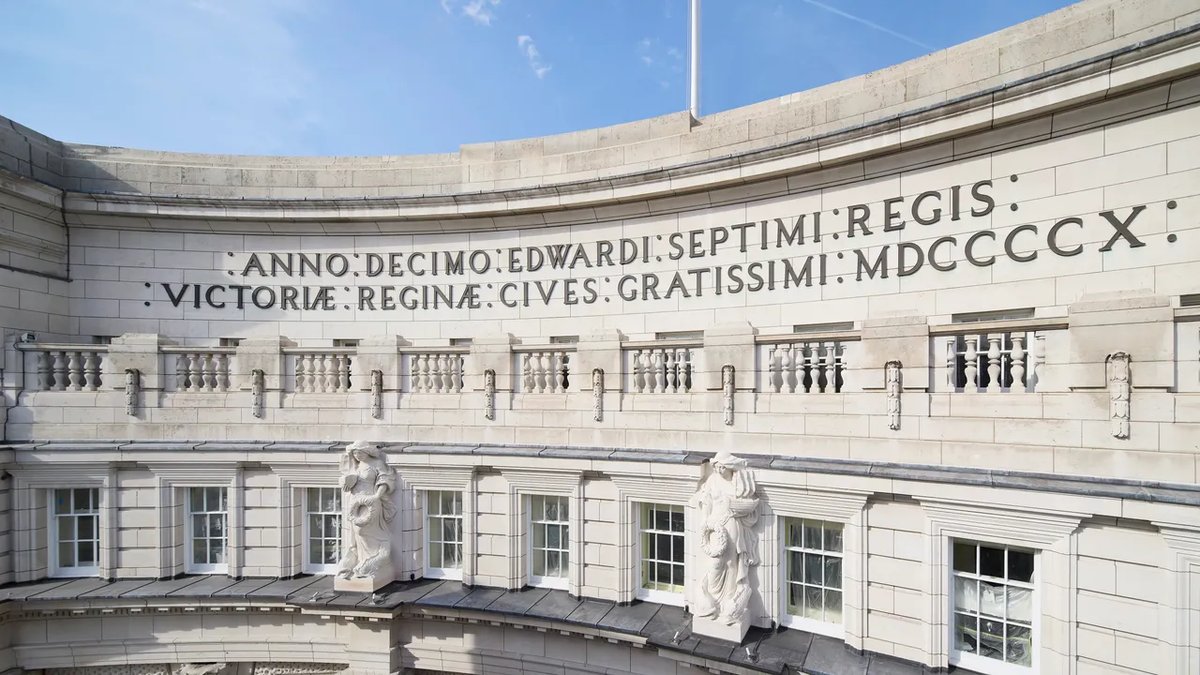
In London, the scaffolding has officially come down on Admiralty Arch, offering a first look at the future home of the city’s new Waldorf Astoria hotel. It’s a milestone for the global hospitality brand, which has spent the past decade transforming the 1911 landmark, commissioned by King Edward VII in honor of his mother. But it’s also a gamechanger for architecture lovers and history buffs. Designed by Sir Aston Webb, Admiralty Arch originally did double duty as the offices of the Royal British Navy and the personal home of the Sea Lord of the Navy, later serving as a base for the army and Winston Churchill. As part of its update, Waldorf Astoria has meticulously restored the limestone exterior, distinguished by three arches that link The Mall to Trafalgar Square. Brass details (long painted over) have been uncovered, iron gates refreshed, and lead dormers replaced, among other sensitive tweaks. And that’s just the outside. When the 114-room Waldorf Astoria London - Admiralty Arch opens this fall, it will be the first time the public has ever been able to access the building. Until then visitors can lock eyes with the two new sculptures of maidens that occupy what had been blank facade brackets, completing Webb’s vision. –Sam Cochran
These stories appear in the July/August issue. Never miss a story when you subscribe to AD.
Sentinel — Human
This text reads like an editorial or feature compilation that synthesizes various creative and architectural narratives into a cohesive aesthetic argument.