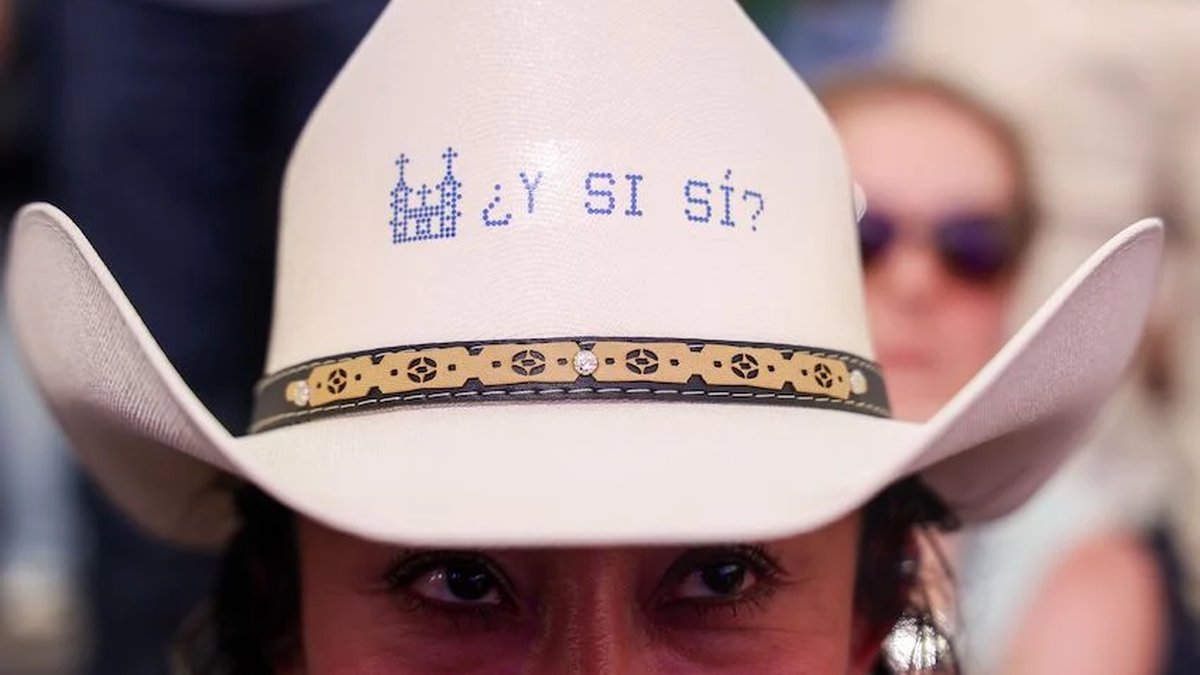
¿Y si sí?
This three-word question — literally translated as “And if yes?” — became a national motto for hopeful Mexican soccer fans during El Tri’s World Cup run to the round of 16.
What if Mexico can beat England at Estadio Azteca and advance to the World Cup quarterfinals for just the third time ever? What if El Tri can continue winning and make it all the way to the final? What if Mexico can do the unthinkable and hold the World Cup aloft at New Jersey’s MetLife Stadium on July 19?
Unfortunately for Mexican fans, Mexico’s 2026 World Cup dream is now over after El Tri lost 3-2 to the Three Lions on Sunday night in a nail-biting match. However, the motto, the question, the collective hope encompassed in ¿Y si sí? will live on in the national psyche and serve as a reminder of a time when a nation as a whole dared to dream.
Those three words will also live on in other ways as they are no longer just about a nation’s World Cup dream. They have been repurposed — converted into a pithy expression of desire for a better Mexico, a country where the most pressing problems are addressed in a meaningful way.
‘Why should hope be confined solely to a soccer field?’
¿Y si sí? was the headline of an editorial published on Saturday by Desde la Fe, a mouthpiece of the Archdiocese of Mexico, one of the world’s largest Catholic archdioceses.
“The enthusiasm that today unites millions of Mexicans around soccer can become an opportunity to ask ourselves if we are also capable of believing in a reconciled, fairer and deeply humane country,” the editorial says in its subheading.
In the body of the text, the Desde la Fe editorial team (hereafter referred to as the Archdiocese of Mexico) writes that “¿Y si sí?” is a phrase that has managed to summarize “the spirit of an entire country.”
“… This tiny question reveals our ability to keep believing when the odds seem stacked against us. It reminds us that hope always finds a way, even when logic invites pessimism,” the Archdiocese of Mexico says.
“In this situation, it’s worth asking ourselves: Why should that hope be confined solely to a soccer field?”
The Archdiocese of Mexico subsequently notes that Mexicans frequently say that “Mexico will never change” and that “we’ve become accustomed to thinking that certain problems are permanent” — that “violence is here to stay,” that “families will continue breaking up,” that “human dignity will always have a price.”
“Why are we able to believe that we can win a World Cup, but not that we can rebuild our country? What would happen if we applied that same conviction to the challenges that truly shape the life of our country?” the editorial asks.
El Tri wins its first knockout game in 40 years, fueling Mexico with unlimited optimism
“What if we could actually reduce the violence that has caused so much pain in our communities? What if we could actually find ways to ensure that fewer and fewer people go missing and more families find peace again?”
After asking various other “What if?” (¿Y si sí?) questions, the Archdiocese of Mexico asserts that “an authentic renewal” of national life only occurs “when we cease asking only what others can do and start asking what we can do ourselves.”
“We won’t solve the crisis our country is facing on our own, but we can become people who care for others, listen to them, stand by them, and defend life wherever we are,” the editorial states.
“Our country’s greatest challenges will continue waiting for people who are capable of believing that change is possible. We therefore invite all of society to ensure that the phrase ‘¿Y si sí?‘ does not remain merely a cheer at a soccer game, but rather becomes a way of looking at life.”
‘And what if they actually find them?’
Also making use of the ¿Y si sí? question are relatives of Mexico’s more than 130,000 missing persons, including the nation’s madres buscadoras, or searching mothers. During a march along Mexico City’s Paseo de la Reforma on Sunday — the avenue that hosted huge celebrations after Mexico’s four 2026 World Cup victories — relatives of missing persons chanted slogans such as, “Negligent government, return our children.”
¿Y si sí…los encontramos?#México#Desaparecidos#HastaEncontrarles#Mundial2026 pic.twitter.com/owd6p2angY
— Margarita Nava 🔥🌊❤️💪🏾🎨💜💚🇯🇴🇺🇦🤖 (@MagosNava) June 30, 2026
The relatives of los desaparecidos, who have long called on Mexican authorities to do more to locate their missing loved ones, also posed the question: “¿Y si sí los encuentran?” (And what if they actually find them?).
In this context, the news outlet Animal Político reported, the question was chanted in reference to “the demands for truth and justice” in missing persons cases, demands that have been made in protests in Mexico for decades, including during the World Cup, where 13 matches were played in Mexico City, Monterrey and Guadalajara — the capital of a state that is the epicenter of Mexico’s disappearances crisis.
In blunter terms, the protesters in Mexico City on Sunday directed this message to Mexican authorities: “Do your work, find our missing loved ones and search for the culprits.”
President Claudia Sheinbaum, who has said that addressing the missing persons problem is a “national priority” even as thousands of people have disappeared during her term in office, has come under fire for welcoming Merlin, the “World Cup duck” to the National Palace, but allegedly not meeting with madres buscadoras, an accusation she denies.
While the federal government has succeeded in significantly reducing Mexico’s homicide rate, per the government’s own statistics, addressing the missing persons problem remains a major challenge for Sheinbaum. Making meaningful headway on the issue — by locating missing people, identifying the large number of remains in morgues, reducing the incidence of abductions and solving high-profile cases such as that involving the 43 Ayotzinapa Rural Teaching College students — would be a laudable achievement for the Sheinbaum administration.
The pressure to do so, including through the use of variations of the ¿Y si sí? question — a question that was an expression of hope, but which has now been rendered as something of a rallying cry — will not go away.
With reports from Animal Político
Sentinel — Human
The text skillfully bridges a specific sporting event with deep, unresolved social and human rights issues in Mexico, using a recurring rhetorical device to prompt reflection on national aspirations versus reality.