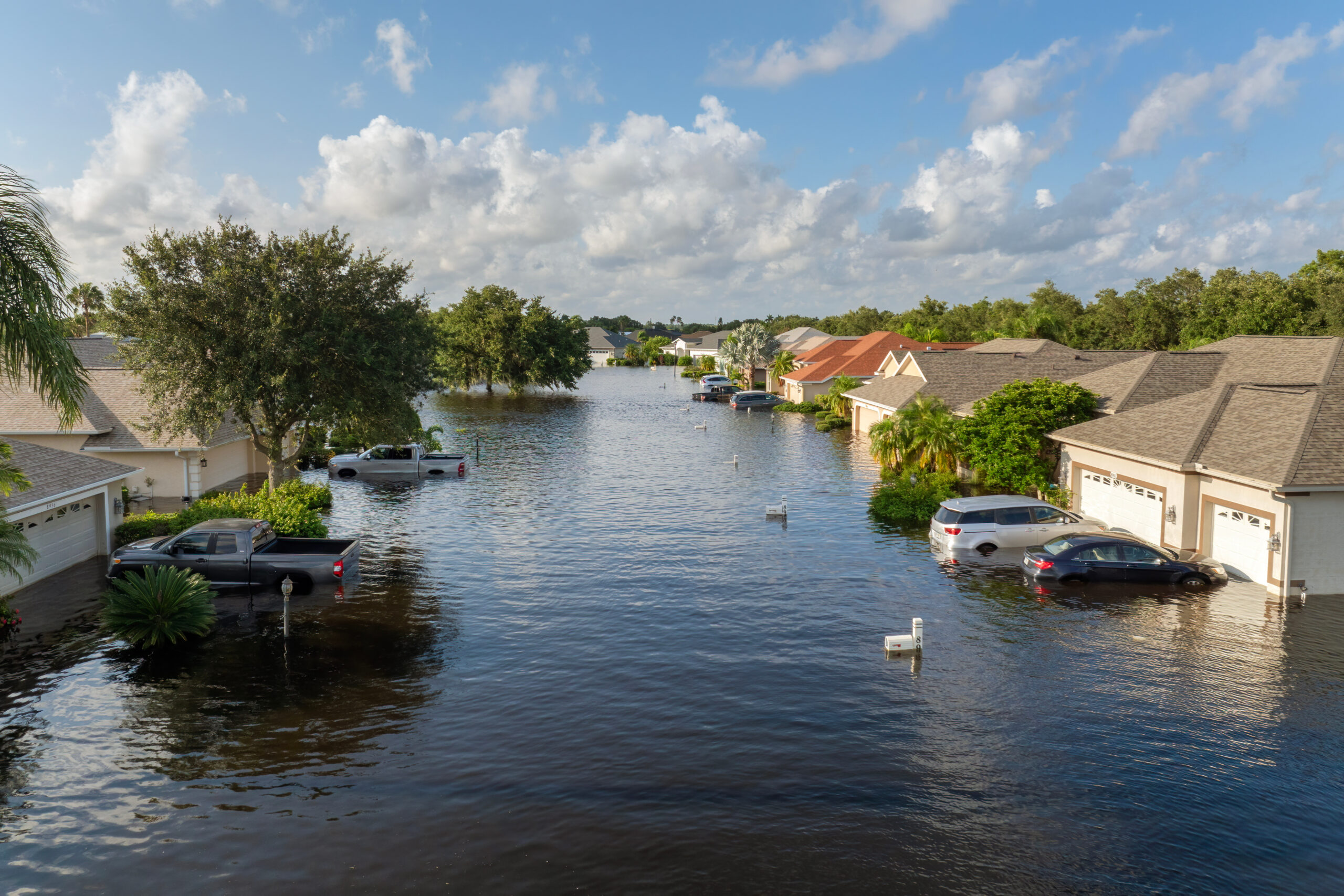
More than 100 homeowners have charged in a lawsuit that officials in Sarasota County, Florida, failed to maintain a dike for years, allowing Hurricane Debby’s floodwaters to inundate homes throughout an upscale subdivision.
“Engineering modeling analysis has confirmed that without the breach of the Cow Pen Slough dike, there would have been no flooding of the interior of the homes in Laurel Meadows,” reads the lawsuit complaint, filed this month in Sarasota County Circuit Court.
Hurricane Debby grazed the western flank of the Florida peninsula in August 2024, deluging some areas with as much as 17 inches of rain over a three-day period, the suit notes. Some homes in the Laurel Meadows subdivision saw as much as 24 inches of water inside, causing extensive damage to drywall, floors, fixtures, appliances and belongings—and forcing residents to move out temporarily.
While the subdivision is near a group of lakes, it had never experienced such flooding before, the complaint alleges.
“Although major storm events have, at times, flooded the streets in Laurel Meadows, the homes within that subdivision had never suffered interior flood intrusion as a result of those major storm events, prior to August 4, 2024,” the suit reads.
It was all because county crews failed to repair a dike surrounding Cow Pen Slough, a drainage canal owned by the county, the homeowners’ attorneys claimed in the suit. Sarasota County’s environmental utility staff noted the breach in the dike three weeks after the hurricane made landfall. But examination of LIDAR (light detection and ranging) measurements showed the breach had existed at least since 2018. Statements from county workers suggest the breach may have been there for decades.
A subsequent engineering firm analysis of the landscape showed that without the Cow Pen Slough dike breach, the homes would not have been flooded, the complaint argues.
The suit charges negligence by the county, and inverse condemnation, or a taking of the value of the homes without formal eminent domain proceedings. The county had a duty to maintain the dike and officials “knew, or should have known, of the breach in the dike along the Cow Pen Slough,” it reads.
The county has not yet answered the complaint.
The suit does not indicate the number of homes in the subdivision that carried flood insurance, nor does it indicate nor the impact that residential development may have had on flood levels.
Photo: Part of the Laurel Meadows subdivision after Hurricane Debby flooded the area. (AdobeStock)
Topics Catastrophe Natural Disasters Flood Hurricane Homeowners
Was this article valuable?
Here are more articles you may enjoy.
Facts Only
More than 100 homeowners in Sarasota County, Florida, filed a lawsuit in Sarasota County Circuit Court.
The lawsuit alleges that county officials failed to maintain a dike along Cow Pen Slough, a drainage canal owned by the county.
Hurricane Debby struck Florida in August 2024, bringing up to 17 inches of rain over three days.
Floodwaters from the storm inundated homes in the Laurel Meadows subdivision, with some homes experiencing 24 inches of water inside.
Engineering analysis cited in the lawsuit states that the breach in the Cow Pen Slough dike caused the flooding.
The breach was detected by county staff three weeks after Hurricane Debby made landfall.
LIDAR measurements indicate the breach existed since at least 2018.
Some county workers suggest the breach may have been present for decades.
The lawsuit charges the county with negligence and inverse condemnation.
The county has not yet responded to the complaint.
The lawsuit does not specify the number of homes with flood insurance or the impact of residential development on flood levels.
Executive Summary
Full Take
The strongest version of this narrative is that Sarasota County’s failure to maintain critical infrastructure directly caused preventable harm to homeowners, supported by engineering analysis and historical evidence of the dike’s breach. The lawsuit frames this as a clear case of negligence, with the county’s own records and worker statements undermining any potential defense of ignorance. However, the absence of details about flood insurance coverage or the role of residential development in exacerbating flooding leaves room for counterarguments—such as whether homeowners bore some responsibility for risk mitigation or if broader land-use policies contributed to the disaster.
Patterns detected: none. The narrative does not appear to employ emotional exploitation, distortion, or bad-faith tactics. It presents a factual dispute with legal and engineering backing, though the omission of certain contextual factors (e.g., insurance, development impacts) could be seen as a subtle framing choice.
Root cause: The paradigm here is one of institutional accountability versus individual resilience. The unstated assumption is that government entities have an absolute duty to prevent foreseeable harm, even in extreme weather events. This echoes historical tensions between public infrastructure maintenance and private property rights, particularly in flood-prone regions where climate change is increasing risks.
Implications: If the lawsuit succeeds, it could set a precedent for holding local governments liable for infrastructure failures during natural disasters, potentially shifting costs from taxpayers to municipalities. Conversely, if the county prevails, it may reinforce the expectation that homeowners bear the burden of flood risks, even when infrastructure failures are involved. Second-order consequences could include higher insurance premiums, stricter zoning laws, or increased investment in flood mitigation.
Bridge questions: What evidence would change your view on whether the county is primarily responsible? How should the balance between public infrastructure maintenance and private risk management be struck in an era of worsening climate disasters? What role, if any, should historical land-use decisions play in assigning liability?
Counterstrike scan: A coordinated influence campaign might amplify this narrative to undermine trust in local government or push for privatized flood management solutions. However, the content here is a straightforward legal dispute without signs of manipulation. The focus on engineering analysis and factual claims aligns with legitimate accountability journalism, not a manufactured outrage playbook.
Sentinel — Human
The article appears to be written by a human journalist, displaying unique writing style, idiosyncratic phrasing, and a lack of mechanical sentence structure, despite showing some variation in sentence length.