Newcastle v the system - is Saudi 2030 vision unrealistic?
- Published
David Hopkinson was remarkably bullish when taking on the role of Newcastle United chief executive at the end of last year.
The Canadian reckoned he could put Newcastle "in the debate about being the top club in the world" by 2030.
After Sunday's 2-1 home defeat by Sunderland, they are not even the top club in the north east in terms of the current Premier League table.
Manager Eddie Howe, under pressure for the first time in his four and a half years at St James' Park, was asked if the Saudi Public Investment Fund (PIF) project was running out of steam.
"The club desperately want to be ambitious, but there's a limit to what we can spend," Howe said.
"I think the rules have made it very difficult - I don't know where we can beat that system."
Howe might have a point. Are the financial rules stifling Newcastle?
The more you generate the more you can spend
There is no doubt Profit and Sustainability Rules (PSR) have put the brakes on Newcastle.
It is why the Magpies support their replacement, Squad Cost Ratio (SCR), which comes in on 1 July. But will it reinforce the position of the elite?
The problem for PIF has always been that it was too late to the party.
Whereas Chelsea and Manchester City were able to spend freely to build their empire, governing bodies now have the shackles on.
PSR was put in place in 2013, well before the Saudi takeover.
Though Manchester City do face 115 charges over alleged spending breaches between 2009 and 2018.
PIF spent £404.7m in the first three years after buying the club in 2021.
But by bringing in only £50.4m from sales the stark reality of PSR hit home in 2024.
Newcastle had to sell Elliot Anderson (£35m) to Nottingham Forest to help stave off a points deduction.
They lost a high-quality academy product, a lad from Whitley Bay who came through Wallsend Boys Club.
The 23-year-old is now an England regular and very likely to go to this summer's World Cup.
BBC Sport understands that Forest would want £80m should he be sold this year.
PSR focuses on limiting losses, but SCR is about income. In short, the more you generate the more you can spend.
In the Premier League that will be 85%, though it is possible to spend as much as 115% in the first year and pay what is in effect a luxury tax.
On the surface, this sounds great. After all, Newcastle have recorded record revenues in each season under PIF.
Football finance expert Kieran Maguire says that for the Magpies it made total sense.
"The plusses outweigh the minuses," Maguire told BBC Sport. "With having a bigger stadium, hoping to either expand the stadium or move, they see the longer-term benefits of SCR."
But once you look under the hood you see that SCR might reinforce the financial dominance of the Premier League's established order.
Budgets of big six will dwarf Newcastle's
Newcastle may be in favour of the new rules, but they will still be well behind on spending power.
Analysis by Swiss Ramble, external shows that, based on the 2023-24 accounts, the Magpies' SCR budget ranked ninth (£243m) in the Premier League.
Compare that with the big six: Manchester United (£597m), Manchester City (£580m), Arsenal and Liverpool (£449m), Chelsea (£407m) and Tottenham Hotspur (£397m).
Unless Newcastle generate higher income, the status quo will always be able to spend more, paying higher wages.
"Look at Newcastle's wages of £220m [in 2023-24]," Maguire added. "It's £100m less than Arsenal and Chelsea. And it was £200m less than Manchester City. So that is the problem.
"The desire to narrow the gap is a challenge. Football is a talent game. Talent follows the money in terms of both recruitment and wages - and it makes it difficult for Newcastle to make that step up."
Newcastle face a battle to qualify for Europe - but not making it could be a positive.
Stay with us while we explain.
Uefa's SCR system limits clubs in European competition to spending 70% of their income.
A club not in Europe would be able to go to 85% or above under the Premier League rules, designed to give teams not in continental competition some extra space to compete.
To show the impact by analysing the 2023-24 figures, West Ham (£267m) and Brighton (£276m) would have had bigger budgets than Newcastle, had these rules been in place.
And this is further underlined by another quirk which means being in the Conference League could be the worst thing financially.
The winners of the competition only earn about £20m, yet must work to the 70% rule. The difference between 70% and 85%, based on the 2023-24 figures? At least £33m less to spend.
Newcastle would prefer the riches of the Champions League, though even that competition further entrenches the position of the biggest clubs.
Uefa gives bonus payments under the 'value pillar', partly based on a club's coefficient. It rewards historical success.
For this season's league phase, Swiss Ramble calculated, external that Newcastle received £47m. But Arsenal, Chelsea, Liverpool and Manchester City were all paid in excess of £79m.
Everywhere you turn it seems the football establishment wins again.
Sunderland not very good compared with Newcastle - Gordon
- Published6 hours ago
Newcastle's Barnes replaces Eze in England squad
- Published9 hours ago
St James' Park key to Newcastle's future
There is one clear solution for PIF - increase matchday income by investing in the stadium. The expenditure does not count towards SCR.
Newcastle's matchday revenue was £50m in 2023-24, compared with £102m for Liverpool and £137m for Manchester United.
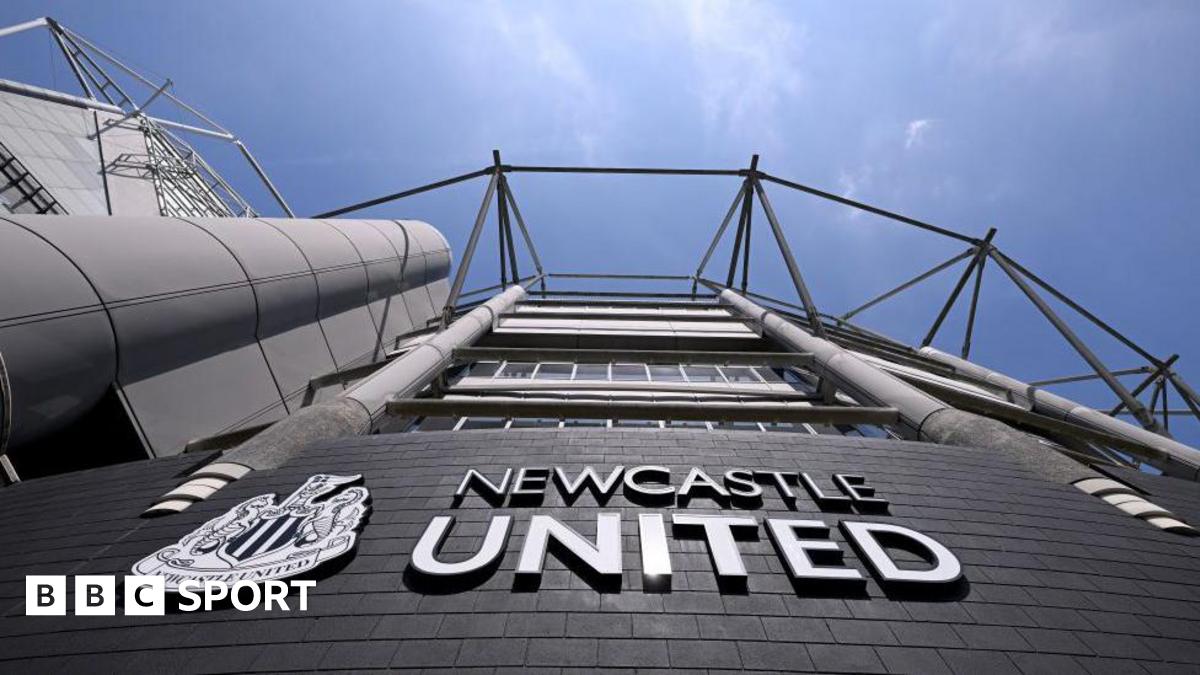
The 52,000-capacity St James' Park must be revamped - or they need a new ground.
Hopkinson told the Financial Times Business of Football Summit last month that Newcastle had not "maximized the opportunity before it".
"If we want to become an elite club, we need to behave like an elite club," Hopkinson said.
It is going to take years to reap the rewards and there are no signs of plans being submitted, let alone spades in the ground.
Performances on the pitch, with the club 12th in the Premier League, indicate that spending big again will be a necessity.
That is after Newcastle's outlay of £242m last summer - their most in one transfer window, although they did recoup £125m from the sale of Alexander Isak to Liverpool.
SCR will create some more scope, but not enough to be transformational - especially when their rivals have greater spending power, as Newcastle discovered last summer. They missed out on Hugo Ekitike to Liverpool, Benjamin Sesko to Manchester United, and Joao Pedro and Liam Delap who both joined Chelsea.
The appointment of Hopkinson indicates that PIF knew there had to be a change in commercial direction.
But the laws of football's ecosystem dictate that without action the club could fall further behind.
Without a new stadium, it is hard to see how Newcastle United can spend more and become the "top club in the world", despite the incredible riches of their Saudi owners.
Facts Only
Newcastle United CEO David Hopkinson stated the club aims to be among the top in the world by 2030.
Newcastle lost 2-1 to Sunderland in a Premier League match, placing them below their rivals in the table.
Manager Eddie Howe cited financial rules as a major obstacle to the club’s ambitions.
Profit and Sustainability Rules (PSR) have restricted Newcastle’s spending, leading to the sale of Elliot Anderson for £35m.
Newcastle spent £404.7m in the first three years under PIF ownership but generated only £50.4m from player sales.
The new Squad Cost Ratio (SCR) rules, effective July 1, allow clubs to spend up to 85% of their income, with a luxury tax for exceeding limits.
Newcastle’s 2023-24 SCR budget ranked ninth in the Premier League at £243m, far below Manchester United (£597m) and Manchester City (£580m).
Newcastle’s wages in 2023-24 were £220m, significantly lower than Arsenal, Chelsea, and Manchester City.
UEFA’s SCR rules limit European clubs to 70% spending, while non-European clubs can spend up to 85% under Premier League rules.
Newcastle’s matchday revenue was £50m in 2023-24, compared to £137m for Manchester United.
Plans to expand or rebuild St James' Park have not yet materialized.
Newcastle spent £242m in the 2023 summer transfer window but recouped £125m from Alexander Isak’s sale.
Executive Summary
Full Take
The strongest version of this narrative highlights the structural barriers in modern football, where financial regulations and historical advantages create an almost insurmountable gap for ambitious clubs like Newcastle. The PIF’s wealth alone cannot overcome the entrenched dominance of the "big six," whose superior revenue streams—from matchday income, commercial deals, and UEFA’s coefficient-based bonuses—perpetuate their superiority. The article effectively illustrates how even well-funded newcomers are constrained by rules designed to curb excess but inadvertently protect the status quo.
Patterns detected: ARC-0024 Ambiguity (implied criticism of financial rules without explicit policy alternatives), ARC-0043 Motte-and-Bailey (generalized complaints about "the system" without specifying actionable solutions).
The root cause is the tension between football’s meritocratic ideals and its financial oligarchy. The narrative assumes that wealth should translate directly into success, but it overlooks the role of institutional inertia—where clubs like Manchester City and Chelsea built their empires before stricter regulations. The implications are stark: without radical reform or a stadium expansion, Newcastle’s trajectory may plateau, reinforcing the idea that football’s elite is a closed shop.
Bridge questions: Could Newcastle’s struggles reflect a broader trend where financial regulations inadvertently stifle competition? What alternative models (e.g., salary caps, revenue sharing) might level the playing field? How much of this is about football’s governance versus the club’s own strategic missteps?
Counterstrike scan: A coordinated influence campaign would amplify frustration with financial rules while downplaying Newcastle’s own operational challenges (e.g., delayed stadium plans). The article does not fully align with this pattern, as it acknowledges both systemic barriers and the club’s internal shortcomings. However, the focus on "the system" as the primary villain could be exploited to deflect accountability.
Sentinel — Human
The article exhibits strong human characteristics, including stylistic quirks, local color, and a clear editorial voice, with no significant markers of synthetic generation.