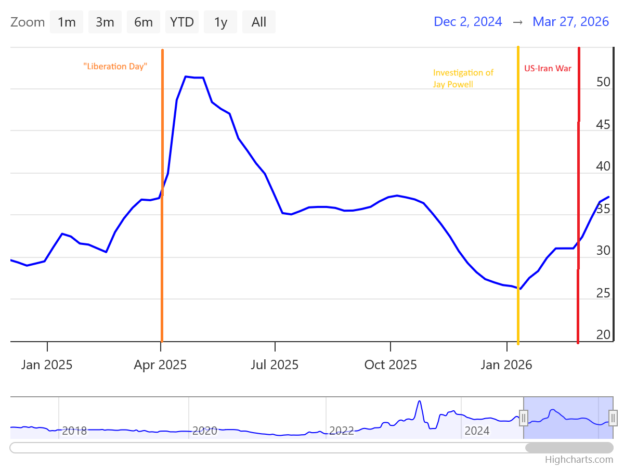
Oh, and the other part of the rise in borrowing rates is the inflation premium and the associated rise in the expected funds rate, in case anyone was wondering:
The article reports, without naming names, that some “big Wall Street banks” shut down electronic quotes for Treasury prices. I suspect they did not trust that they could match trades at the quoted price, creating a potential loss for the bank; that’s a symptom of illiquidity.
This is not a financial crisis, but it does increase the risk. Inability to convert assets to cash is the stuff of financial crisis, and there is an obvious deterioration underway. It probably doesn’t help that the cost of carry is both uncertain and perhaps rising. Nor does it help that the priced-in odds of default are rising.
There is a good bit of press attention on an article published by the Royal United Services Institite which argues that the U.S. is nearly out of sophisticated offensive and defense munitions as a result of our war against Iran:
The article backs up what a good many military analysts have been saying for a couple of weeks. The article goes into some detail about the likely persistence of the problem. U.S. arms suppliers are so far not working to replace spent weapons because they have not received firm orders from the Pentagon for replacement weapons. Once orders are placed, refilling weapons inventories will take five years.
The press mostly claims the article is from RUSI. It is not. RUSI makes clear it is an opinion piece written by guest authors. Even so, the article seems well founded.
This seems important context for the felon-in-chief’s new urgency to strike a deal. Soon, the U.S. will be down to dropping “dumb” bombs, which would mean exposing our aircraft to attack. U.S. ground troops, meanwhile, have not depleted their munitions. The easy part of the war is just about over.
Every recitation of the destruction and horror brought on by the relentless corruption and incompetence of MAGA rule should end with that infamous punch line…The Aristocrats!
Which partly accounts for the rise in term premium:
https://fred.stlouisfed.org/graph/?g=1UfX6
Which partly accounts for the rise in Treasury rates:
https://fred.stlouisfed.org/graph/?g=1UfXv
Which partly accounts for higher private borrowing costs:
https://fred.stlouisfed.org/graph/?g=1UfXR
Which partly accounts for the slowdown in mortgage applications:
https://www.tradingview.com/symbols/FRED-M0264AUSM500NNBR/?timeframe=60M
Oh, and the other part of the rise in borrowing rates is the inflation premium and the associated rise in the expected funds rate, in case anyone was wondering:
https://fred.stlouisfed.org/graph/?g=1UfYh
In a related development, Treasury liquidity is down, volatility up:
https://archive.is/842tv#selection-1599.0-1599.71
The article reports, without naming names, that some “big Wall Street banks” shut down electronic quotes for Treasury prices. I suspect they did not trust that they could match trades at the quoted price, creating a potential loss for the bank; that’s a symptom of illiquidity.
This is not a financial crisis, but it does increase the risk. Inability to convert assets to cash is the stuff of financial crisis, and there is an obvious deterioration underway. It probably doesn’t help that the cost of carry is both uncertain and perhaps rising. Nor does it help that the priced-in odds of default are rising.
There is a good bit of press attention on an article published by the Royal United Services Institite which argues that the U.S. is nearly out of sophisticated offensive and defense munitions as a result of our war against Iran:
https://www.rusi.org/explore-our-research/publications/commentary/over-11000-munitions-16-days-iran-war-command-reload-governs-endurance
The article backs up what a good many military analysts have been saying for a couple of weeks. The article goes into some detail about the likely persistence of the problem. U.S. arms suppliers are so far not working to replace spent weapons because they have not received firm orders from the Pentagon for replacement weapons. Once orders are placed, refilling weapons inventories will take five years.
The press mostly claims the article is from RUSI. It is not. RUSI makes clear it is an opinion piece written by guest authors. Even so, the article seems well founded.
This seems important context for the felon-in-chief’s new urgency to strike a deal. Soon, the U.S. will be down to dropping “dumb” bombs, which would mean exposing our aircraft to attack. U.S. ground troops, meanwhile, have not depleted their munitions. The easy part of the war is just about over.
Every recitation of the destruction and horror brought on by the relentless corruption and incompetence of MAGA rule should end with that infamous punch line…The Aristocrats!
Facts Only
Some large Wall Street banks have suspended electronic quotes for Treasury prices.
Rising borrowing rates are partially driven by inflation premiums and expected increases in the Federal funds rate.
Treasury market liquidity has declined, while volatility has increased.
Mortgage application activity has slowed, correlated with higher borrowing costs.
A RUSI-published opinion piece claims the U.S. has nearly exhausted its supply of sophisticated offensive and defensive munitions in its conflict with Iran.
The article states that U.S. arms suppliers have not received Pentagon orders to replenish spent weapons.
Replenishing munitions inventories is projected to take five years once orders are placed.
The piece suggests U.S. military operations may soon rely on unguided "dumb" bombs, increasing risks to aircraft.
U.S. ground troops have not yet depleted their munitions supplies.
The author links the military situation to political leadership, describing it as a consequence of "MAGA rule."
The analysis includes references to Federal Reserve economic data (FRED) and trading platforms (TradingView).
The RUSI article is clarified as an opinion piece by guest authors, not an official institutional report.
Executive Summary
The analysis highlights two interconnected concerns: financial market instability and military readiness. In financial markets, borrowing rates are rising due to inflation premiums and expectations of higher Federal Reserve rates, contributing to increased Treasury yields and private borrowing costs. This has led to reduced liquidity in Treasury markets, with major banks temporarily halting electronic price quotes—a sign of illiquidity and potential trading risks. While not yet a full-blown crisis, these conditions raise systemic risks, including higher perceived odds of default and uncertain carrying costs for assets.
On the military front, a widely cited opinion piece from the Royal United Services Institute (RUSI) argues that U.S. stockpiles of advanced munitions are nearly depleted due to ongoing conflict with Iran, with resupply estimated to take five years once orders are placed. The Pentagon has not yet issued firm replacement orders, leaving defense contractors inactive. This context suggests urgency in diplomatic efforts, as the U.S. may soon rely on less precise "dumb" bombs, increasing risks to aircraft and personnel. The piece also critiques political leadership, framing the situation as a consequence of broader governance failures.
Full Take
The strongest version of this narrative ties financial instability to geopolitical strain, framing both as symptoms of systemic mismanagement. The financial analysis is grounded in observable data—rising term premiums, Treasury illiquidity, and slowing mortgage applications—while the military claims, though sourced from an opinion piece, align with broader concerns about U.S. defense industrial capacity. The piece effectively steelmans its argument by linking economic and security risks, suggesting a feedback loop where fiscal strain exacerbates strategic vulnerabilities.
Pattern scan: The language occasionally veers into emotional exploitation, particularly in the closing reference to "the Aristocrats!"—a provocative punchline that weaponizes anger and ridicule. The framing of "MAGA rule" as the root cause of military and financial woes risks strawmanning by reducing complex systemic issues to partisan blame. The repeated emphasis on "felon-in-chief" and "corruption" leans into moral panic, though the underlying concerns about munitions depletion and market illiquidity are substantively valid.
Root cause: The narrative assumes a direct link between political leadership, economic policy, and military readiness, echoing historical patterns where wartime resource depletion exposes deeper governance failures (e.g., Vietnam-era supply chain strains). The unstated assumption is that these crises are interconnected by policy inertia—whether in Pentagon procurement delays or Federal Reserve rate decisions.
Implications: For human agency, the analysis suggests that both financial and military systems are approaching tipping points where individual actors (banks, policymakers, defense contractors) face constrained options. The costs are borne by taxpayers and service members, while the benefits of urgency—such as diplomatic deals—may accrue to political leaders. Second-order consequences could include eroded market confidence or adversarial exploitation of perceived U.S. weakness.
Bridge questions: How much of the Treasury illiquidity is driven by structural market changes versus transient panic? What alternative explanations exist for the Pentagon’s delay in replenishing munitions—bureaucratic, strategic, or budgetary? Would evidence of robust defense industrial mobilization or stabilized borrowing costs change the assessment of systemic risk?
Counterstrike scan: If this were a coordinated influence campaign, the playbook would amplify financial fear and military vulnerability to undermine confidence in institutions, while using partisan framing to polarize responses. The actual content partially matches this pattern—particularly in its emotive closing—but the core financial and military data points are independently verifiable. The partisan framing is the most manipulative element, though it doesn’t dominate the analysis.
Patterns detected: ARC-0024 Ambiguity (partisan framing as causal explanation), ARC-0043 Motte-and-Bailey (broad systemic critique narrowed to political blame).
Sentinel — Human
This analysis suggests the text is likely human-written based on its stylistic characteristics and personal voice.