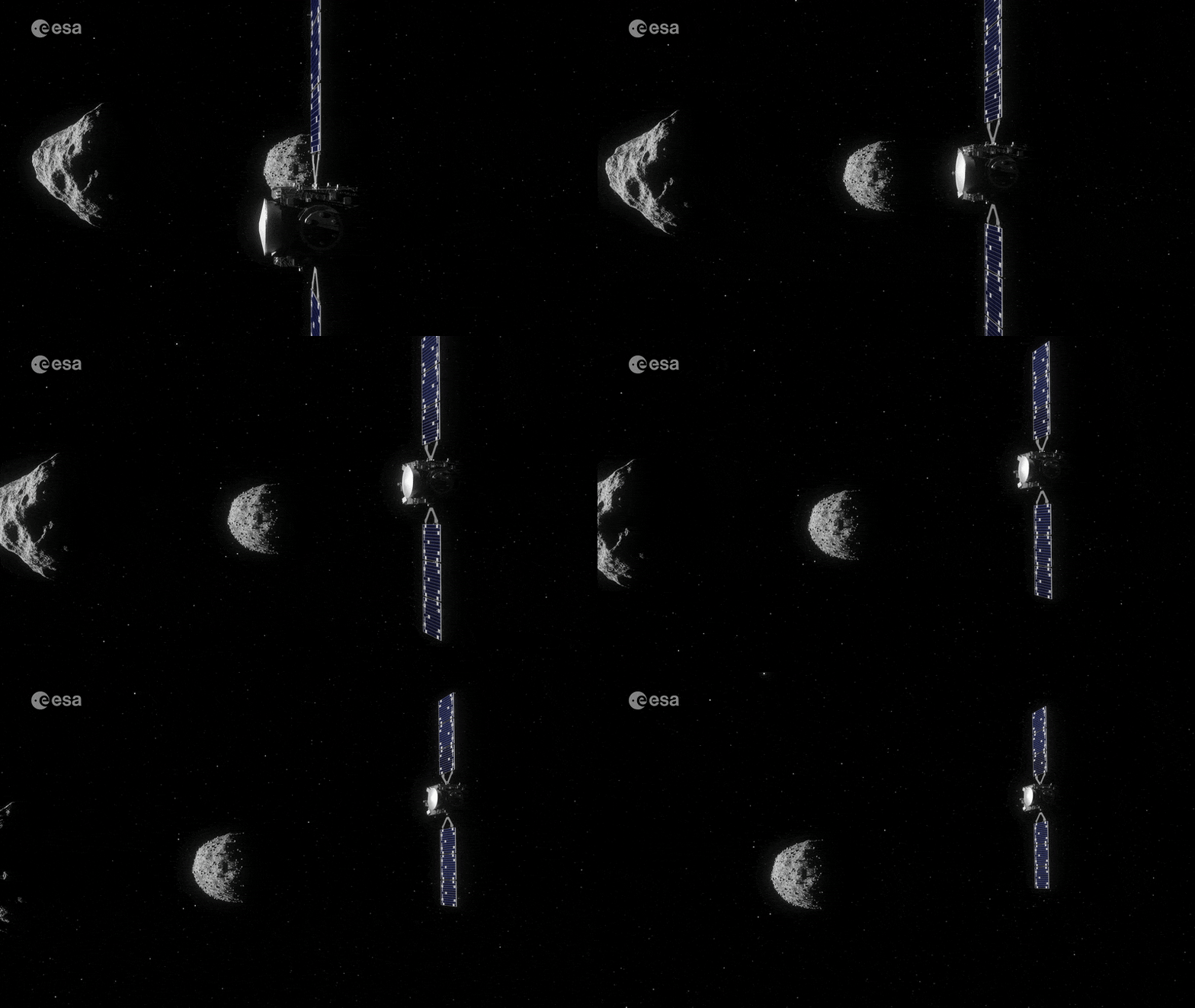
A successful deep-space manoeuvre has put ESA’s Hera spacecraft on course for its rendezvous with the Didymos binary asteroid system later this year.
The European Space Agency’s (ESA) Hera spacecraft is on its way to the only asteroids in existence whose orbits have been deliberately altered by human action.
At the Didymos binary system, Hera will help scientists answer the questions remaining after NASA’s DART spacecraft impacted Didymos’ smaller moon Dimorphos. In doing so, Hera will help to transform asteroid deflection by kinetic impact into a well-understood and repeatable technique for protecting Earth.
Hera recently completed the second of two deep-space manoeuvres on its journey from Earth to Didymos. The manoeuvre burned 123 kg of onboard hydrazine fuel and changed the spacecraft’s velocity by 367 m/s – a change comparable to an object accelerating from stationary to supersonic flight.
“We divided the deep space manoeuvre into three engine burns, plus one much smaller correction manoeuvre, carried out over a period of around four weeks,” says Francesco Castellini from the Flight Dynamics team at ESA’s European Space Operations Centre in Germany.
“This is the Hera mission’s largest manoeuvre in terms of fuel consumption, and we used it to test all of the systems that we will need during the braking and rendezvous manoeuvres later this year as we arrive at Didymos.”
Tracking data from ESA’s Estrack network of deep space antennas confirmed the success of the manoeuvre, and downlinked telemetry from the spacecraft shows that all subsystems performed as expected.
With the deep-space manoeuvre complete, the Hera team has its sights set on arrival at Didymos. Extensive onboard software updates have been designed to prepare the spacecraft for close-proximity operations at the asteroids.
The update adds and improves functionalities that Hera will need to carry out humankind’s first thorough survey of a binary asteroid, such as new software for Hera’s laser altimeter – which will continuously monitor its distance from the asteroids – and for the monitoring camera that will visually monitor and confirm the release of Hera’s two CubeSats.
“Uploading new software to Hera across deep space is like having a video call with a friend on Mars at just 0.004% the speed of a typical home internet connection and with a twenty-minute time delay between speaking and hearing your friend’s response,” says Anna Schiavo from the Hera Flight Control Team.
“Sending the software to the spacecraft, which is just the first step in the overall software update, will take around three hours.”
In October, Hera will begin a series of precisely timed burns to transition from interplanetary cruise to asteroid rendezvous.
Unlike larger deep-space destinations such as planets, Didymos and Dimorphos are small, dark and hard to see: Hera will need to actively search for the asteroids and keep them centred in its field of view as it navigates towards them.
The approach will last around three weeks and will test Hera’s guidance, navigation and control systems to the fullest.
Find out more about the Hera mission and ESA’s role in turning asteroid deflection from science fiction into science fact at the links below.
Facts Only
ESA’s Hera spacecraft completed a deep-space maneuver to adjust its course toward the Didymos binary asteroid system.
The maneuver burned 123 kg of hydrazine fuel and changed the spacecraft’s velocity by 367 m/s.
The maneuver was divided into three engine burns and one correction maneuver over approximately four weeks.
Hera is en route to the Didymos system, where NASA’s DART spacecraft previously impacted Dimorphos, altering its orbit.
Hera’s mission is to survey the aftermath of the DART impact and validate asteroid deflection techniques.
Tracking data from ESA’s Estrack network confirmed the maneuver’s success.
The Hera team is preparing software updates for close-proximity operations, including a laser altimeter and monitoring camera for CubeSat deployment.
Software updates are transmitted to Hera at a data rate equivalent to 0.004% of typical home internet speeds, with a 20-minute delay.
In October, Hera will begin a series of burns to transition from interplanetary cruise to asteroid rendezvous.
The approach to Didymos will last around three weeks, requiring active search and navigation due to the asteroids’ small size and low visibility.
Hera aims to conduct the first thorough survey of a binary asteroid system.
Executive Summary
The European Space Agency’s Hera spacecraft has successfully completed a critical deep-space maneuver, adjusting its trajectory toward the Didymos binary asteroid system. This mission follows NASA’s DART spacecraft, which deliberately altered the orbit of Dimorphos, the smaller moon of Didymos, in a test of kinetic impact asteroid deflection. Hera’s goal is to conduct a detailed survey of the aftermath, transforming asteroid deflection from an experimental concept into a repeatable planetary defense technique. The maneuver involved burning 123 kg of hydrazine fuel, changing the spacecraft’s velocity by 367 m/s, and was executed in multiple stages over four weeks. The mission team is now preparing for Hera’s arrival at Didymos later this year, including extensive software updates to enable close-proximity operations, such as deploying CubeSats and using a laser altimeter for navigation. The approach phase will test Hera’s guidance systems as it actively searches for the small, dark asteroids. This mission represents a significant step in validating humanity’s ability to deflect potentially hazardous asteroids.
The mission’s success hinges on precise engineering and international collaboration, building on NASA’s DART impact to refine asteroid deflection strategies. However, the complexity of deep-space navigation and the challenges of tracking small, fast-moving objects like Didymos and Dimorphos remain significant hurdles. The software updates and maneuvering techniques being tested could set precedents for future planetary defense missions. While the immediate focus is on scientific and technical validation, the broader implications for Earth’s safety from asteroid threats are substantial.
Full Take
The Hera mission represents a pivotal moment in planetary defense, building on NASA’s DART experiment to turn asteroid deflection from theory into a repeatable technique. The strongest version of this narrative highlights the precision of deep-space engineering, the importance of international collaboration, and the potential to safeguard Earth from future asteroid threats. The mission’s focus on validating kinetic impact deflection is a credible step toward developing a reliable planetary defense strategy.
However, the narrative also carries subtle patterns of authority appeal and mission drift. The framing of Hera as a necessary follow-up to DART assumes that kinetic impact is the most viable or only solution for asteroid deflection, without explicitly addressing alternative methods or their trade-offs. The emphasis on "protecting Earth" could evoke fear appeals, though the tone remains scientific rather than alarmist. Additionally, the technical challenges—such as navigating to small, dark asteroids—are presented as surmountable, which may downplay the inherent risks of deep-space missions.
Root causes of this narrative include the broader paradigm of planetary defense as a global priority, driven by the recognition of asteroid impacts as a low-probability but high-consequence risk. The unstated assumption is that kinetic impact deflection is the most feasible near-term solution, which may overshadow other approaches like gravity tractors or nuclear options. Historically, this echoes Cold War-era space race dynamics, where technological prowess was framed as a necessity for survival.
Implications for human agency are significant: success could empower humanity with a tool to prevent catastrophic asteroid impacts, but failure or unforeseen consequences could erode public trust in space agencies. The primary beneficiaries are scientific institutions and future generations, while costs are borne by taxpayers and the mission teams managing the technical risks.
Bridge questions: What alternative asteroid deflection methods deserve equal attention and funding? How might the failure of Hera’s mission reshape public perception of planetary defense efforts? What ethical considerations arise from humanity’s ability to alter celestial orbits?
Counterstrike scan: A coordinated influence campaign might exaggerate the immediacy of asteroid threats to justify increased funding or frame Hera as a singular solution to complex problems. However, the actual content focuses on technical details and scientific validation, avoiding sensationalism or forced urgency. No structural alignment with manipulation patterns is detected.
Patterns detected: none
Sentinel — Human
The article exhibits strong human authorship signals, including technical specificity, natural analogies, and direct attribution to named experts, with no detectable AI-generated patterns.