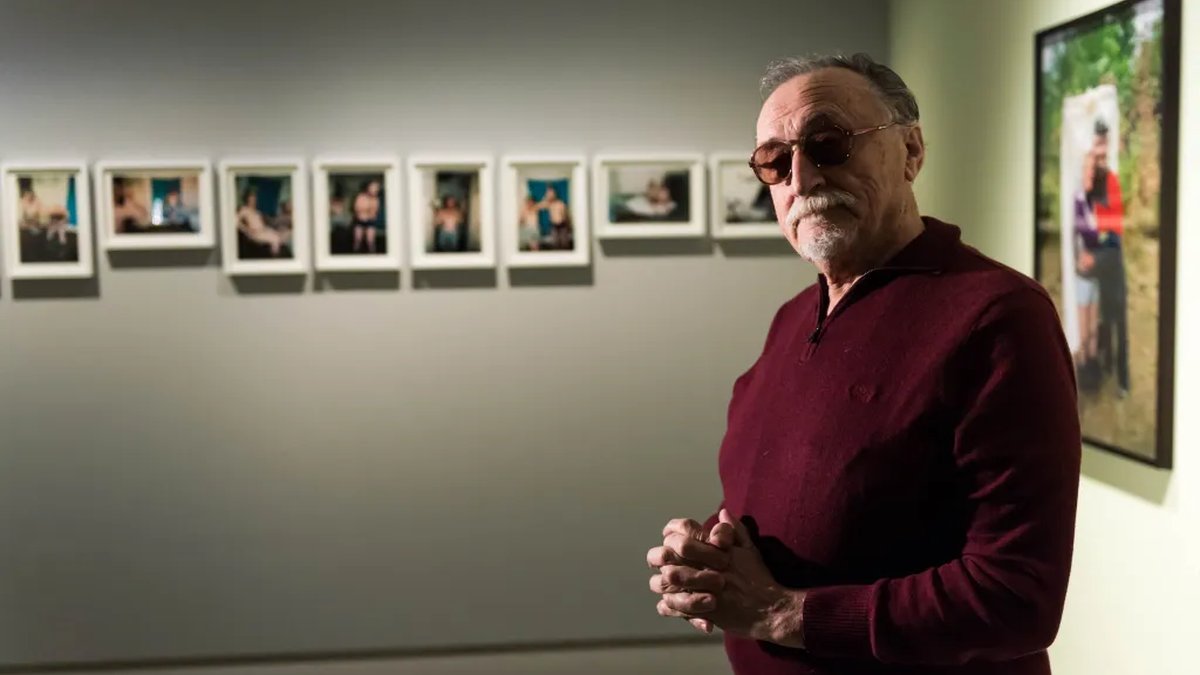
A photograph by acclaimed Ukrainian artist Boris Mikhailov has been stolen from the Lithuanian National Museum of Art in what officials believe was a targeted theft.
The work, part of Mikhailov’s 1993 series At Dusk, disappeared from the Radvila Palace Museum of Art in Vilnius on June 28 while on view in the exhibition Ukrainian Dreamers: Kharkiv School of Photography, according to museum officials. Police are investigating after the incident was captured on security cameras.
According to reporting in Ocula, museum staff discovered the photograph missing from a second-floor gallery shortly after 1:30 p.m., but the suspected thief had already left the building.
“We believe the perpetrator likely knew in advance that Boris Mikhailov is the most prominent artist featured in the exhibition and that his works are among its most valuable,” museum director general Arūnas Gelūnas told Ocula. He said officials suspect the work may have been stolen either for a private collection or for sale on the black market.
Lithuanian police have valued the photograph at about €7,000 (roughly $8,200). Under Lithuanian law, the theft carries a maximum sentence of three years in prison.
The theft comes after a string of high-profile museum robberies across Europe over the past year, prompting renewed scrutiny of museum security. In October, thieves used a cherry picker and an angle grinder to steal nine pieces of jewelry worth an estimated $102 million from the Louver’s Apollo Gallery in a raid that lasted less than eight minutes. Other recent thefts have targeted the Natural History Museum in Paris, the Drents Museum in the Netherlands and the House of Enlightenment, Denis Diderot, in Langres, France.
The stolen photograph is one of 111 hand-tinted panoramic images Mikhailov made in his hometown of Kharkiv following the collapse of the Soviet Union. The series documents a city grappling with economic hardship through scenes of food lines, abandoned buildings, and crumbling infrastructure.
Gelūnas said it was the first theft reported at the museum in more than two decades. The last occurred more than 20 years ago, when another small-scale artwork disappeared and was never recovered.
The incident has prompted the museum to review how it protects smaller works on display.
“While it is not feasible to install individual alarm systems for every object, it is clear that reinforcing the physical security of vulnerable works is an important step,” Gelūnas said.
Represented by Marian Goodman Gallery, Mikhailov is widely regarded as one of Eastern Europe’s most influential photographers. His work, which blends documentary photography with conceptual practice, has earned honors including the Hasselblad Award and the Deutsche Börse Photography Foundation Prize.
Sentinel — Human
The text exhibits clear characteristics of well-sourced journalistic reporting, relying on specific details and contextual links that suggest human authorship rather than generic synthetic generation.