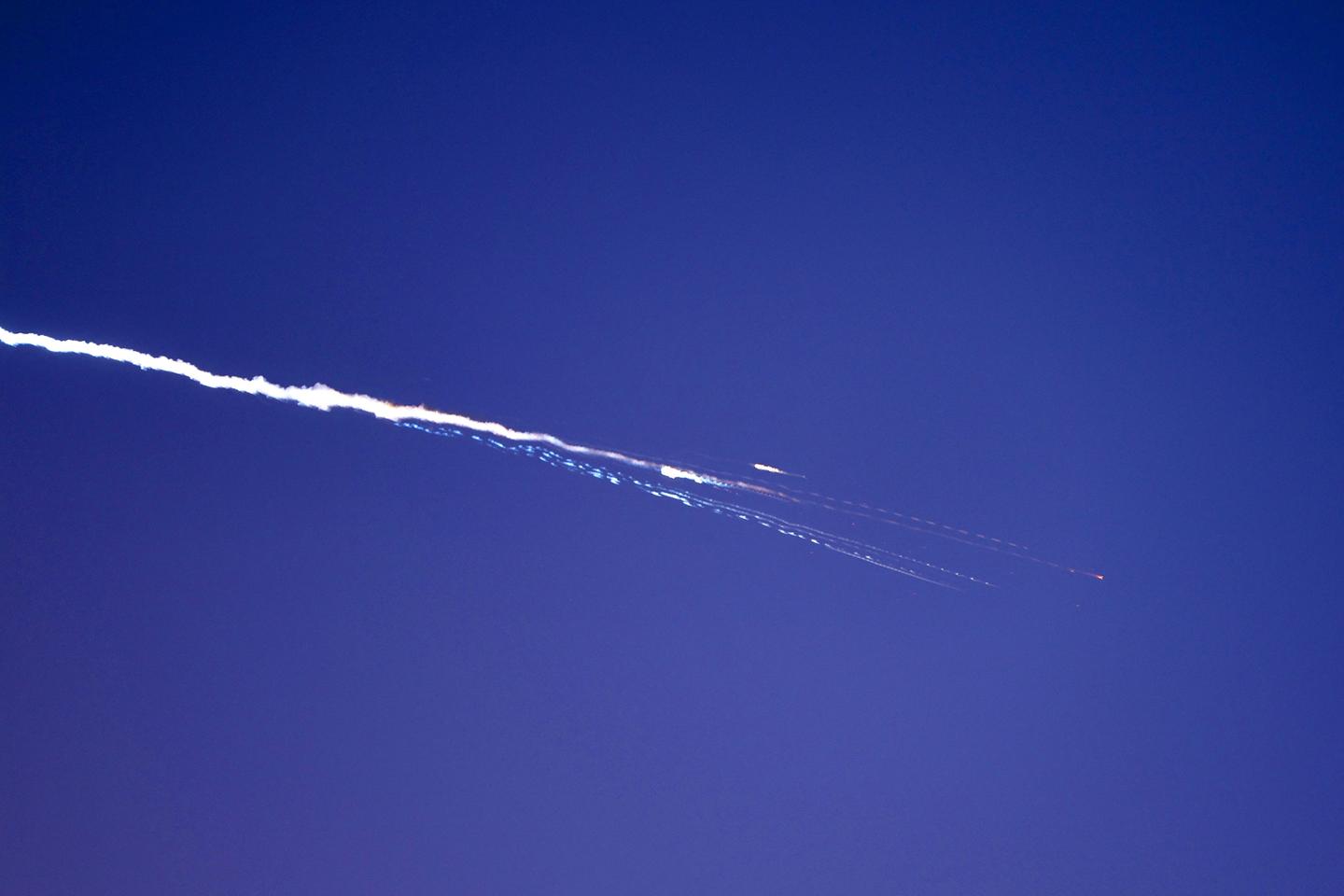
Yemen's Iran-backed Houthi rebels on Saturday, March 28 claimed their first strike on Israel since the start of the Middle East war a month ago, after the Israeli military said it was intercepting an attack.
The attack came after the Yemeni group had threatened to join the regional war if its ally Tehran continued to be attacked or if more countries joined the conflict.
In a video statement posted on X, spokesman Yahya Saree said the group, which controls most of northern Yemen and targeted Israel with drones and missiles throughout much of the Gaza war, had launched ballistic missiles at Israeli military sites.
A few hours earlier, the Israeli military said in a statement it had "identified the launch of a missile from Yemen toward Israeli territory, aerial defense systems are operating to intercept the threat." There were no reports of any casualties or damage in Israel, and media reports suggested the missile may have been intercepted.
The Houthis also attacked shipping in the Red Sea and Gulf of Aden during the Gaza war, saying they were acting in solidarity with the Palestinians, but have so far refrained from doing so in the latest war.
"We affirm that our fingers are on the trigger for direct military intervention," the group said in a statement on Friday, warning that it would act if other nations joined the US-Israeli fight or if the Red Sea was used for "hostile operations."
The Red Sea has become increasingly important during the US-Israeli war with Iran, as Saudi Arabia has diverted a large proportion of its oil exports to the port of Yanbu, with Iran having all but closed the Strait of Hormuz and cut off the Gulf.
Retaliatory strikes
Israeli authorities said an Iranian missile attack killed a man in Tel Aviv on Friday, March 27, as Tehran pressed its retaliatory strikes across the region a month into the war.
The Israeli military said it had "identified missiles launched from Iran toward the territory of the State of Israel" in at least five rounds in just over five hours, triggering air defense systems and warning sirens late on Friday and early Saturday.
The Magen David Adom (MDA) emergency medical service said a man was killed in Tel Aviv in one of the attacks. Two other men, aged 65 and 50, were wounded in a separate incident in the city, and another two in the southern town of Kuseife, MDA said.
AFP images from Tel Aviv showed emergency responders at the scene of a missile impact, where the bombed-out entrance to a building was littered with debris. Video footage that a witness shared with AFP showed what appeared to be a missile barrage over Jerusalem, where air raid sirens had sounded. AFP correspondents also heard the sound of explosions from Jericho in the Israeli-occupied West Bank.
Israeli media said that one of the rounds of inbound attacks, which according to the army's Home Front Command triggered sirens in Israel's north and parts of the annexed Golan Heights, was carried out simultaneously by Iran and its Lebanese ally Hezbollah.
Earlier Friday, Iran's Foreign Minister Abbas Araghchi said Tehran would exact a "HEAVY price for Israeli crimes," after attacks major steel factories and nuclear sites.
Before the latest fatality was confirmed, emergency services and authorities had said attacks killed 18 civilians on the Israeli side since the start of the war on February 28. They said Iranian missile attacks had killed 13 Israelis, including four minors, as well as one Filipino caregiver and one Thai national.
'Successful interceptions'
Meanwhile, UAE authorities said fires broke out early Saturday at an industrial zones following an incoming missile and drone attack from Iran, with no reports of casualties.
The United Arab Emirates' defense ministry said air defenses were responding to incoming cruise missiles and drones fired by Iran, as Tehran pressed strikes in the Gulf a month into the regional war.
The Abu Dhabi government media office said in a statement posted online that authorities were dealing with two fires in the area of the emirate's Khalifa Economic Zones.
The statement said the fires had broken out due to falling debris from a "successful interception" of a ballistic missile.
Facts Only
Yemen's Houthi rebels claimed their first strike on Israel on March 28, 2024.
The Israeli military intercepted a missile launched from Yemen toward Israeli territory.
Houthi spokesman Yahya Saree stated the group launched ballistic missiles at Israeli military sites.
The Israeli military reported no casualties or damage from the intercepted missile.
The Houthis had previously threatened to join the regional war if Iran was attacked or if more countries became involved.
Iran launched multiple rounds of missile attacks on Israel on March 27-28, killing one man in Tel Aviv and wounding others.
The Israeli military identified missiles launched from Iran in at least five rounds over five hours.
The UAE reported fires in industrial zones after intercepting Iranian missiles and drones on March 28.
Saudi Arabia has diverted oil exports to the Red Sea port of Yanbu due to Iran's actions in the Strait of Hormuz.
The Houthis have previously targeted shipping in the Red Sea and Gulf of Aden during the Gaza war.
Iran's Foreign Minister Abbas Araghchi stated Tehran would exact a "heavy price for Israeli crimes."
The Israeli military reported simultaneous missile attacks from Iran and Hezbollah on March 27-28.
Executive Summary
Yemen's Iran-backed Houthi rebels claimed their first direct strike on Israel on March 28, launching ballistic missiles at Israeli military sites. The Israeli military confirmed intercepting a missile launched from Yemen, with no reported casualties or damage. This follows the Houthis' earlier threats to join the regional conflict if Iran faced further attacks or if more nations became involved. The group has previously targeted shipping in the Red Sea and Gulf of Aden in solidarity with Palestinians but had refrained from direct strikes on Israel until now.
Meanwhile, Iran escalated its retaliatory strikes, with missile attacks killing one man in Tel Aviv and wounding others. The Israeli military reported multiple rounds of missile launches from Iran, triggering air defense systems and sirens across the country. The UAE also reported fires in industrial zones after intercepting Iranian missiles and drones, though no casualties were reported. The conflict has intensified regional tensions, with Saudi Arabia rerouting oil exports through the Red Sea due to Iran's actions in the Strait of Hormuz.
Full Take
The strongest version of this narrative highlights a significant escalation in the Middle East conflict, with Iran-backed groups like the Houthis expanding their direct involvement. The reporting credibly documents the sequence of events, including missile launches, intercepts, and casualties, while acknowledging the regional context of oil rerouting and Red Sea tensions. However, the framing leans toward a binary "Iran vs. Israel" dynamic, which may oversimplify the multifaceted alliances and motivations at play.
Patterns detected: ARC-0024 Ambiguity (in the framing of "regional war" without clarifying all involved parties), ARC-0043 Motte-and-Bailey (the Houthis' shifting justifications for intervention).
The root cause appears to be a paradigm of proxy warfare, where regional actors leverage allied groups to project power without direct confrontation. The unstated assumption is that Iran and Israel are the primary antagonists, though other actors (e.g., Saudi Arabia, the UAE) are also deeply involved. This echoes historical patterns of Cold War-era proxy conflicts, where local disputes become battlegrounds for broader geopolitical rivalries.
The implications for human agency are stark: civilians in Tel Aviv, Yemen, and the UAE bear the costs of these strikes, while political and military leaders benefit from projecting strength. Second-order consequences may include further destabilization of global oil markets and increased militarization of the Red Sea.
Bridge questions: How might the involvement of non-state actors like the Houthis reshape traditional state-based conflict resolution? What alternative narratives exist beyond the "Iran vs. Israel" framework? What evidence would change your assessment of who holds primary responsibility for escalation?
Counterstrike scan: A coordinated influence campaign would amplify the "Iran vs. Israel" binary, downplay civilian casualties, and frame all actions as defensive. The actual content does not fully match this pattern, as it includes civilian impacts and multiple perspectives. However, the lack of deeper analysis on non-state actors' agency could be exploited to simplify the narrative.
Sentinel — Human
The article shows signs of being written by a human. While it exhibits some balance in its framing, the variation in sentence length and emotional emphasis suggest human authorship.