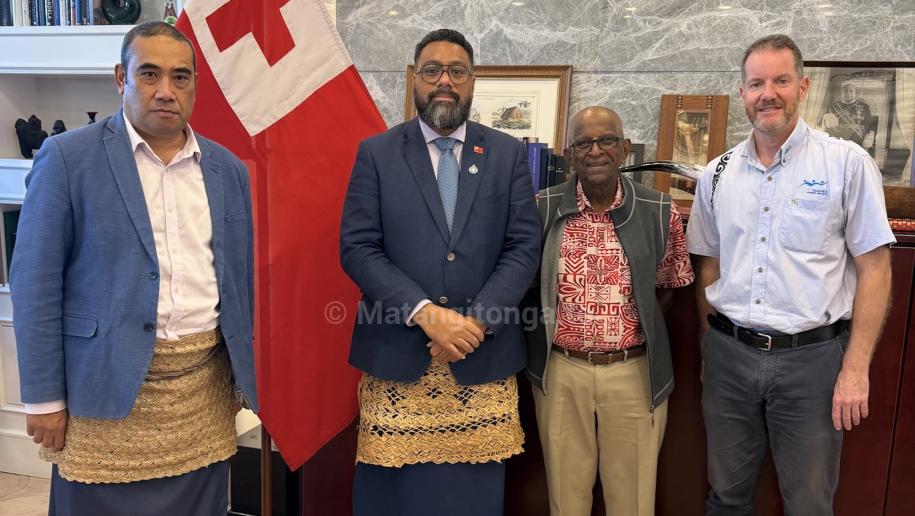
Tonga must begin immediate preparations for the 2031 Pacific Games, according to senior Pacific Games Council officials who visited the Kingdom this week, warning that delays in planning, governance and technical readiness could place significant pressure on the host nation.
The Tonga Sports Association and National Olympic Committee (TASANOC) welcomed Pacific Games Council President Vidhya Lakhan and Chief Executive Officer Andrew Minogue from 6–8 May for a series of high-level meetings focused on advancing Tonga’s preparations to host the 2031 Pacific Games.
During the visit, the delegation met with Prime Minister Lord Fakafanua, senior government officials, the TASANOC Executive Board led by President Michael Bloomfield, and representatives from Tonga’s National Federations.
While reaffirming regional confidence in Tonga’s ability to successfully host the Games, the Council stressed the urgency of progressing critical planning and governance milestones.
Addressing National Federations at Olympic House, President Lakhan congratulated Tonga on securing the right to host the 2031 Pacific Games, describing the successful bid as a major opportunity for national sporting development.
He said hosting the Games would require close cooperation between Government, TASANOC and the future Organising Committee.
“The success of the 2031 Pacific Games depends on all stakeholders working together — Government, National Federations, and TASANOC — to ensure Tonga delivers a Games the Pacific can be proud of.”
President Lakhan also highlighted the importance of progressing legislation to formally establish the Organising Committee and ensuring planning momentum is maintained.
Pacific Games Council CEO Andrew Minogue said the timing of Tonga 2031 would carry added significance, with the Games to be staged just one year before the Brisbane 2032 Summer Olympics.
He described Tonga 2031 as a key pathway for Pacific athletes seeking Olympic qualification opportunities through an expanding number of sports.
Recent Pacific Games have already served as qualification pathways in archery, athletics and taekwondo, while the Tahiti 2027 Pacific Games are expected to provide qualification opportunities for the 2028 Summer Olympics across more sports than ever before.
A major focus of discussions was the role National Federations will play in ensuring Tonga is prepared well ahead of 2031.
Federations were encouraged to develop and qualify technical officials, assess equipment and facility requirements, strengthen relationships with Oceania and International Federations, increase local competition opportunities and prepare athletes to compete strongly on home soil.
The Council warned that insufficient preparation in technical officiating and venue readiness could place significant financial strain on Tonga as host nation.
National Federations were also encouraged to maximise opportunities through the 2027 Pacific Games and 2029 Pacific Mini Games, with participation expected to provide vital experience for athletes, technical officials and administrators ahead of 2031.
The Council further encouraged Tongan federations to pursue hosting regional championships before 2031 to build operational experience.
TASANOC Secretary General and CEO Netina Latu Vea said the visit marked an important step in Tonga’s Pacific Games preparations.
“This visit has provided valuable clarity and direction as we move from planning into action. The message from the Pacific Games Council is clear — preparation must begin now, and every stakeholder has a role to play.”
TASANOC President Michael Bloomfield reaffirmed the organisation’s commitment to working closely with Government and National Federations to ensure Tonga is ready to host the Pacific region in 2031.
As part of the preparation pathway, TASANOC confirmed the Tonga National Games will be staged in December 2026 to support athlete and official development.
The road to 2031 will continue through the Tahiti 2027 Pacific Games and the Cook Islands 2029 Pacific Mini Games, as Tonga works to build the infrastructure, systems and sporting capability needed to successfully host the Pacific Games.
Facts Only
* Senior Pacific Games Council officials visited Tonga between May 6 and 8.
* The visit focused on advancing Tonga’s preparations to host the 2031 Pacific Games.
* The delegation met with Prime Minister Lord Fakafanua, senior government officials, the TASANOC Executive Board, and representatives from Tonga’s National Federations.
* The Council stressed the urgency of progressing critical planning and governance milestones.
* The success of the 2031 Pacific Games depends on cooperation between the Government, TASANOC, and the Organising Committee.
* The Council highlighted the importance of progressing legislation to formally establish the Organising Committee.
* The Games are scheduled to take place in 2031.
* The Tonga National Games are confirmed to be staged in December 2026.
* The preparation pathway includes the Tahiti 2027 Pacific Games and the Cook Islands 2029 Pacific Mini Games.
* National Federations were encouraged to develop technical officials, assess equipment/facility requirements, and strengthen relationships with federations.
Executive Summary
Full Take
The narrative establishes a clear pattern of urgency and mandates a specific collaborative structure for success. The Council’s consistent warning that delays will cause "significant pressure" frames the planning process not merely as an administrative task, but as a critical political and financial imperative. This pattern leverages the collective accountability of the stakeholders—Government, TASANOC, and National Federations—to drive action, subtly positioning any future failure as a failure of collective responsibility rather than individual capacity.
The emphasis on "cooperation" and the mandate for National Federations to build capacity (technical officials, infrastructure assessment) suggests a systemic reliance on external oversight and the implementation of externally defined preparatory steps. This structure implicitly reinforces a hierarchical relationship where the Council's directives translate into operational requirements for the host nation.
The underlying assumption driving this framing is that centralized, high-level governance and immediate, standardized action will mitigate risk. This framing implicitly overlooks potential internal complexities or systemic constraints within the host nation that might challenge this unified approach. The focus on building "operational experience" through preparatory events (2027, 2029) establishes a timeline that prioritizes logistical experience over potential long-term institutional capacity building.
Sentinel — Human
The text reads like a professionally reported press release detailing high-level coordination efforts, suggesting a human journalistic origin.