My early two for Tuesday morning train WFH reads:
• Et Tu, S&P 500?: Robin Wigglesworth on the fascinating possibility that S&P index rules may be rewritten to accommodate SpaceX—the implications for passive investing and index integrity are enormous. (Financial Times) see also S&P Weighs Rule Changes That Would Speed SpaceX’s S&P 500 Entry: S&P Dow Jones is considering rule changes that would pave the way for SpaceX to join the index—a move that could reshape both the index and the IPO timeline for the world’s most valuable private company. (Yahoo Finance)
• Iran Has Just Fired the Most Dangerous Shot of This War and It Wasn’t a Missile: The argument that Iran’s most potent weapon isn’t military but economic—the oil market disruption may prove more damaging than any missile strike. (European Business Magazine)
• Judge Smacks Down Trump’s Investigation Into Jerome Powell: The judiciary steps in to protect Fed independence. The attempt to investigate the Fed chair was always legally dubious — now a judge has confirmed it. A federal judge said the Department of Justice had found “zero evidence” of wrongdoing. (New Republic) see also Board of Governors of the Federal Reserve System v. United States of America (District Court Decision: Federal Reserve System v. United States (District of D.C., File No. 26-12)
• China’s Edge in an Oil Shock: Electric Cars and Renewables: Beijing’s massive investments in EVs and renewables are paying off precisely when it matters most—China is far better insulated from this oil shock than the West. (New York Times)
• How the Housing Market Split in Two: The housing market has fractured into haves and have-nots, with affordability varying wildly by region. The data here is granular and alarming. New and existing homeowners live in different worlds (Agglomerations) see also The Great American Condo Crisis: If America wants to remain a nation of homeowners, it needs to start building condos again—a compelling argument that the missing middle of housing is the condo, not just the duplex. If the U.S. wants to remain a nation of homeowners, it has no choice but to start building condos again. (The Atlantic)
• Encyclopedia Britannica Sues OpenAI Over AI Training: Britannica and Merriam-Webster take OpenAI to court over training data, adding to the growing pile of copyright litigation that will ultimately define what AI companies can and can’t scrape. (Reuters)
• Donald Trump Warns NATO Faces ‘Very Bad Future’ If Allies Fail to Help US in Iran: Trump demands NATO allies share the burden of the Iran conflict, threatening consequences—the transatlantic relationship continues to deteriorate at the worst possible moment. “It’s only appropriate that people who are the beneficiaries of the strait will help to make sure that nothing bad happens there,” Trump said, arguing that Europe and China are heavily dependent on oil from the Gulf, unlike the US. “If there’s no response or if it’s a negative response I think it will be very bad for the future of Nato,” he added. (Financial Times).
• How Rivian Is Pulling Off Its $45,000 R2 Electric SUV: Rivian’s $45K R2 is the EV that could actually move the mass-market needle—if they can execute on manufacturing at scale, which remains the billion-dollar question. How the automaker’s engineering team learned to say no—or make some compromises to create a smaller, more affordable electric car. (Wired) see also Why Rivian Is Holding the $45,000 Base Model R2 Until ‘Late 2027’: The fine print on Rivian’s affordable R2: the base model won’t ship until late 2027, which is an eternity in the EV market and a test of consumer patience. (TechCrunch)
• Satellite Firm Pauses Imagery After Revealing Iran’s Attacks on US Bases: Planet Labs stops publishing satellite imagery of US bases hit by Iranian strikes to avoid giving adversaries battle damage assessments—the tension between transparency and operational security in real time. (Ars Technica)
• The reviews are in. It’s not looking good, America. Allies are giving the U.S. one-star and two-star ratings on its efforts to protect democracy and dependability in a crisis. (Politico) see also America’s Diminished Place in the World and the Consequences of Not Impeaching: A sharp assessment of how America’s global standing has eroded and the institutional failures that accelerated the decline—the consequences of not holding power accountable are now impossible to ignore. (Techdirt)
Be sure to check out our Masters in Business interview this weekend with Matt Cherwin, co-founder and Chief Investment Officer of Marek Capital. The alternative asset management firm launched in 2024. Previously, he spent 16-years at JPMorgan Chase & Co where he held titles of Chief Investment Officer, Group Treasurer, Co-Head of Global Spread Markets, Global Head of Securitized Products, and Global Head of Asset-Backed Trading.
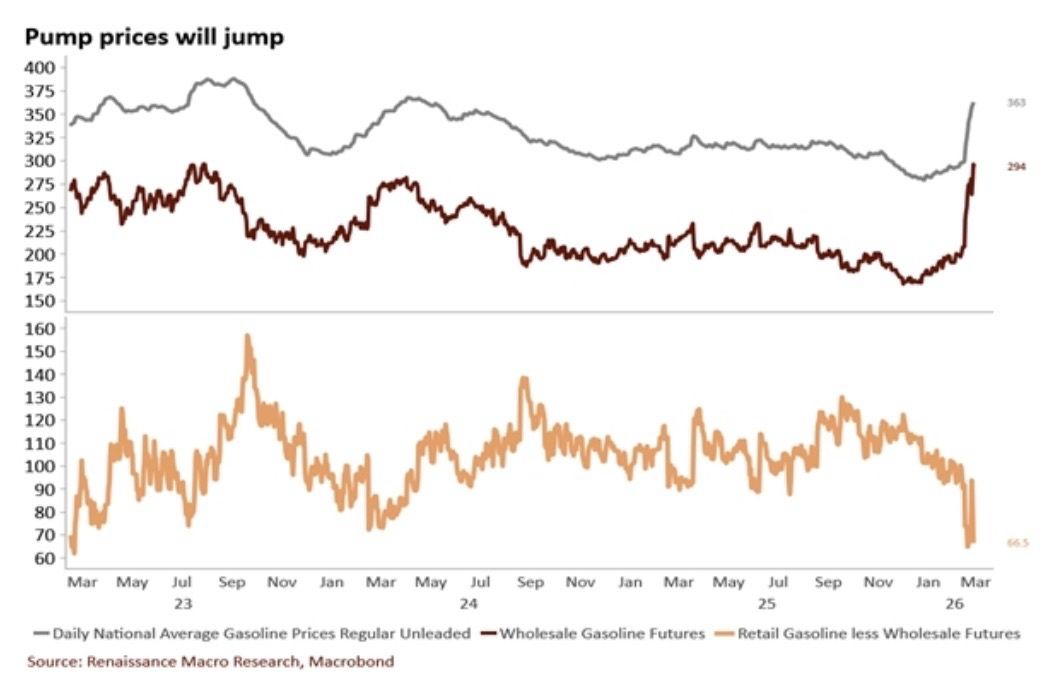
Quantifying the gas shock: Every 50 cent increase is a $75B annual drag on consumer purchasing power
Source: LinkedIn
Sign up for our reads-only mailing list here.
Facts Only
S&P Dow Jones is evaluating rule changes to facilitate SpaceX’s inclusion in the S&P 500 index.
Iran’s economic disruption of oil markets is being positioned as a more significant threat than direct military actions.
A federal judge ruled against Trump’s investigation into Federal Reserve Chair Jerome Powell, citing no evidence of wrongdoing.
China’s investments in electric vehicles and renewable energy are mitigating the impact of oil price shocks compared to Western economies.
The U.S. housing market is divided, with affordability varying sharply by region and housing type, particularly condominiums.
Encyclopedia Britannica and Merriam-Webster have filed lawsuits against OpenAI over the use of their content in AI training data.
Rivian’s R2 electric SUV, priced at $45,000, aims for mass-market appeal, but the base model won’t ship until late 2027.
Planet Labs halted satellite imagery publication of U.S. bases attacked by Iran to prevent adversaries from assessing battle damage.
Allies are criticizing U.S. leadership, citing concerns over democracy and reliability in crises.
Donald Trump warned NATO of consequences if allies do not assist the U.S. in addressing Iran-related conflicts.
A federal court decision (Board of Governors of the Federal Reserve System v. United States) upheld the Fed’s independence from political investigations.
The U.S. housing market faces a "condo crisis," with a shortage of mid-tier housing options like condominiums.
Every 50-cent increase in gas prices translates to a $75 billion annual drag on U.S. consumer purchasing power.
Executive Summary
Full Take
The strongest version of this narrative highlights systemic tensions across financial, geopolitical, and technological domains. The potential inclusion of SpaceX in the S&P 500 underscores how index rules—once rigid—may bend for market giants, raising questions about passive investing’s integrity. Iran’s economic leverage via oil markets reveals a shift from kinetic warfare to financial coercion, a pattern echoing historical resource-based power plays. Meanwhile, China’s strategic insulation from oil shocks via renewables and EVs contrasts with Western vulnerabilities, suggesting a long-term energy transition with geopolitical winners and losers.
Patterns detected: **ARC-0024 Ambiguity** (in framing Iran’s "economic shot" as more dangerous than missiles without quantifying impact), **ARC-0043 Motte-and-Bailey** (Trump’s NATO warnings oscillate between burden-sharing and existential threats).
Root causes include institutional fragility (Fed independence under attack, housing market fractures) and the weaponization of economic interdependence (oil shocks, AI copyright battles). The implications for human agency are stark: consumers face purchasing power erosion, homeowners grapple with structural affordability crises, and allies question U.S. reliability—all while tech and finance reshape power dynamics.
Bridge questions: How might S&P’s rule changes for SpaceX set precedents for other private giants? Could Iran’s economic strategy backfire if oil markets stabilize? What unexamined assumptions underlie the "condo crisis" narrative—is it supply, demand, or regulatory capture?
Counterstrike scan: A coordinated campaign would amplify fears of U.S. decline (ally criticism, housing fractures) while framing China’s resilience as inevitable. The actual content aligns partially—highlighting vulnerabilities—but lacks the hallmarks of a full-scale influence op (e.g., no coordinated messaging across outlets). The focus on systemic strains is valid, but the tone remains analytical rather than manipulative.
Sentinel — Human
The text exhibits strong human stylistic markers, including informal phrasing and personal curation, with no significant signs of AI generation.