By: Steven Schwankert
The archbishop brings a message to Staten Island’s largest Catholic high school: “God is in charge”
Archbishop Ronald Hicks celebrated Mass for administrators, faculty, and students at St. Joseph by-the-Sea High School in Huguenot, Staten Island, during his first pastoral visit to an Archdiocese of New York Catholic high school.
St. Joseph by-the-Sea is Staten Island’s largest Catholic high school and one of the largest in the archdiocese.
A spirit of graciousness and welcome
In his homily, Archbishop Hicks anchored his message in a question drawn from everyday life, one that he said people ask more often than they realize.
“Who’s in charge?” he asked the students. “If you have any doubt about who’s in charge, it is God. God, ultimately, is in charge.”
Drawing on the day’s gospel, in which Jesus tells his disciples that he and the Father are one, Archbishop Hicks reflected on the human tendency to seek control.
“Sometimes we want to be so in charge of our own lives, to control everything, every step, every action, every consequence,” he said. “But part of following Jesus is to let God be in charge. It’s a prayer, and it’s one of the hardest prayers to say: ‘God, not my will be done, but your will be done.'”
He closed his homily with a reminder of what he called the one desire of the God who is in charge.
“God wants one thing,” Archbishop Hicks said. “He wants all people to be saved. He wants people to have eternal life. This life here, this is rental property. We have one home, and it is in heaven.”
READ MORE: Rev. John McCarthy To Serve Archbishop-designate Ronald Hicks’ Secretary
At the end of Mass, Archbishop Hicks praised the students and faculty for their behavior and participation.
“I have had a micro impression of St. Joseph by-the-Sea this morning,” he said. “I drove in, arrived, and saw a beautiful campus, well-maintained, with sports fields and a beautiful building. Then I walked inside the student center, which is so beautifully decorated, and there was a spirit of graciousness and welcome the moment I walked in.”
He also praised the students’ conduct and attentiveness during the Mass. “I have never seen, at the moments when we kneel before the Eucharist, such stillness,” he said. “It was so quiet, so reverent, and so dignified. I can tell when people are paying attention and when they are not. Your attentiveness, to me and, more importantly, to the Lord in the Eucharist, was really powerful.”
Students presented the archbishop with a St. Joseph by-the-Sea Vikings hooded sweatshirt, which Archbishop Hicks promised to wear during his walks to Central Park and around Manhattan.
A sort of homecoming
Archbishop Hicks was accompanied on the visit by his secretary, Father John McCarthy, who served as chaplain at St. Joseph by-the-Sea for seven years before being appointed to his current role. Father McCarthy’s return was warmly received, as students greeted him with handshakes and hugs as he toured the building alongside the archbishop.
“It feels good to be back,” Father McCarthy said. He recently received the Founder’s Award from the St. Joseph by-the-Sea Pillar Fund at its annual dinner on April 16.
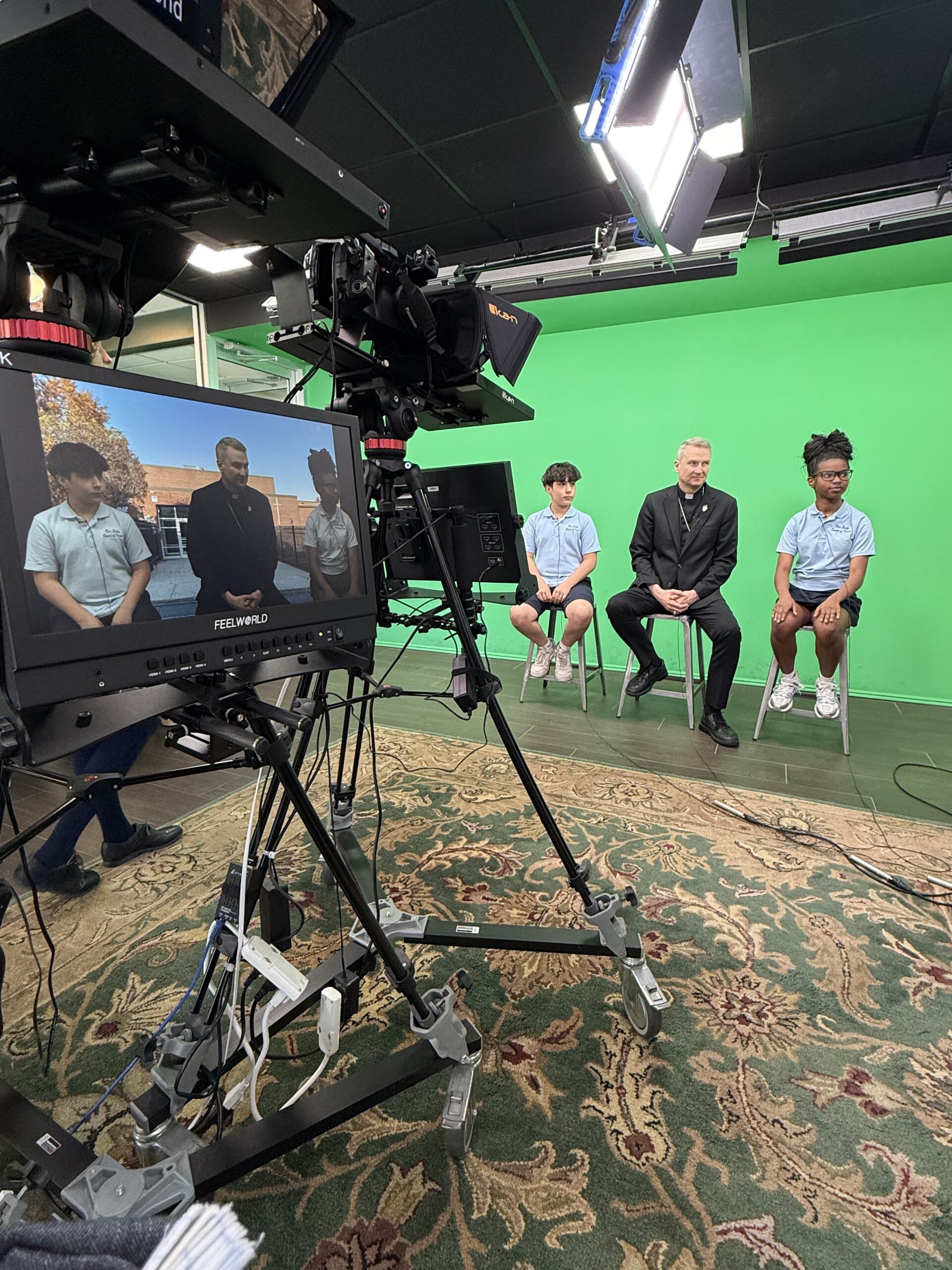
Archbishop Hicks toured the school’s large campus, including the Bloomberg Business Lab and its media center, where he was the subject of an impromptu interview by London Ortiz and Angelo Barisciano, both seventh-grade students from nearby Our Lady Queen of Peace School. The pair’s class happened to be visiting the high school and touring the media center when the archbishop stopped by.
Following the visit, Archbishop Hicks reflected on what he had seen beyond the Mass, the classrooms, the culture, and the community.
“I have seen the students in their classrooms, their level of prayer, their attentiveness, and how it all comes together as a culture in which Catholic identity is growing,” he said. “Excellence in education, a real commitment to the faith and to service, and having God at the center. I am walking away with a macro impression, and I am extremely impressed. I ask God to continue to bless this particular mission, and all of our Catholic schools.”
Facts Only
Archbishop Ronald Hicks celebrated Mass at St. Joseph by-the-Sea High School in Huguenot, Staten Island.
The visit marked Hicks’ first pastoral visit to an Archdiocese of New York Catholic high school.
St. Joseph by-the-Sea is Staten Island’s largest Catholic high school and one of the largest in the archdiocese.
Hicks delivered a homily emphasizing God’s sovereignty, quoting the gospel where Jesus states he and the Father are one.
He urged students to relinquish control and trust in God’s will.
Hicks praised the students’ reverence during Mass, noting their stillness and attentiveness.
Students presented Hicks with a St. Joseph by-the-Sea Vikings hooded sweatshirt.
Father John McCarthy, Hicks’ secretary and former chaplain at the school, accompanied him on the visit.
McCarthy received the Founder’s Award from the St. Joseph by-the-Sea Pillar Fund on April 16.
Hicks toured the school’s campus, including the Bloomberg Business Lab and media center.
He was interviewed by two seventh-grade students from Our Lady Queen of Peace School during the tour.
Hicks described the school’s culture as one where Catholic identity, academic excellence, and service are central.
Executive Summary
Archbishop Ronald Hicks made his first pastoral visit to an Archdiocese of New York Catholic high school, celebrating Mass at St. Joseph by-the-Sea High School in Staten Island. During his homily, he emphasized the theme of divine sovereignty, urging students to trust in God’s plan rather than seeking total control over their lives. He highlighted the school’s strong Catholic identity, praising the students' reverence during Mass and the campus's welcoming atmosphere. The visit included a tour of the school’s facilities, where Hicks interacted with students and faculty, including an impromptu interview conducted by visiting middle school students. Father John McCarthy, Hicks’ secretary and former chaplain at the school, accompanied him, adding a personal dimension to the visit. Hicks expressed admiration for the school’s blend of academic excellence, faith commitment, and service, describing it as a model of Catholic education.
The event underscored the archdiocese’s focus on reinforcing spiritual values in its institutions while also showcasing the community’s pride in its educational environment. The archbishop’s remarks framed the school’s mission as one centered on eternal salvation, contrasting earthly life with the ultimate goal of heaven. His observations about the students' conduct and the school’s culture reflected a broader narrative of Catholic schools as places where faith and learning intersect meaningfully.
Full Take
This narrative presents a carefully curated portrayal of Catholic education as a bastion of faith, discipline, and community. The strongest version of this story—its steelman—highlights the archbishop’s role as a spiritual leader reinforcing core religious values while celebrating the tangible successes of a thriving institution. The emphasis on reverence, attentiveness, and divine sovereignty serves a dual purpose: it reinforces the school’s mission and models ideal behavior for students and readers alike. The inclusion of Father McCarthy’s personal connection adds emotional resonance, grounding the visit in continuity and tradition.
Pattern scan: The piece leans into emotional appeal through descriptions of the students’ conduct and the archbishop’s praise, which could be seen as a form of virtue signaling or institutional pride. However, the tone remains earnest rather than manipulative. The framing of earthly life as "rental property" and heaven as the true home is a classic religious motif, but it also subtly devalues temporal concerns, which could be critiqued as a form of escapism. No overt distortion or bad faith is detected, though the absence of dissenting voices or challenges to the school’s model is notable.
Root cause: The narrative reflects a broader paradigm within Catholic education that prioritizes spiritual formation alongside academic rigor. The unstated assumption is that faith and discipline are inherently linked to success, both in this life and the next. Historically, this echoes the Church’s role as a moral and educational authority, particularly in communities where Catholic identity is central to cultural cohesion.
Implications: For students, this visit reinforces a worldview where divine will supersedes personal agency, which could foster resilience but also discourage critical questioning of institutional norms. The school benefits from the archbishop’s endorsement, which may bolster enrollment and funding. However, the focus on eternal salvation over earthly concerns might inadvertently downplay the importance of addressing immediate social or material challenges.
Bridge questions: How might students reconcile the call to surrender control to God with the need to make autonomous decisions in their lives? What perspectives from students who struggle with faith or the school’s expectations are missing from this narrative? Would the archbishop’s message resonate as strongly in a less homogeneous or more secular setting?
Counterstrike scan: If this were part of a coordinated campaign, the playbook would likely emphasize institutional loyalty, emotional appeal, and the authority of religious leadership to reinforce a specific worldview. The actual content aligns with this pattern but does so transparently, without signs of manipulation or coercion. The focus remains on celebration rather than persuasion, making it a clean example of institutional storytelling.
Patterns detected: none
Sentinel — Human
The text reads as a typical, smoothly written piece of localized news reporting, exhibiting natural variation and specific anecdotal detail that points strongly toward human authorship.