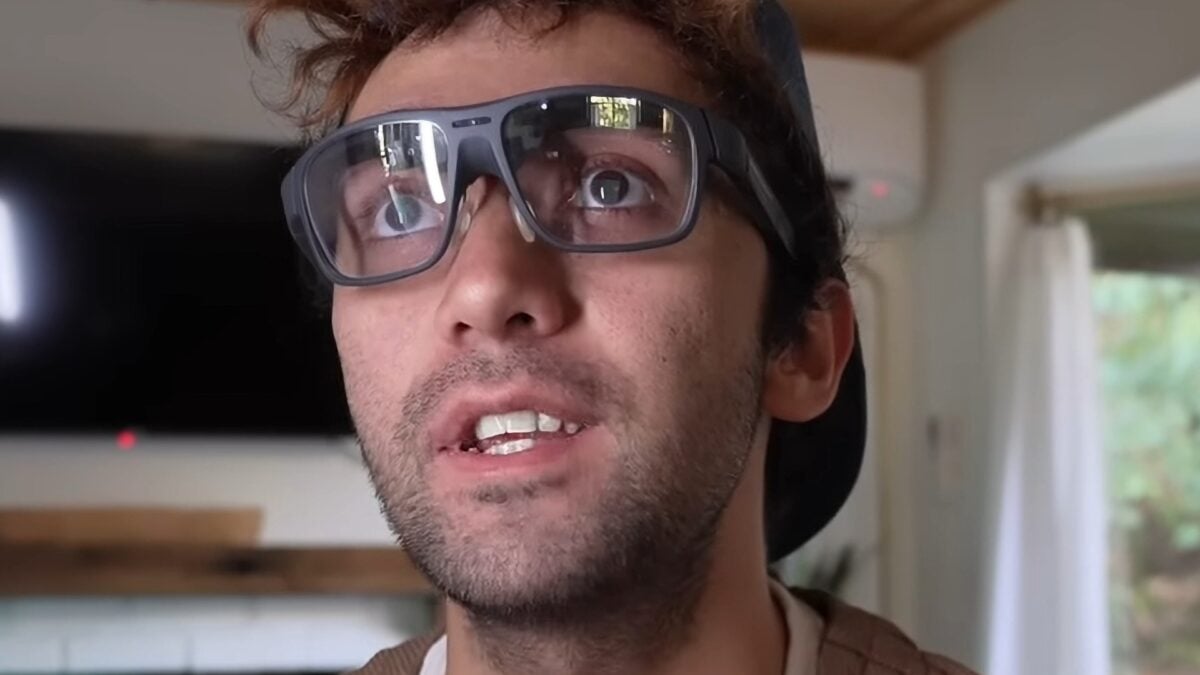
One of the biggest challenges of smart glasses (outside of trying to make sure they’re not a privacy nightmare) is figuring out how to control them. So far, we’ve seen lots of different methods, including your standard taps and swipes on the arm, AI voice controls, as well as other more novel input methods like touch-sensitive smart rings and Meta’s muscle-reading Neural Band. One thing we haven’t seen, however, is eye tracking—or at least we haven’t seen it until now.
The Maverick AI Pro, which was unveiled by a company called Everysight this week, is the first pair of smart glasses with eye tracking, meaning it has an on-device camera that can follow your subtle eye movements and then translate them into inputs on the glasses. If that sounds familiar, that’s because it’s a defining feature of input systems on vastly more powerful and expensive devices like the Apple Vision Pro, which uses a mixture of hand and eye tracking.
I can’t say without using the Maverick AI Pro if its eye tracking actually works well, but based on early demos, it looks like another intriguing solution to the question of how to control face computers without it being an aggravating experience. Here’s a demo from YouTuber, Steven Sullivan showing how eye tracking on the smart glasses works and how it can be used to select apps on the smart glasses’ screen.
Outside of eye tracking, the Maverick AI Pro have quite a few impressive features, including a full-color OLED display (monocular, meaning it’s in just one eye) that can project a 130-inch virtual screen, a camera, and eight hours of battery life. One of the specs that jumped out to me more than others, though, was the fact that they weigh just 47g; somehow, 2g lighter than the Ray-Ban Meta AI glasses, which weigh 49g and don’t even have a screen. How exactly these smart glasses manage to do a lot more than Meta’s Ray-Bans while also weighing less is unclear, but it’s impressive nonetheless.
There are quite a few features built into the Maverick AI Pro, including navigation, translation, and computer vision that can identify objects in your surroundings—most of the stuff we’ve seen in every other pair. A feature I definitely have not seen in a pair of smart glasses yet, though, is sports-focused apps. In Sullivan’s video, he demonstrates how the Maverick AI Pro can be applied in sports like golf, using its camera to deliver metrics about your swing and other stats. That’s right, eye-tracking smart glasses are here to elevate your golf game, I guess?
The Maverick AI Pro aren’t fully launched yet, but crowdfunding opens on March 31, and Everysight says it expects to ship them in August of this year. Despite some specs that actually make the smart glasses more sophisticated than the Meta Ray-Ban Display, they’re a good deal cheaper than Meta’s high-end frames. The Maverick AI Pro have an early bird price of $359 but will MSRP at $599. Everysight also plans to sell a cheaper pair without eye tracking, the Maverick AI, which will launch at an early bird price of $299 and MSRP at $499.
Facts Only
Actors: Everysight (developer), Meta (competitor)
Actions/Events: Unveiling of the Maverick AI Pro, eye-tracking technology integration, crowdfunding announcement, expected shipping date
Dates: Present day, August 2023 (expected ship date)
Locations: Not specified
Institutions: Not specified
Executive Summary
Full Take
The Maverick AI Pro represents a significant step forward in smart glasses technology with its eye-tracking capabilities. This innovation allows for more intuitive control of the device and opens up possibilities for applications in various fields, such as sports analytics. The integration of eye tracking also raises concerns about privacy and potential misuse of personal data. By offering both an eye-tracking model (Maverick AI Pro) and a non-eye-tracking version (Maverick AI), Everysight caters to different user needs and preferences, while also providing a less expensive alternative for those unwilling or concerned about the privacy implications of eye tracking.
Questions for further inquiry: How will users react to and adopt this new technology? What measures will Everysight take to ensure user privacy and data security? How might competitors respond to the introduction of eye-tracking smart glasses, and how could this impact the development of similar technologies?
Sentinel — Human
Based on stylometric analysis, coherence, and human signals, this text is likely written by a human.