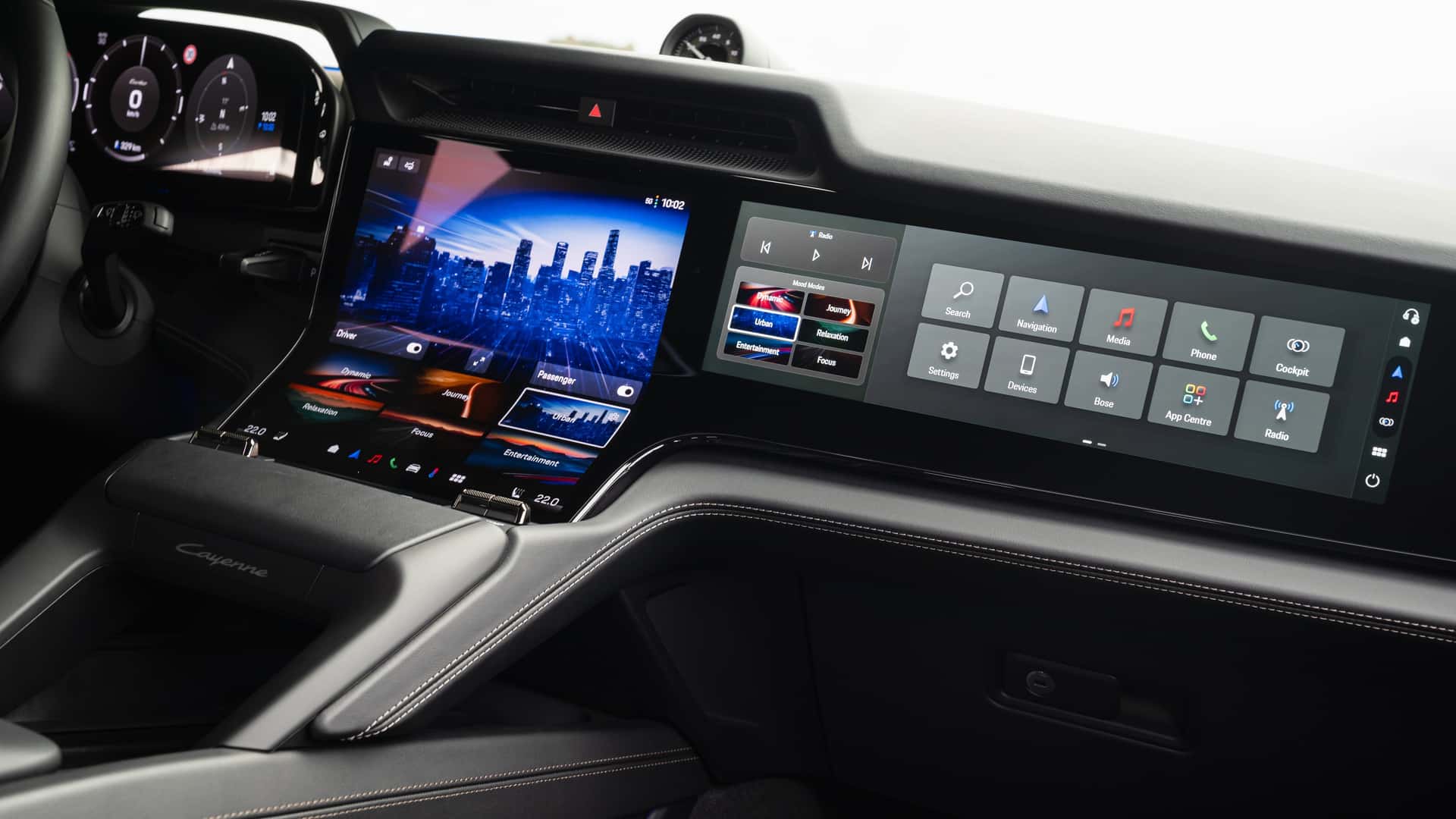
There is a better way to do in-car touchscreens than simply plopping an iPad on the dash, and you're looking at it.
In-car touchscreens get a lot of wrath, much of it deserved. There’s been heavy backlash against the Tesla-led consolidation of all functions behind touchscreen menus and their cousins, haptic buttons. And automakers are taking notice. Even Volkswagen’s CEO came out against touchscreen menus in certain applications, saying: "I don't understand why anybody would have [touch-sensitive] sliders."
So naturally, I was skeptical of the Porsche Cayenne Electric’s giant, folded central touchscreen. Could putting a simple, 45-degree bend in a screen really make it easier to use, or more intuitive?
I was wrong, folks. There is a better way to do an in-car touchscreen, and this is it.
See, the problem with a Tesla-style tablet plopped in the middle of a dashboard isn’t so much the fact that it’s a touchscreen; rather, it’s that it’s a poorly-designed experience. The slab of touch-capacitive glass sits at a uniform angle to the driver, giving no intuitive thought or layout to which functions the driver might need to access on the go. Touching anything requires unnaturally craning your elbow or wrist and taking your eyes off the road—all while squinting at the screen because of glare.
The Cayenne Electric’s curved touchscreen solves many of these problems. Its curved design means the things you need to touch the most—climate controls, music selection, quick settings adjustments, and routing options—are always in the easiest spot to reach. The built-in wrist rest means those controls fall easily to hand. And the upper part of the screen still shows your maps in the spot they’re easiest to see (along with the driver’s cluster and head-up display).
The interface itself is Android-based, with native Google Maps, and it’s intuitive enough to use. The Cayenne’s center console armrest scoots back and forth, so you can rest your elbow on it for an even easier reach.
This approach isn’t without flaws. I wish there were actual buttons for turning on the heated seats or defrosting the windshield, rather than touch-capacitive ones. But given the myriad of features, drive modes, and settings Porsche built into this car, I don’t see how it could’ve avoided putting some of them behind a touchscreen. Thankfully, there are still rockers for climate temperature and fan speed, as well as a volume roller and hard buttons on the steering wheel.
I’m cautiously optimistic about interfaces like this, along with BMW’s pillar-to-pillar Panoramic Vision display, which embrace technology while focusing on ease of use. The era of bigger-for-its-own-sake may finally be over when it comes to in-car screens.
When the last grafted-on dashboard tablet goes the way of the carphone in favor of smarter touchscreens like this, I will say: Good riddance.
Click here to see all articles with lists of the best EVsRECOMMENDED FOR YOU
I Can't Believe How Smooth The Porsche Cayenne Electric Is
China's EV Companies Aren't Just Making Great Cars. They're Making Money
The New Porsche Cayenne S Electric Undercuts The Top-Spec Turbo By $36,000
BMW Pioneered Range Extended EVs. Now It’s Not So Sure
Over 30 New EVs Are Launching In 2026. Here's What You Need To Know About Them
2026 Toyota bZ Review: One Big Thing Missing
The Cayenne EV Is ‘Much Better’ Off-Road Than The Gas Version: Porsche
Facts Only
Porsche's Cayenne Electric features a curved central touchscreen with a 45-degree bend.
The touchscreen is Android-based and includes native Google Maps.
The design positions frequently used controls (climate, music, settings) within easier reach.
A built-in wrist rest and adjustable center console armrest improve ergonomics.
Physical controls remain for climate temperature, fan speed, and volume.
Some functions, like heated seats and defrost, use touch-sensitive buttons instead of physical ones.
Volkswagen's CEO has criticized touch-sensitive sliders in car interiors.
Tesla's touchscreen-heavy design has faced backlash for poor ergonomics and glare.
BMW's Panoramic Vision display is another example of a pillar-to-pillar screen focusing on usability.
The Cayenne Electric retains hard buttons on the steering wheel for essential functions.
The article highlights a potential industry shift away from oversized, flat touchscreens.
The Cayenne Electric's interface aims to balance technology with driver accessibility.
Executive Summary
Porsche's Cayenne Electric introduces a curved touchscreen design that addresses common criticisms of in-car touchscreens, such as poor ergonomics and glare. The 45-degree bend positions frequently used controls—like climate and navigation—within easier reach, while a built-in wrist rest enhances usability. The interface runs on Android with native Google Maps, and the center console armrest adjusts for better accessibility. Despite these improvements, some functions, like heated seats, still rely on touch-sensitive controls rather than physical buttons, though critical climate and volume controls retain tactile elements. Industry trends suggest a shift away from oversized, flat touchscreens toward more intuitive designs, with BMW's Panoramic Vision display also emphasizing user-friendly technology. While the Cayenne Electric's approach isn't flawless, it represents a step toward balancing digital integration with practical driving needs.
Criticism of touchscreen-heavy interiors, particularly Tesla's design, has grown, with even Volkswagen's CEO questioning the logic behind touch-sensitive sliders. Porsche's solution attempts to reconcile technological advancement with driver safety and comfort, though it stops short of fully abandoning touch-based controls. The broader automotive industry appears to be reevaluating how to implement screens without compromising functionality, signaling a potential move away from gimmicky, oversized displays toward more thoughtful designs.
Full Take
The strongest version of this narrative is that Porsche's curved touchscreen represents a meaningful improvement over traditional flat screens, addressing ergonomic and safety concerns while maintaining some physical controls. The design acknowledges the limitations of touchscreen-only interfaces, particularly in driving contexts where distraction is dangerous. By positioning critical functions within easier reach and retaining tactile elements for essential controls, Porsche demonstrates a nuanced approach to in-car technology—one that prioritizes usability over sheer screen size.
However, the narrative leans into a subtle form of **ARC-0024 Ambiguity** by framing the Cayenne Electric's design as a definitive solution without fully addressing whether touchscreens, even well-designed ones, are inherently safer than physical controls. The piece also employs **ARC-0043 Motte-and-Bailey** by criticizing Tesla's "slab of glass" approach while still defending touchscreens in general, retreating to the safer position that "some touchscreens are better than others." The underlying assumption—that touchscreens are inevitable in modern cars—goes unchallenged, despite evidence that physical controls reduce cognitive load.
Root cause: This reflects a broader automotive industry paradigm where digital integration is treated as progress, even when it introduces new risks. The tension between innovation and safety mirrors historical shifts, like the replacement of mechanical gauges with digital displays—changes often driven by cost and aesthetics rather than user needs.
Implications: If this design becomes standard, drivers may benefit from better ergonomics, but the reliance on touchscreens could still increase cognitive demand. The real winners are automakers who can justify premium pricing through "cutting-edge" interfaces, while drivers bear the cost of potential distraction.
Bridge questions: How much of this shift is driven by genuine safety improvements versus marketing? Would a hybrid system with more physical controls be even better? What does the research say about touchscreen vs. tactile control reaction times?
Counterstrike scan: A bad actor pushing this narrative might exaggerate the flaws of competitors (e.g., Tesla) while downplaying the limitations of their own solution, framing it as the only viable alternative. The actual content doesn’t fully match this pattern, as it acknowledges remaining issues with touchscreens. However, the lack of deeper critique about the necessity of touchscreens at all aligns with a softer form of industry-friendly framing.
Patterns detected: ARC-0024 Ambiguity, ARC-0043 Motte-and-Bailey