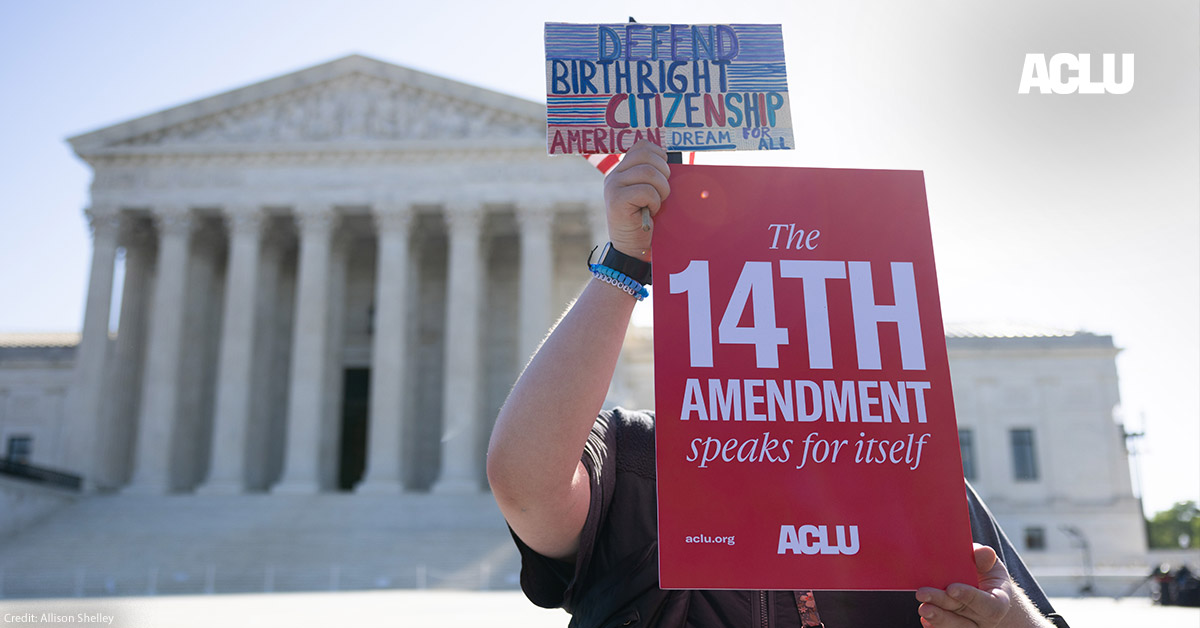
The Supreme Court today struck down President Donald Trump’s executive order attacking birthright citizenship.
President Trump attempted to rewrite the Constitution, and we stopped him. This decision is a major victory for immigrant families across the country and a clear rejection of President Trump’s attempt to redefine who is a citizen in the United States.
Groups Representing Plaintiffs Respond to Supreme Court Birthright Citizenship Ruling - ACLU of New Hampshire
Groups Representing Plaintiffs Respond to Supreme Court Birthright Citizenship Ruling - ACLU of New Hampshire
“With a 6-3 judgment from the U.S. Supreme Court, President Trump suffered a stunning loss on a signature order he signed on day one of his presidency,” said ACLU Executive Director Anthony D. Romero. “This was one of the most important constitutional cases of the past 100 years. The president bet his legacy trying to secure this policy win — even attending the argument in person — and he lost. It was especially gratifying that the majority opinion was authored by Chief Justice Roberts, and that Trump appointees Brett Kavanaugh and Amy Coney Barrett agreed with the decision to strike down the order.”
President Trump's attempt flew in the face of American values, but the Constitution is clear: birthright citizenship is a right.
President Trump’s order threatened to upend the lives of hundreds of thousands of families and create a permanent subclass of people born in this country but denied their rights as Americans. Today, the Supreme Court has resoundingly rejected that effort, reaffirming what this country has understood for generations: The Constitution, not the president, determines who is recognized as a native-born citizen.
The Constitution’s promise of birthright citizenship is plain, and President Trump’s attempt to evade it was transparent. Birthright citizenship has always been — and will continue to be — one of the clearest expressions of our American values. Enshrined in the Fourteenth Amendment in the aftermath of the Civil War and Reconstruction, it reflects this country’s commitment to equality, fairness, and the idea that America has no permanent underclasses.
Courageous families and communities stood up for themselves and the Constitution, and secured rights for all Americans.
This ruling matters enormously for the families in American communities who spent the last year and a half living in fear, with their children’s citizenship, belonging, and future under attack. Birthright citizenship remains a core pillar of our democracy because of those same brave families, advocates, and communities who refused to let the president erase a constitutional right by executive decree.
“The court’s decision reaffirms a fundamental American promise — if you are born here, you are a citizen,” said ACLU National Legal Director Cecillia Wang, who argued the case at the Supreme Court. “A president cannot change the Constitution by executive fiat. Our brave clients and our legal team stand with millions of people around our country who spoke up for one of our most cherished rights. The Constitution’s guarantee of birthright citizenship stands strong.”
We secured a historic victory for birthright citizenship today, and this decision shows that when Americans work together to stand up to protect our rights and our freedom, we can win. We litigated, organized, advocated, and mobilized.
This fight isn't over. Follow the ACLU for updates as we continue to challenge every attack from President Trump on immigrant rights — in the courts, in Congress, and in communities across the country.
The Fight for Birthright Citizenship, Explained
Within two hours of President Trump signing the executive order on his first day back in office, the ACLU and our partners were in court fighting, in a lawsuit called NHICS v. Donald J. Trump. We saw the executive order as an illegal power grab targeting the constitutional guarantee that if you are born here, you are a citizen. Within days, other legal challenges followed and several judges issued injunctions that blocked the order, temporarily halting enforcement and preventing harm while the legal challenges proceeded. At every turn, courts recognized the order for what it was and blocked it from taking effect.
In response, the Trump administration filed emergency applications asking the Supreme Court to narrow the injunctions from the entire country to just a handful of individual plaintiffs. On June 27, 2025, in Trump v. CASA, Inc., the Supreme Court issued a ruling in favor of the administration. That raised the possibility that hundreds of thousands of U.S.-born babies could be left vulnerable to arrest, deportation, discrimination, and denial of critical early-life nutrition and health care.
Immigrants' Rights
Barbara v. Donald J. Trump
Immigrants' Rights
Barbara v. Donald J. Trump
In order to protect these babies, the ACLU, the Legal Defense Fund, Asian Law Caucus, Democracy Defenders Fund, and ACLU affiliates in New Hampshire, Maine, and Massachusetts filed a nationwide class action lawsuit, Barbara v. Donald J. Trump, immediately after the CASA ruling. On July 10, 2025, a federal court provisionally certified the class (or allowed the lawsuit to be litigated as a class action), and blocked the order against all babies born in the United States while questions over the legality of the order continued to move through the courts.
Trump v. Barbara was argued in the Supreme Court on April 1, 2026, by ACLU National Legal Director Cecillia Wang, on behalf of the plaintiffs, and John Sauer, the U.S. Solicitor General, on behalf of the administration. A broad coalition — including members of Congress, civil rights organizations, and constitutional law scholars — also weighed in on the case. On June 30, 2026, the Supreme Court struck down the order and upheld the constitutional guarantee of birthright citizenship.
Sentinel — Human
The text displays characteristics of human advocacy writing, structured around a clear legal narrative, although potential LLM involvement is suggested by unusual temporal data used in the case summary section.