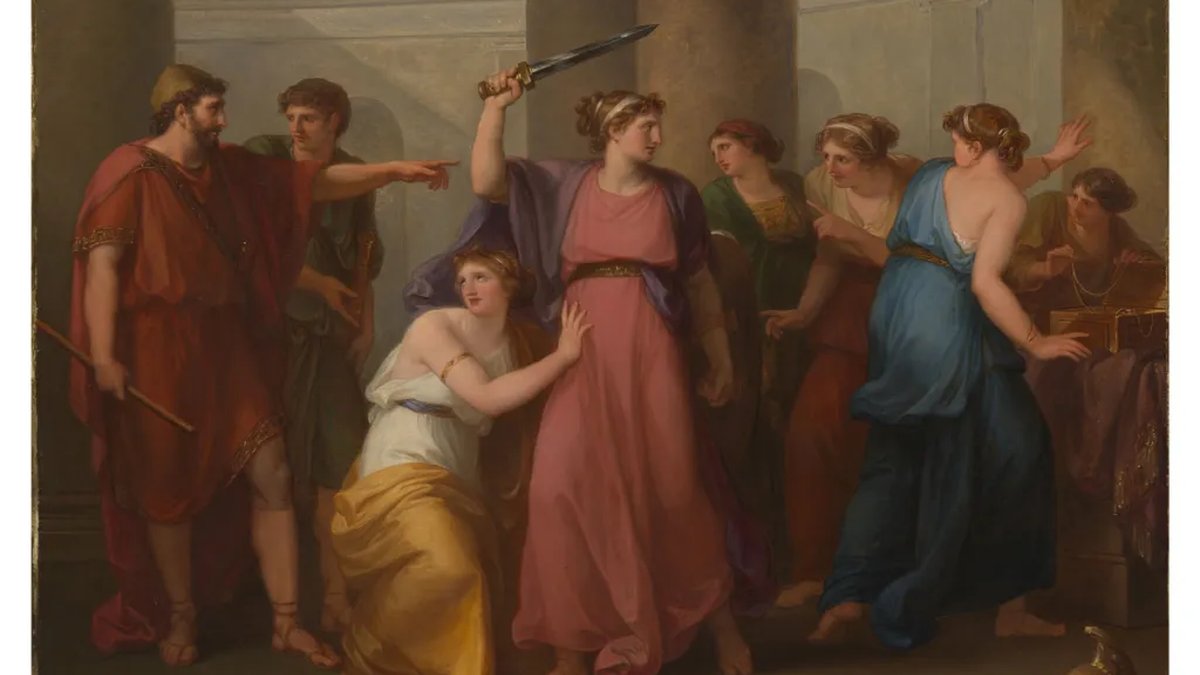
The National Gallery in London announced that it has acquired a significant history painting by 18th-century artist Angelica Kauffman. The work is now on view at the museum.
Achilles discovered among the Daughters of Lycomedes (1787–88) is the first work by Kauffman to enter a UK national collection in nearly two centuries. Another painting by the artist was bequeathed to the National Gallery in 1835 but was later transferred to Tate Britain, as the museum is now known, when it opened in 1897. Tate Britain lent the work to Guildhall in Plymouth, and it is believed to have been destroyed during World War II in the 1941 Plymouth Blitz.
Achilles discovered among the Daughters of Lycomedes depicts a Greek mythological scene during the Trojan War in which the hero Achilles has been hidden by his mother, the sea nymph Thetis, on the island of Skyros. He had been dressed as a woman among the king’s daughters in order to avoid participating in the Trojan War and ultimately his fate to die a young heroic death, as opposed to a long life of obscurity.
The painting shows Achilles, wearing “a pink gown with a white ribbon woven fashionably in his golden hair,” at the moment he draws a sword and is discovered by Odyssey who convinces him to join the Greeks in their war against Troy, per a description by the National Gallery. The museum adds, “The poses of the figures are reminiscent of ancient classical sculpture. In the foreground we see a discarded lute, and a piled up red mantle, plumed helmet and sword sheath, reinforcing the scene’s classical setting. Large round columns and sweeping architecture in the background create a stage-like setting.”
While Achilles is a central character of The Iliad, Homer’s epic does not feature that scene, as it focuses on the final days of the years-long war. Kauffman takes her inspiration from Achilleid, a first century CE text by Publius Papinius Statius. According to the National Gallery, Kauffman is said to become interested in the painting while she lived in London between 1766 and 1782. Kauffman painted at least three versions of this scene, with one having been exhibited at the Royal Academy, where she was one of two women among its founding members.
The recently acquired Achilles is technically an oil study, or modello, for a 1789 work now in the collection of the Scientific-Research Museum of the Academy of Arts of Russia in St. Petersburg. At nearly 4-feet-square, it is “unusually large” and detailed for a study, according to the gallery. It was commissioned by Catherine the Great by 1787 as a companion to another work owned by the Russian empress, Servius Tullius as a Child Asleep beneath the Miraculous Flame (1783–85).
The painting was gifted to the museum by Richard and Luba Barrett, Dallas-based collectors who focus on Swiss art from the 15th to 20th centuries. The Barretts also gifted the National Gallery two other paintings: Portrait of Louis Montchal (1885) by Ferdinand Hodler and Alexandre Calame’s Four Large Trees (before 1850).
“We are very grateful to Richard and Luba Barrett for this generous gift of three outstanding pictures by Swiss artists from the 18th and 19th centuries,” National Gallery director Gabriele Finaldi said in a statement. “As well as a striking portrait by Hodler and a fine landscape by Calame we have been given the first work by Angelica Kauffmann to enter the National Gallery’s current collection.”
Sentinel — Human
The text exhibits the high specificity, structural precision, and specialized vocabulary typical of professional institutional reporting, suggesting a high probability of human authorship.