Sign up for the Slatest to get the most insightful analysis, criticism, and advice out there, delivered to your inbox daily.
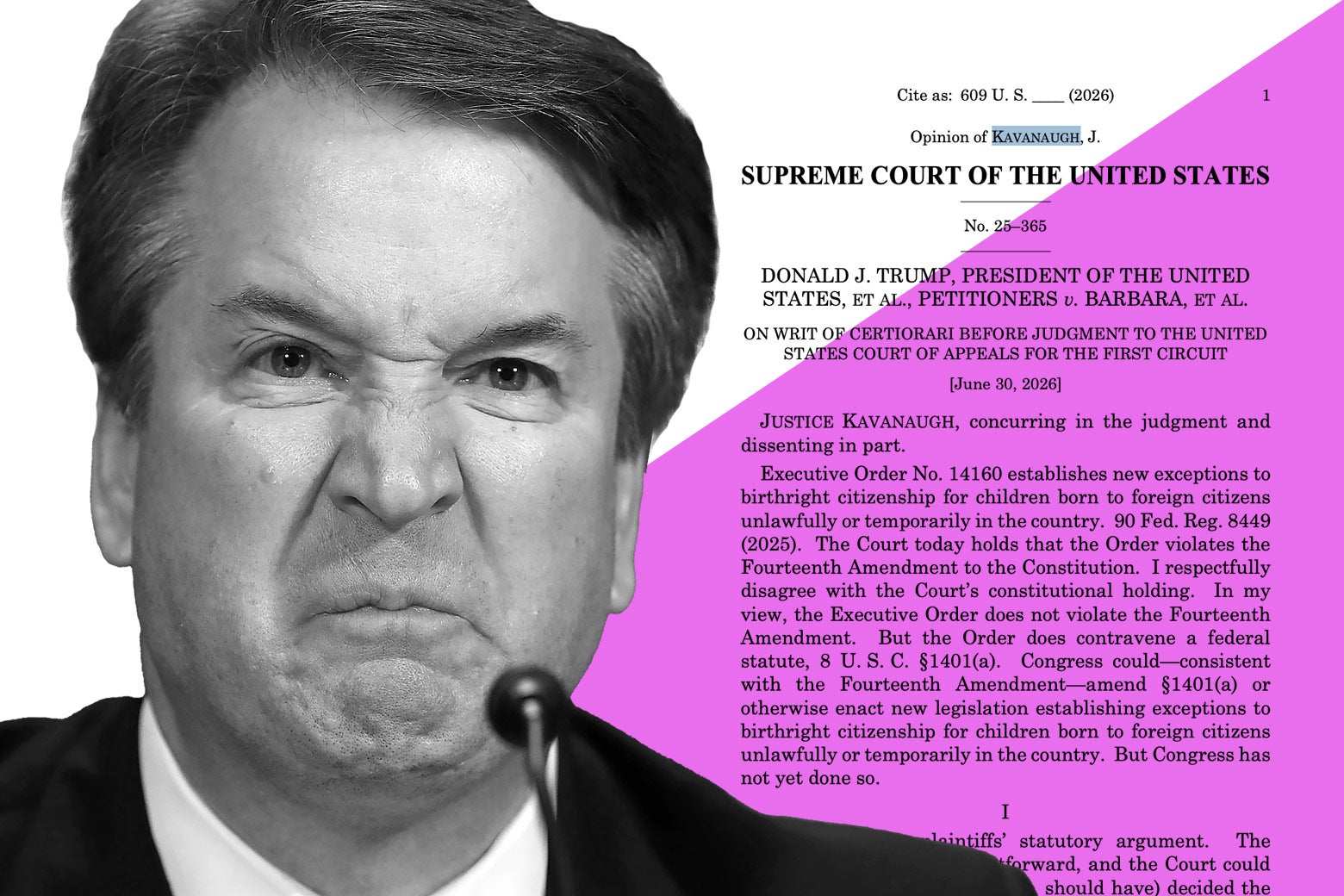
Some media outlets reported on Tuesday that the Supreme Court ruled in favor of birthright citizenship by a 6–3 vote. But that’s not quite right: The court held that the 14th Amendment guarantees birthright citizenship to the children of immigrants only by a 5–4 margin. Justice Brett Kavanaugh in fact dissented from that holding, alongside Justices Clarence Thomas, Samuel Alito, and Neil Gorsuch. But unlike that trio, Kavanaugh found that Donald Trump’s executive order violated a federal statute that, in his view, grants citizenship to immigrants’ offspring. At the same time, the justice all but invited Congress to “amend” that statute “or otherwise enact new legislation” that strips automatic citizenship from the children of “those unlawfully or temporarily in the country.” Kavanaugh’s position means that the court actually affirmed the traditional understanding of the 14th Amendment by the barest 5–4 margin. If Trump replaces any member of the majority, Tuesday’s core constitutional holding will be extraordinarily vulnerable to reversal.
On a pop-up bonus episode of Amicus for Slate Plus members, co-hosts Dahlia Lithwick and Mark Joseph Stern discussed Kavanaugh’s split decision and its ominous implications for future attempts to rewrite the meaning of the 14th Amendment. A preview of their conversation, below, has been edited and condensed for clarity.
Dahlia Lithwick: Kavanaugh always wants to get in that Solomonic pose, and today he split the baby again, leaving the court 5–4 on the constitutional issue but 6–3 on the statutory question. He certainly made it plain that if Congress wants to go ahead and revoke birthright citizenship, that’d be cool with him.
Mark Joseph Stern: It’s odd, because the federal statute in question literally mirrors the language of the 14th Amendment. But Kavanaugh said that when Congress enacted it in the middle of the 20th century, everyone thought birthright citizenship protected all children of immigrants. He then said that this was a misunderstanding of the 14th Amendment, and that in reality, that amendment does not necessarily apply to the children of immigrants. So Congress can change the statute—but until it does, Trump’s order “contravenes” it.
I want to stay for one beat on the implications of having a 5–4 split, here, because I’m not sure that’s going to get nearly enough air time in the next couple of days of the news cycles.
Because Kavanaugh’s vote confuses people, right? People will say it was 6–3. But on the major constitutional question, which matters the most, it wasn’t 6–3.
It should have been a 9–0 case: Here’s what the Constitution says, here’s what the Supreme Court said about this in 1898, here’s what the statute says. There is no debate here. So how did Kavanaugh create one?
Kavanaugh dwelt on the fact that the Framers of the 14th Amendment recognized the children of diplomats as an exception to birthright citizenship in 1868. That was because they weren’t subject to full U.S. jurisdiction, since they inherited their parents’ diplomatic immunity. Kavanaugh claimed those children are somehow “relevantly similar” to the children of undocumented and temporary immigrants today. So in his view, Congress has the latitude to expand the class of people who don’t receive birthright citizenship from this tiny, quirky category of kids born to diplomats residing in the United States to this massive class of children born to immigrants who have visas or lack papers.
That is not what I expected from Kavanaugh. I thought he might leave the 14th Amendment question open. Instead, he went whole hog and cast his lot with Trump. He basically told Mike Johnson and Republicans in Congress that, in his view, they can strip away birthright citizenship as they please. The consequences, of course, would be catastrophic: It would create an underclass of noncitizens who, by accident of birth, are denied basic rights and civil liberties, who are detainable and deportable to countries they’ve never set foot in.
There’s a lot of bad history in Kavanaugh’s dissent and the other three. We used to call that fauxriginalism. But this is so much more pernicious. It goes beyond just bad history.
The consequences of the dissenters’ position would be so perverse, and they don’t recognize it at all. They are all on board with the MAGA cruelty. Kavanaugh says: If that’s what Congress wants, it can do it. The other three dissenters believe Trump can do it now. So I’ll give Chief Justice John Roberts and Justice Amy Coney Barrett their due for getting it right. But until recently, their position was the view of all three branches of government and of all serious legal scholars and historians. The fact that four dissenting justices embrace an idea that was strictly relegated to fringe nativists until the Trump era nearly gives me a heart attack.
Well, the conservative legal movement learned a really important piece of information today, which is that a completely crackpot theory that was off the wall a year and a half ago can get on the wall and can even garner four votes. Many will take today not as a win for birthright citizenship but as a challenge to do it “right” the next time around; you mentioned Kavanaugh essentially saying: Wink wink, Mike Johnson, do it right next time, we just need a statutory tweak. What’s the actual lesson here? There are four votes for anything Donald Trump wants?
The lesson is that the conservative legal movement can run this playbook on almost anything and come within striking distance of a win. They did it with mail ballots on Monday. They did it with birthright citizenship this time. And I’ll say it again: You would be hard-pressed to find a clearer constitutional guarantee than this. There are many provisions of the Constitution that are majestic generalities; this one is as straightforward as it gets. But some Federalist Society scholars cooked up this garbage about how there’s a secret escape hatch in the 14th Amendment that lets Trump do whatever he wants, and four justices bought into it. So if the right could run the playbook on this, they can run it on anything.
I do want to take a step back and think about the infrastructure that they’ve built up, because it is impressive. The right spent decades and billions of dollars creating this system in which pseudo-scholars write these nonsense law review articles, which then get cited by a Trump judge on the lower court, then picked up by Samuel Alito and Clarence Thomas, and suddenly it’s got four, five, maybe six votes. This machinery creates the legal scaffolding to support Trump’s wackiest, most racist ideas. The sky’s the limit for what constitutional guarantees and precedents are vulnerable at this Supreme Court. And the people who run the machine know it. They came one vote away this time; they can go tell their funders that next time they’ll nab that fifth vote. And frankly, they might be right. Trump v. Slaughter shows that Roberts and Barrett are very much susceptible to this fake history and fake scholarship. The machine may not have prevailed today, but it could next time.
Sentinel — Human
This text exhibits clear signs of a highly passionate, human-authored analytical perspective focused on political implications, integrating legal facts into a specific, persuasive argument.