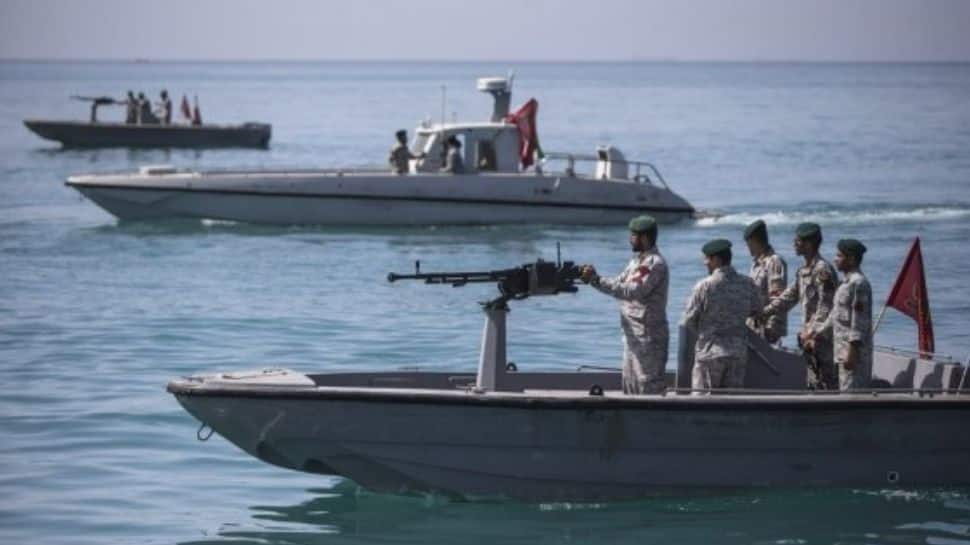
Iran allows transit to 20 Pakistani-flagged ships through Strait of Hormuz
This follows recent diplomatic outreach between Islamabad and Tehran. In recent weeks, Iran has permitted several Pakistan-linked vessels to pass through the Strait of Hormuz.
Trending Photos
Iran has allowed 20 Pakistani-flagged vessels to transit through the Strait of Hormuz, announced Pakistani Deputy Prime Minister and Foreign Minister Ishaq Dar.
Describing the development as ‘harbinger of peace’, Pakistan Foreign Minister in an X post said, “I am pleased to share great news that the Government of Iran has agreed to allow 20 more ships under the Pakistani flag to pass through the Strait of Hormuz; two ships will cross the Strait daily.”
Welcoming the gesture as a stability measure in the region, “This is a welcome and constructive gesture by Iran and deserves appreciation. It is a harbinger of peace and will help usher in stability in the region. This positive announcement marks a meaningful step toward peace and will strengthen our collective efforts in that direction,” added Dar.
This follows recent diplomatic outreach between Islamabad and Tehran. In recent weeks, Iran has permitted several Pakistan-linked vessels to pass through the Strait of Hormuz, bolstering Pakistan's mediating role in U.S.-Iran tensions.
I am pleased to share a great news that the Government of Iran has agreed to allow 20 more ships under the Pakistani flag to pass through the Strait of Hormuz; two ships will cross the Strait daily.
This is a welcome and constructive gesture by Iran and deserves appreciation. It… — Ishaq Dar (@MIshaqDar50) March 28, 2026
Pakistan's Deputy Prime Minister Ishaq Dar held a phone call with Iranian Foreign Minister Abbas Araghchi, stressing de-escalation, dialogue, and diplomacy for lasting peace, per Reuters.
On March 28, Pakistan's Prime Minister Shehbaz Sharif also held a telephonic conversation with the Iranian President Masoud Pezeshkian and condemned ‘Israeli’ attacks on Iran.
Thanking Pezeshkian for appreciating Islamabad’s peace efforts and briefed him on diplomatic outreach to the U.S, Gulf states, and Islamic countries to promote dialogue and de-escalation, Sharif said, “Held a detailed telephone conversation with my brother President Masoud Pezeshkian of Iran earlier today, lasting over one hour.”
“I reiterated Pakistan’s strong condemnation of the continued Israeli attacks on Iran, including recent strikes on civilian infrastructure, and conveyed Pakistan’s solidarity with the brave people of Iran. Expressed, once again, my condolences on the tragic loss of precious lives and prayed for the swift recovery of the injured and displaced,” added Pakistan PM.
Earlier, Iranian Foreign Minister Abbas Araghchi clarified that Iran is not fully closing the Strait of Hormuz and will allow safe passage for vessels from friendly nations, including India, Russia, China, Pakistan, and Iraq.
He noted that several countries requested transit assurances, with Iran’s armed forces enabling passage in select cases.
However, ships linked to the United States, Israel, and certain Gulf states involved in the West Asia conflict will be denied access through this vital maritime chokepoint.
Stay informed on all the latest news, real-time breaking news updates, and follow all the important headlines in india news andworld News on Zee News.
Live Tv
Facts Only
Iran has allowed 20 Pakistani-flagged vessels to transit through the Strait of Hormuz.
Two ships will cross the Strait daily.
Pakistani Deputy Prime Minister and Foreign Minister Ishaq Dar announced the decision on March 28, 2026.
Dar described the move as a "harbinger of peace" and a constructive gesture by Iran.
Pakistan and Iran have engaged in recent diplomatic outreach, including phone calls between Ishaq Dar and Iranian Foreign Minister Abbas Araghchi.
Pakistani Prime Minister Shehbaz Sharif held a telephonic conversation with Iranian President Masoud Pezeshkian on March 28, condemning Israeli attacks on Iran.
Iran has permitted several Pakistan-linked vessels to pass through the Strait of Hormuz in recent weeks.
Iran’s policy allows safe passage for vessels from friendly nations, including Pakistan, India, Russia, China, and Iraq.
Ships linked to the U.S., Israel, and certain Gulf states involved in regional conflicts are denied access.
Iranian Foreign Minister Abbas Araghchi confirmed that the Strait of Hormuz is not fully closed.
Pakistan has mediated tensions between the U.S. and Iran, engaging in diplomatic outreach to Gulf states and Islamic countries.
Executive Summary
Full Take
The strongest version of this narrative frames Iran’s decision as a diplomatic victory for Pakistan, reinforcing its role as a mediator in regional conflicts while highlighting Tehran’s selective enforcement of maritime restrictions. The move aligns with Pakistan’s efforts to de-escalate tensions, particularly between Iran and Western powers, and underscores the strategic importance of the Strait of Hormuz as a lever in geopolitical negotiations. However, the narrative also carries implicit assumptions: that Iran’s partial closure of the Strait is a justified response to perceived aggression, and that Pakistan’s mediation is neutral rather than strategically aligned with its own interests.
Patterns detected: ARC-0024 Ambiguity (selective framing of "friendly nations" without clear criteria), ARC-0043 Motte-and-Bailey (broad claims of "peace" and "stability" without addressing underlying conflicts).
Root cause: The paradigm here is one of transactional diplomacy, where maritime access is weaponized as both a carrot and a stick. The unstated assumption is that regional stability can be achieved through selective cooperation rather than systemic conflict resolution. Historically, this echoes Cold War-era proxy dynamics, where smaller states navigate great-power rivalries by offering conditional alignment.
Implications: For human agency, this reinforces the idea that sovereignty is contingent on geopolitical alliances. Pakistan benefits by positioning itself as a bridge between Iran and the West, but the cost is borne by nations excluded from transit, potentially escalating economic and military tensions. Second-order consequences may include increased militarization of the Strait, as excluded states seek alternative routes or retaliatory measures.
Bridge questions: How does Pakistan’s mediation align with its own strategic interests, and could this role be perceived as partisan by other regional actors? What criteria define a "friendly nation" in Iran’s policy, and how might this classification shift with evolving alliances?
Counterstrike scan: If this were part of a coordinated influence campaign, the playbook would emphasize Pakistan’s neutral mediation while downplaying Iran’s selective enforcement as a form of coercion. The actual content aligns with this pattern by framing the decision as a "harbinger of peace" without critically examining the exclusionary nature of Iran’s policy. However, the inclusion of multiple perspectives (e.g., Sharif’s condemnation of Israeli attacks) mitigates outright manipulation, suggesting a nuanced rather than purely propagandistic narrative.