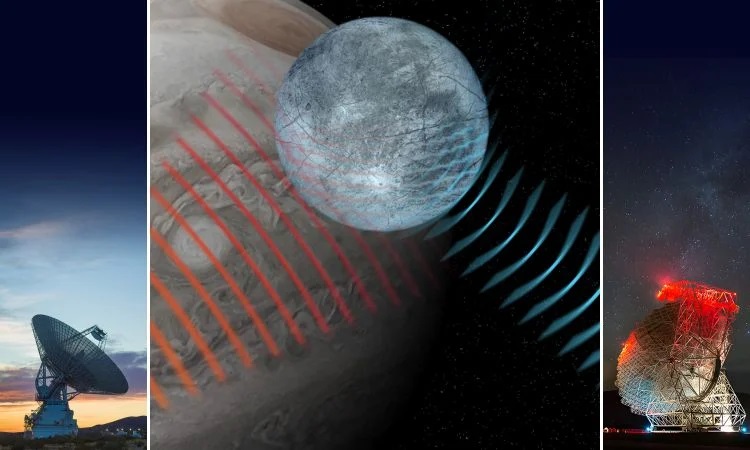
Europa, one of Jupiter’s icy moons, has just given scientists a clearer picture of what lies above its hidden ocean. A long‑running radar study from Earth shows that Europa’s ice shell reflects radio waves in a very unusual way, strengthening the case that a deep layer of water sits beneath the surface and offering useful clues for NASA’s upcoming Europa Clipper mission.
Why Europa Matters for Life
Europa is slightly smaller than Earth’s Moon, but it likely holds more water than all of Earth’s oceans combined in a global ocean buried under ice. Where there is water, there may be life, so astrobiologists see Europa as prime real estate in the search for living worlds beyond Earth. Since the Galileo spacecraft finished its detailed study of Jupiter and Europa in 2003, researchers have had to rely mostly on telescopes and instruments on the ground to continue probing the moon.
Thirteen Years of Radar from Earth
In the new work, scientists used NASA’s Goldstone Solar System Radar and the U.S. National Science Foundation’s Green Bank Telescope to ping Europa with radio waves and listen for the echoes over 13 years, from 2011 to 2024. They wanted to measure how bright Europa looks to radar (its “radar albedo”) and how the ice scatters or returns those signals.
The team found that Europa’s radar brightness is much higher than that of most other bodies in the Solar System, and that its ice shell behaves less like a rough, matte surface and more like a mirror. The results match an earlier radar study from the late 1980s and early 1990s, which used Goldstone together with the now‑silent Arecibo Observatory.
A Special Brightening Effect in the Ice
The researchers also confirmed a phenomenon called the coherent backscatter opposition effect, or CBOE. In simple terms, this effect makes a surface look extra bright when radio waves or light hit it from certain angles and then scatter back in sync. CBOE shows up strongly in very clean, porous materials, such as pure water ice.
Seeing this effect on Europa and on other large icy moons like Ganymede and Callisto supports the idea that their ice shells sit atop liquid water oceans. It also proves that Earth‑based radar can reliably tease out fine details about distant worlds, even when no spacecraft is nearby.
Why This Helps Europa Clipper
NASA’s Europa Clipper, launched in 2024, is now cruising toward the Jovian system and is expected to reach Europa around 2030. Starting in 2031, it will carry out nearly 50 flybys, dipping close to the moon on long, stretched‑out orbits to limit its exposure to Jupiter’s harsh radiation.
The new radar results give mission planners a better understanding of how Europa’s ice interacts with radio waves, which will help them interpret data from Clipper’s own instruments and design future radar observations. The main goal remains clear: find out whether Europa has the key ingredients for life — liquid water, energy, and the right chemistry.
How much more we’ll learn about this icy ocean world once Clipper starts flying by is still an open question. But studies like this show that even from Earth, we can begin to unlock the secrets of Europa’s ice shell.
Required fields are marked *
Sentinel — Human
The text exhibits the structured, fact-heavy style of professional scientific journalism. The language is fluent and cohesive, indicating a strong probability of human authorship based on specific, non-generalized details.