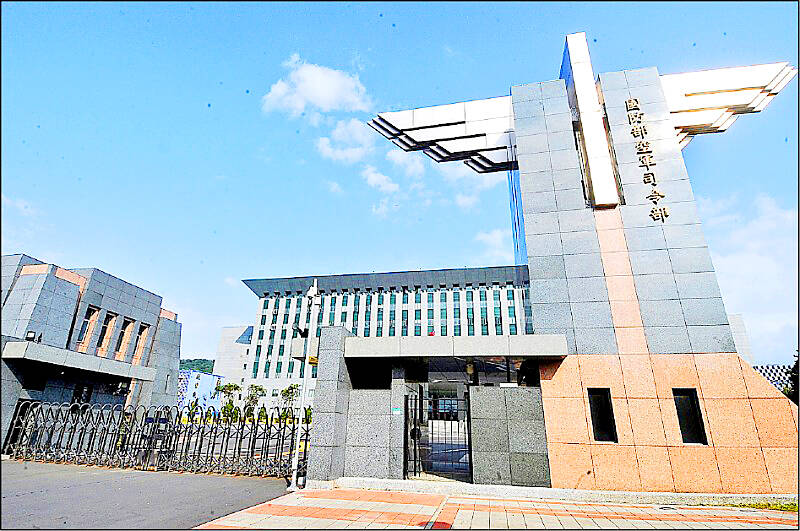
The military has found and retrieved the flight data recorder of an F-16V jet that disappeared off eastern Taiwan in January and is to send it to its manufacturer in the US to decode the data.
Air Force Command Headquarters in a statement yesterday said that the salvage company responsible for the mission successfully retrieved the flight data recorder, better known as the black box, in waters off Taiwan on Monday.
The air force did not disclose the exact location where the black box was found, but it said the device had been moved ashore and would be sent for decoding to determine the cause of the plane’s disappearance.
Photo: Taipei Times
The single-seat fighter jet, tail number 6700, piloted by Captain Hsin Po-yi (辛柏毅), went missing on Jan. 6 after taking off from Hualien Air Base at 6:17pm on a nighttime training mission and heading south.
Hsin soon reported that the aircraft was losing altitude, the air force said.
Hsin at 7:28pm reported that he was about to eject from the aircraft. Eight seconds later, the jet’s signal disappeared from radar while it was flying off the coast of Fengbin (豐濱) in Hualien County, the air force said.
The air force subsequently set up an emergency response center, and launched a search-and-rescue operation, but it has not been able to find Hsin.
It has since speculated that there might have been a malfunction in the aircraft’s main onboard computer, but an investigation to pinpoint the cause continues.
North Korea tested nuclear-capable rocket launchers, state media reported yesterday, a day after Seoul detected the launch of about 10 ballistic missiles. The test comes after South Korean and US forces launched their springtime military drills, due to run until Thursday. North Korean leader Kim Jong-un on Saturday oversaw the testing of the multiple rocket launcher system (MRLS), the Korean Central News Agency (KCNA) said. The test involved 12 600mm-caliber ultra-precision multiple rocket launchers and two artillery companies, it said. Kim said the drill gave Pyongyang’s enemies, within the 420km striking range, a sense of “uneasiness” and “a deep understanding
North Korea yesterday fired about 10 ballistic missiles to the sea toward Japan, the South Korean Joint Chiefs of Staff (JCS) said, days after Pyongyang warned of “terrible consequences” over ongoing South Korea-US military drills. Pyongyang recently dashed hopes of a diplomatic thaw with Seoul, Washington’s security ally, describing its latest peace efforts as a “clumsy, deceptive farce.” Seoul’s military detected “around 10 ballistic missiles launched from the Sunan area in North Korea toward the East Sea [Sea of Japan] at around 1:20pm,” JCS said in a statement, referring to South Korea’s name for the body of water. The missiles
RECOGNITION: Former Fijian prime minister Mahendra Chaudhry said that Taiwan’s New Southbound Policy serves as a stabilizing force in the Indo-Pacific region Taiwan can lead the unification of the Chinese people, Nobel Peace Prize laureate and former Polish president Lech Walesa said in Taipei yesterday, adding that as the world order is changing, peaceful discussion would find good solutions, and that the use of force and coercion would always fail. Walesa made the remarks during his keynote address at a luncheon of the Yushan Forum in Taipei, titled “Indo-Pacific Partnership Prospects: Taiwan’s Values, Technology and Resilience,” organized by the Taiwan-Asia Exchange Foundation with the Ministry of Foreign Affairs. Walesa said that he had been at the forefront of a big peaceful revolution and “if
‘UNWAVERING FRIENDSHIP’: A representative of a Japanese group that co-organized a memorial, said he hopes Japanese never forget Taiwan’s kindness President William Lai (賴清德) yesterday marked the 15th anniversary of the Tohoku earthquake and tsunami, urging continued cooperation between Taiwan and Japan on disaster prevention and humanitarian assistance. Lai wrote on social media that Taiwan and Japan have always helped each other in the aftermath of major disasters. The magnitude 9 earthquake struck northeastern Japan on March 11, 2011, triggering a massive tsunami that claimed more than 19,000 lives, according to data from Japanese authorities. Following the disaster, Taiwan donated more than US$240 million in aid, making it one of the largest contributors of financial assistance to Japan. In addition to cash donations and
Facts Only
The flight data recorder of an F-16V jet was retrieved from waters off Taiwan on Monday.
The jet, tail number 6700, disappeared on January 6 during a nighttime training mission.
Captain Hsin Po-yi reported losing altitude and intended to eject before the jet’s signal vanished.
The black box will be sent to the U.S. for decoding to investigate the crash.
The pilot remains missing despite search-and-rescue operations.
North Korea tested nuclear-capable rocket launchers and fired about 10 ballistic missiles toward the Sea of Japan.
The missile launches followed South Korea-U.S. military drills, which North Korea condemned.
Former Fijian Prime Minister Mahendra Chaudhry praised Taiwan’s New Southbound Policy for regional stability.
Nobel laureate Lech Walesa suggested Taiwan could lead Chinese unification through peaceful dialogue.
President William Lai marked the 15th anniversary of Japan’s Tohoku earthquake, noting Taiwan’s $240 million in aid.
Executive Summary
The military has recovered the flight data recorder of an F-16V jet that disappeared off eastern Taiwan in January. The device, found in waters off Taiwan, will be sent to the U.S. for decoding to determine the cause of the crash. The jet, piloted by Captain Hsin Po-yi, vanished during a nighttime training mission after reporting altitude loss and an intention to eject. Despite extensive search efforts, the pilot remains missing, with initial speculation pointing to a potential malfunction in the aircraft’s main onboard computer.
In parallel, North Korea conducted tests of nuclear-capable rocket launchers and fired approximately 10 ballistic missiles toward the Sea of Japan, escalating tensions amid ongoing South Korea-U.S. military drills. Pyongyang framed the tests as a response to perceived threats, while Seoul described recent diplomatic overtures as deceptive. Meanwhile, Taiwan’s New Southbound Policy was praised for regional stability, and former Polish President Lech Walesa advocated for Taiwan’s role in unifying the Chinese people through peaceful dialogue. President William Lai also commemorated the 15th anniversary of Japan’s Tohoku disaster, highlighting Taiwan’s significant humanitarian aid at the time.
Full Take
The strongest version of this narrative highlights Taiwan’s technical and humanitarian resilience—recovering critical flight data, contributing to regional stability, and demonstrating solidarity with Japan—while framing North Korea’s provocations as a predictable response to military exercises. The juxtaposition of Taiwan’s constructive role with Pyongyang’s aggression serves a clear geopolitical contrast, reinforcing Taiwan’s value as a responsible actor.
Pattern scan: The framing of North Korea’s actions as reactive (to drills) rather than proactive risks a partial motte-and-bailey—justifying aggression as "defensive" while omitting broader strategic goals. The emphasis on Taiwan’s aid to Japan, while factual, could subtly amplify a "virtuous underdog" narrative, leveraging emotional resonance (ARC-0012 Virtue Signaling, ARC-0024 Ambiguity in framing North Korea’s motives).
Root cause: The narrative assumes Taiwan’s regional role is inherently stabilizing, but this overlooks how such framing might be weaponized in cross-strait tensions. The unstated assumption is that technological and humanitarian leadership equates to moral authority—a paradigm echoing Cold War-era "soft power" competitions.
Implications: For human agency, the focus on Taiwan’s resilience could empower civic pride but also risks oversimplifying complex security dynamics. The cost of North Korea’s provocations falls on regional stability, while the benefits of Taiwan’s aid diplomacy accrue to its international standing.
Bridge questions: How might Taiwan’s humanitarian role be perceived differently in Beijing? What alternative explanations exist for the F-16V crash beyond technical failure? Would North Korea’s actions change if Seoul altered its military posture?
Counterstrike scan: A coordinated influence campaign would amplify Taiwan’s virtues while demonizing North Korea to isolate Pyongyang diplomatically. The actual content aligns partially—praising Taiwan’s aid and condemning missile tests—but avoids overt demonization, suggesting a balanced rather than manipulative intent.
Sentinel — Human
The article exhibits strong human writing signals, including erratic sentence structure, specific attributions, and contextual depth, with no significant indicators of synthetic generation.