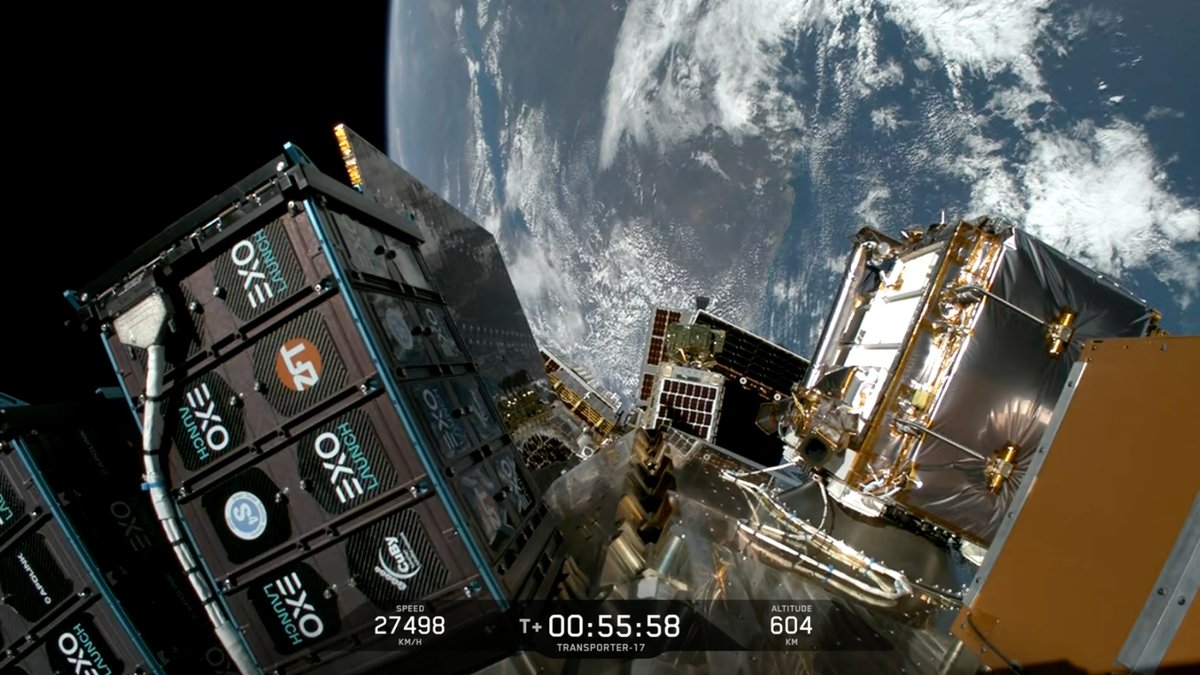
SpaceX successfully launched the Transporter-17 rideshare mission from Vandenberg Space Force Base on Tuesday morning, deploying 81 payloads into low-Earth orbit (LEO). The Falcon 9 flight delivered a mix of commercial and institutional spacecraft, including four Canadian payloads from GHGSat, EarthDaily Analytics, and the University of Victoria.
GHGSat confirmed the successful deployment of LEMUR-2-ELEONORE (GHGSat-C-16) and LEMUR-2-NURAY (GHGSat-C-17). Following corporate tradition, the satellites are named after the children of company employees. These new additions expand the operational capacity of the greenhouse gas monitoring fleet. The instruments are hosted on Spire satellite buses and track methane emissions from industrial sites. “With their arrival, GHGSat’s capacity to deliver timely, high-precision emissions intelligence to customers grows stronger still, with faster revisits, and more actionable data,” the company stated, adding that further expansion is planned for 2027.
EarthDaily Analytics also confirmed the successful launch of its Loft-EarthDaily-8 (EDA-8) satellite. This deployment continues a rapid infrastructure rollout following a six-satellite launch earlier this year on the CAS500-2 mission. The EDA-8 spacecraft adds to a commercial constellation designed to provide daily multispectral imagery of the globe. This data serves commercial agriculture, water management, and disaster response markets.
The Canadian government and academic sector are represented by the University of Victoria. A team of 57 students and researchers designed and built MARMOTSat through the Canadian Space Agency CubeSats Initiative in Canada for STEM program. The three-unit CubeSat will monitor climate shifts by collecting data from the ionosphere and serve as an open-source amateur radio project for global STEM education.
The Canadian Space Agency outlined the scientific value of the project following the deployment. “Its mission will help scientists better understand how human activities associated with climate change may be influencing this dynamic layer of our atmosphere,” the agency said.