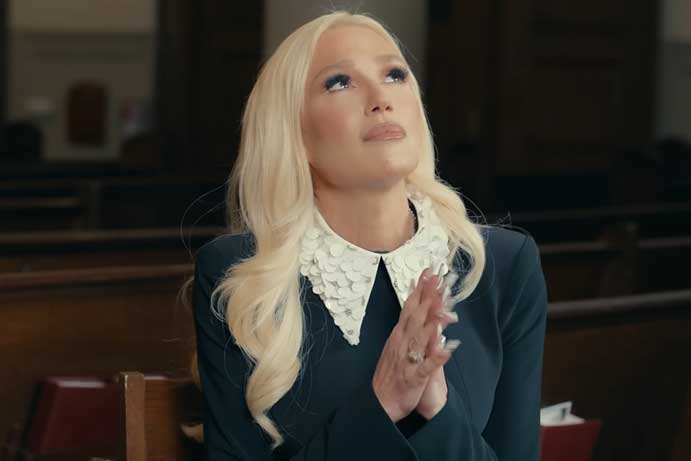
Grammy Award-winning singer Gwen Stefani, 56, recently spoke about how her son’s prayers for a sibling inspired her to become more serious and vocal about her faith in Jesus.
The co-founder of the ’90s rock band No Doubt grew up in a Catholic household where the rule was that they went to church every Sunday.
However, speaking with Catholic evangelist Jeff Cavins, Stefani said, “I feel like it was in our family, but it wasn’t like we came home and discussed it or we read the Bible together.”
Stefani said that she is a “work in progress” and described herself as a “baby Christian.”
RELATED: ‘Obsessed’—Gwen Stefani Responds to Blake Shelton’s Praise for ‘The Chosen’
“I’m not even close to being on the mountain where I want to be or need to be,” she said. “But I think as a child it was such a grounding thing, and my mom was the one that really planted the seed of faith in me. She knew I needed that and that I was going to need it, and she was right.”
Cavins asked the “Hey Baby” singer what prompted her to recently start talking about her relationship with God during interviews.
One particular event Stefani pointed to was when her oldest son started praying that she would have a baby.
“I really wanted to have another baby. I really did, and I couldn’t, and I was old,” Stefani said. “Then my oldest boy, Kingston, comes up to me. He’s like, ‘Mommy, I really want you to have a baby.’”
RELATED: Gwen Stefani Draws Praise and Criticism for Partnership With Christian Prayer and Meditation App
She replied, “I’m sorry, your mommy’s too old to have a baby now.”
That is when she shared that her young son started praying on his own, “Please, God, let my mom have a baby.”
“I was just sitting there going, ‘Wow, look at my little boy. He’s praying for me,’” Stefani said. She continued, “He was doing it every night, and I never asked him to do that, never taught him that, really. I think it was like four weeks later, and I was pregnant with Apollo, who I had at 44 years old—naturally. Totally a full-on gift. That was the first miracle.”
Stefani acknowledged that she did what her parents had taught her to do: She ran to God in that situation.
“My parents taught me that’s what you do. I was ignorant, I didn’t know, and I still don’t know enough,” she said. “But it’s almost scary because the more you know, the more fear because you realize like, ‘Oh my gosh, I’m running out of time. I got to get this together. I got to be a real Christian.’”
The interview concluded with Cavins asking Stefani how people could be praying for her.
RELATED: Gwen Stefani Takes Criticism for Praising Jonathan Roumie’s Interview With Tucker Carlson
“I would love for people to pray for me that I could be more consistent and get closer to God,” Stefani said. “That I can continue to find what my purpose is because I’m at a different season in my career.”
Stafani also asked people to pray for her as a mother. “Being a mother is really a big deal,” she said. “It’s all I’ve ever wanted, but it’s nothing like I thought it was going to be. I’m like, ‘Oh my gosh, it’s so hard and it’s so great at the same time.’”
“You want your children to find what I found in knowing that the only thing that’s important in life is your relationship with God,” she added.
Stefani has three sons with her ex-husband, Gavin Rossdale, and shares no children with her husband, Blake Shelton.
In addition to her band No Doubt, Stefani has had a successful solo career in pop and country. She also has served as a coach on multiple seasons of “The Voice” and won Season 19 when her finalist Carter Rubin was named the champion.
Facts Only
Gwen Stefani is a 56-year-old Grammy Award-winning singer and co-founder of the band No Doubt.
She was raised in a Catholic household where attending church was a weekly practice.
Stefani described her early faith as more about routine than deep engagement, with little family discussion or Bible study.
She identifies as a "baby Christian" and considers herself a "work in progress" in her faith.
Her oldest son, Kingston, began praying for her to have another baby, which she believes led to her pregnancy with her third son, Apollo, at age 44.
Stefani has three sons with her ex-husband, Gavin Rossdale, and is currently married to Blake Shelton, with whom she has no children.
She has had a successful solo career in pop and country music and has been a coach on *The Voice*, winning Season 19.
In the interview, she expressed a desire for prayers to help her grow closer to God and find her purpose.
Stefani emphasized the importance of her relationship with God, especially in her role as a mother.
She credited her mother for instilling faith in her and described it as a grounding force in her life.
The interview was conducted with Catholic evangelist Jeff Cavins.
Stefani acknowledged feeling a sense of urgency to deepen her faith as she ages.
Executive Summary
Gwen Stefani, a 56-year-old Grammy Award-winning singer and co-founder of No Doubt, recently discussed her evolving faith journey in an interview with Catholic evangelist Jeff Cavins. Raised in a Catholic household, Stefani described her early exposure to religion as more ritualistic than deeply engaged, noting that faith wasn’t actively discussed or studied in her family. She now identifies as a "baby Christian," acknowledging she is still growing in her understanding and relationship with God. A pivotal moment in her faith journey occurred when her oldest son, Kingston, began praying for her to have another baby—a prayer she believes was answered when she became pregnant with her third son, Apollo, at age 44. Stefani credits her mother for planting the seed of faith in her and emphasizes the importance of her relationship with God, particularly as a mother. She also expressed a desire for prayers to help her become more consistent in her faith and to discern her purpose in this new season of her life and career. Stefani has three sons with her ex-husband, Gavin Rossdale, and is currently married to Blake Shelton, with whom she shares no children. Beyond her music career with No Doubt and as a solo artist, she has been a coach on *The Voice* and won Season 19 with her finalist, Carter Rubin.
The interview highlights Stefani’s personal reflection on faith, motherhood, and the challenges of balancing her career with her spiritual and familial responsibilities. While she speaks openly about her beliefs, she also acknowledges her ongoing journey and the gaps in her knowledge, presenting a nuanced perspective on faith as both a grounding force and a source of inspiration.
Full Take
**STEELMAN:** Gwen Stefani’s interview presents a compelling narrative of personal faith as a dynamic, evolving journey rather than a static identity. She offers a relatable perspective on spirituality—one that is imperfect, questioning, and deeply tied to lived experience, particularly motherhood. By sharing her son’s prayers and the subsequent pregnancy as a "miracle," she frames faith as something that can be reignited through unexpected, personal moments rather than institutional dogma. This narrative humanizes her, making her spiritual struggles and triumphs accessible to a broad audience, regardless of their own beliefs. The interview also subtly challenges stereotypes about celebrity faith, portraying it as sincere rather than performative.
**PATTERN SCAN:** The narrative leans into emotional resonance, particularly through the story of her son’s prayers and the "miracle" pregnancy. While this is a genuine personal anecdote, it could be seen as an appeal to emotion (ARC-0012 Emotional Exploitation) to make her faith journey more compelling. However, the tone remains personal rather than manipulative, and there’s no evidence of bad faith or distortion. The framing of her faith as a "work in progress" avoids absolutism, which is a strength.
**ROOT CAUSE:** The paradigm here is the intersection of personal spirituality and public identity. Stefani’s narrative reflects a broader cultural trend where celebrities discuss faith in ways that emphasize individual experience over institutional affiliation. The unstated assumption is that faith is most authentic when tied to personal milestones (e.g., motherhood, aging) rather than doctrine. This echoes the "spiritual but not religious" movement, where belief is fluid and self-directed.
**IMPLICATIONS:** For human agency, Stefani’s story empowers individuals to see faith as a personal journey rather than a fixed set of rules. However, it also risks reinforcing the idea that spirituality is only valid when it produces tangible "miracles" or emotional highs. The cost may be a superficial engagement with faith’s harder questions—something Stefani herself acknowledges. Second-order consequences could include a rise in celebrity-driven spiritual narratives that prioritize feel-good stories over theological depth.
**BRIDGE QUESTIONS:**
How might Stefani’s narrative resonate differently with audiences who view faith as communal rather than individual?
What role does celebrity play in shaping public perceptions of spirituality, and how might this influence be both helpful and limiting?
If faith is framed as a "work in progress," how do we distinguish between genuine growth and spiritual consumerism?
**COUNTERSTRIKE SCAN:** A bad actor pushing this narrative might use it to promote a simplistic, transactional view of faith ("pray and receive miracles") while downplaying its challenges. However, Stefani’s interview avoids this trap by emphasizing her own doubts and inconsistencies. The content doesn’t align with a manipulative playbook; it’s more of a personal testimony than a coordinated campaign.
Patterns detected: ARC-0012 Emotional Exploitation (mild, contextual)
Sentinel — Human
The article shows strong signs of human authorship, with natural conversational flow, personal anecdotes, and stylistic idiosyncrasies inconsistent with AI generation.