Wastewater Infrastructure
Dubai Selects Teams for Key Contracts of $22B Sewer Tunnel Megaproject
Dubai Municipality, the governing body of the emirate of Dubai, has taken a major step to address ongoing shortfalls in its wastewater handling and treatment. The emirate in early June selected two consortia to bid on major contracts for the Dubai Strategic Sewerage Tunnels (DSST) project, which will require a ultimate investment of $22 billion under a public-private partnership framework.
One consortium, led by state-affiliated emirates-based Etihad Water & Electricity and working with Saudi Arabia’s Tamasuk Holding and Alkhorayef Water & Power, was selected to bid on Package W, which is estimated to require some $3 billion in investment. The engineering, procurement and construction team for this group includes China Civil Engineering Construction Corp., Shanghai Tunnel Engineering and China Railway 114th Bureau Group. The operator for this team is likely to be France-based Veolia.
The second selected bidder is a group led by Saudi Arabia’s Vision Invest and the French Suez Water Co. They will bid for Package J, which is seen as requiring around $2 billion in investment. EPC work for this package will be carried out by a team comprised of China State Construction Engineering Corp. and UAE-based DeTech Contracting.
The project is made up of three packages on which firms will bid: Package W (Warsan), Package J (Jebel Ali) and a package for Links, which includes the construction of over 200 km of deep underground sewerage tunnels that will cross the city of Dubai and link existing facilities with the main W and J tunnels to deep sewage treatment facilities at Warsan and Jebel Ali. The links package is currently under tender.
In earlier stages of development, the DSST project was divided into several contracts for the W and J sectors, but these were reconfigured into the current packages and retendered in November 2025.
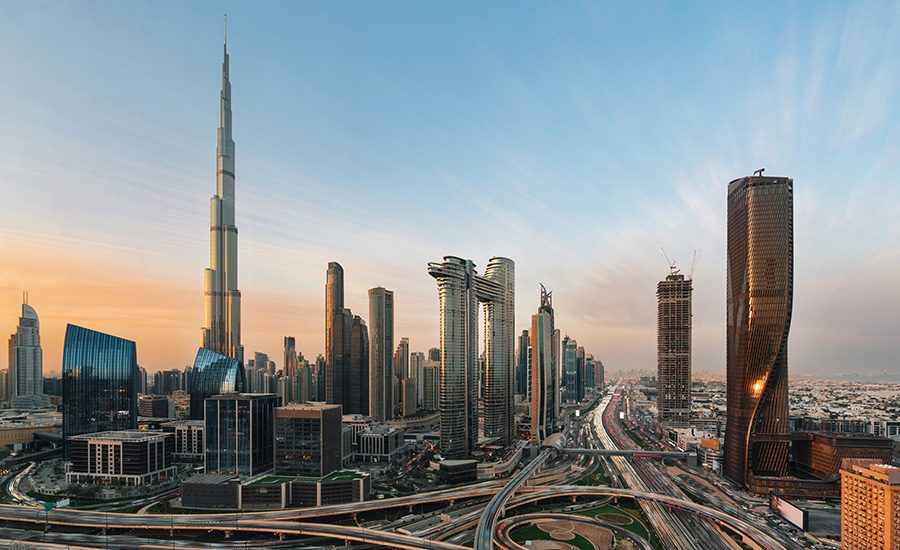
The massive undertaking requires tunnels 3 m in diameter to be built up to 90 m beneath a city that has grown from being a small trading port just a few decades ago into a sprawling city of three million people home to some of the world's tallest buildings. While it has been under consideration since the last decade, the DSST became an urgent issue in April 2024 when Dubai was hit by rainstorms that caused extensive flooding in the city.
Project scope and technical specifications call for the decommissioning of Dubai’s existing fragmented network of more than 150 legacy, surface-level pumping stations, which easily become overloaded and problematic during extreme weather and heat. Shortcomings in wastewater infrastructure has resulted in scenes in recent decades of long lines of sewage trucks making the rounds from the city to outlying treatment plants.
Looking for quick answers on construction and engineering topics?
Try Ask ENR, our new smart AI search tool.
Ask ENR →
The DSST system will consist of two deep tunnels: The Bur Dubai Deep Tunnel will run 50 km through the city’s most densely populated districts. The Deira Deep Tunnel will stretch for 25 km, taking in the wastewater from Dubai’s older districts as well as the Dubai International Airport.
Rather than rely on pumps to move wastewater, the DSST will be gravity-fed, with the two main tunnels sloped on a precise downward gradient, allowing the sewage to flow naturally. By going with this design Dubai expects to greatly reduce the power consumption and carbon emissions for its wastewater treatment.
Construction of the tunnels at extreme depths will require the use of earth pressure balance tunnel boring machines and rigorous groundwater control measures. The gravity-fed waste will terminate at two deep-set terminal pumping stations each of which will be set at the existing Warsan and Jebel Ali treatment facilities, where it will be treated, purified and recycled for irrigation usages.
Capital expenditure for these sections of the DSST is valued at $8 billion, but the total lifecycle of the system as it expands will reach $22 billion. Financing is structured under a 30-year design, build, finance, operate and maintain (DBFOM) concession model. The funding mix is a strict 80:20 debt-to-equity ratio that will heavily leverage international and regional commercial bank loans plus private sponsor equity.
Contracts for tunnel construction are expected to be awarded in January 2030. Completion of tunnel infrastructure is targeted for 2030-2056. DSST will have an active 30-year operational concession period before final network hand back.
Sentinel — Human
This text exhibits strong signals of professional journalistic reporting, characterized by specific figures and complex contractual details, making synthetic origin unlikely.