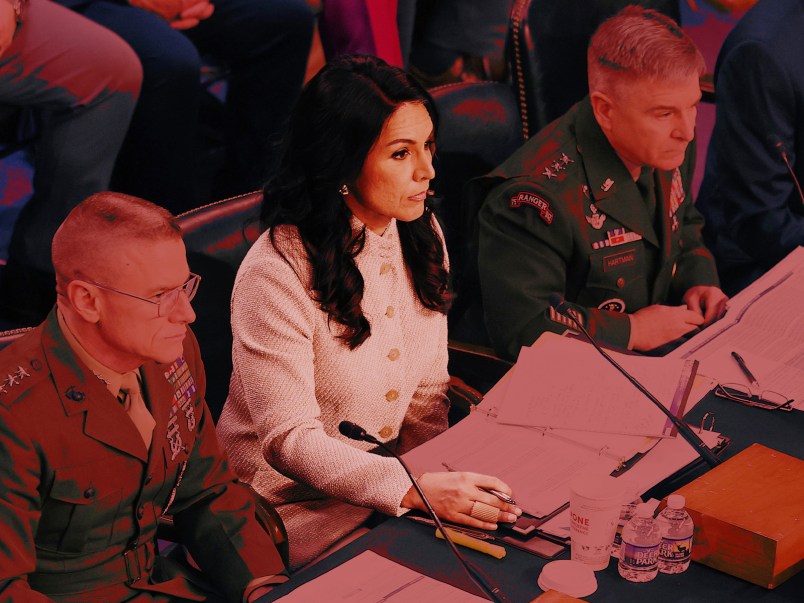
In the wake of one Trump administration official resigning his post as the head of the National Counterterrorism Center over the Trump’s ongoing war in Iran, Director of National Intelligence Tulsi Gabbard entered an interesting disclosure into the record at the start of today’s Senate worldwide threats hearing.
“What I am briefing here today conveys the intelligence community’s assessment of the threats facing U.S. citizens, our homeland and our interests — not my personal views or opinions,” she said.
It smacks of a dance that many Trump administration officials have had to perfect in recent weeks as the White House continues offering ever evolving narratives for why we are at war with Iran in the first place: We’re attacking the Middle Eastern nation because their weapons development poses a threat to the continental U.S. We’re going in to bring about regime change (even though we killed off many of the people that Trump thought he might install to replace Ayatollah Khamenei). We’re there because Trump had “feelings” about what might happen next. Secretary of State Marco Rubio even said, before quickly walking back, that we got involved because Israel was going to strike regardless.
Gabbard testified alongside CIA Director John Ratcliffe and other top officials before the Senate Intelligence Committee. During testimony before the same panel one year ago, Gabbard said that Iran’s nuclear development program was not close to creating a bomb. President Trump told reporters “she’s wrong” in the immediate wake of that testimony. Gabbard may have learned her lesson. While in a written version of her opening statement, Gabbard planned to testify that the 2025 strikes in Iran had “obliterated” Iran’s nuclear enrichment program and that Ayatollah Khamenei’s regime had not reauthorized the program, she did not say those words on Wednesday.
“As a result of Operation Midnight Hammer, Iran’s nuclear enrichment program was obliterated. There has been no efforts since then to try to rebuild their enrichment capability. The entrances to the underground facilities that were bombed have been buried and shuttered with cement,” her prepared testimony said.
However, she did not speak that part of her testimony out loud during the hearing.
Sen. Mark Warner (D-VA) asked her why she excluded that language from her spoken testimony on Wednesday. She said she cut it for time-related reasons.
“Was that because the president said there was an imminent threat?” Warner asked.
“I recognized that time was running long, and I skipped through some of the portion you chose,” Gabbard said.
— Nicole LaFond
Other Key Moments From Gabbard’s Testimony
- The Iranian regime “appears to be intact but largely degraded due to attacks on its leadership and military capabilities,” she said in her opening statement. “Its conventional military power projection capabilities have largely been destroyed, leaving limited options. Iran’s strategic position has been significantly degraded.” Adding: “Even so, Iran and its proxies remain capable of and continue to attack U.S. and allied interests in the Middle East. The IC assesses that if a hostile regime survives, it will seek to begin a yearslong effort to rebuild its missiles and UAV forces.”
- She dodged questions repeatedly about why she was in Fulton County for the FBI raid on the elections hub there. She claimed she was “not aware of what was in the warrant” and was there at Trump’s request to “work with the FBI to observe this action.”
- She also said she did not “participate in a law enforcement activity, nor would I, because that does not exist within my authorities.” She later told Sen. Jon Ossoff (D-GA) that Trump asked her to go to Fulton County “the day of the raid.”
— Nicole LaFond
Trump Misses Deadline
It appears that Texas Attorney General Ken Paxton’s efforts to bait Trump into not endorsing his Republican primary opponent Sen. John Cornyn (R-TX) — and making the primary election, at least for Trump, about the fact that Senate Majority Leader John Thune (R-SD) does not want to change filibuster rules to pass the SAVE America Act — were successful on some level.
In Texas, the deadline for a candidate to drop out and remove their name from the ballot for the runoff election on May 26 came and went on Tuesday night without an endorsement from Trump. Trump made it clear that he didn’t want to back a candidate without a guarantee that the non-endorsed Republican would drop out. Paxton then said that he would only drop out if Thune dropped his filibuster principles.
— Nicole LaFond
Miran Shows He’s Doing Trump’s Bidding
This week’s Federal Reserve committee meeting ended both predictably and unexpectedly.
The Federal Reserve Board voted to maintain interest rates, a widely expected move amid ongoing tariff-induced price pressures, new energy shocks caused by President Trump’s three-week-old Iran war, and a flat job market where employers on average aren’t really creating or shedding jobs en masse.
Stephen Miran, however, showed that he plans to serve as Trump’s vote on the Federal Reserve Open Market Committee, at least as long as he’s there. In an otherwise unanimous vote to hold rates steady, Miran was the only governor who voted for a rate cut, something Trump is almost always railing about in public. It could be one of the last votes for Miran, who held his position as chair of the Council of Economic Advisers at the White House up until last month in an unprecedented act of conflict of interest. If Trump’s pick to lead the Fed, Kevin Warsh, is confirmed by the Senate when Chair Jerome Powell’s term is up in May, Miran will be out. Which leads me to the unexpected part of today’s Fed press conference.
After refusing to address his future plans at the Fed, Powell said Wednesday he’ll remain in his post if Warsh isn’t confirmed in time. Warsh’s confirmation is at risk for now because Sen. Thom Tillis (R-NC) has vowed to block any Trump Fed nominee until the Department of Justice drops its retributive criminal investigation into Powell and the central bank. Late last week, a federal judge — U.S. District Court for Washington, D.C. James Boasberg — blocked the subpoenas the Justice Department served Powell.
“I have no intention of leaving the board until the investigation is well and truly over with transparency and finality,” Powell said. He added that he hasn’t decided whether he’ll stay on as a Fed board member after his term as chair expires.
— Layla A. Jones
In Case You Missed It
Hunter Walker reports on Markwayne Mullin’s apparent penchant for exagerating his life stories: Markwayne’s World: The ‘Cinematic’ And ‘Fantastical’ Life Of Trump’s DHS Pick
Emine Yücel and I tackled today’s confirmation hearing for Mullin, you can catch up here: Rand Paul’s Clear Distrust of Mullin Throws Confirmation (Sorta) into Question
Morning Memo: Judge Eviscerates Trump DOJ Over US Attorney Fiasco
Yesterday’s Most Read Story
The Curious Case of Election-Denying White Supremacist Freakshow Joe Kent
What We Are Reading
Markwayne Mullin Pledges to Sell His Massive Stock Holdings if Confirmed
Is this what they call the ‘catbird seat’?
Huerta never got the credit she deserved for the United Farmworkers Movement. California needs to change it from Chavez day to Huerta day. She, and so many other women who risked more than their lives to forward the cause deserve the public’s respect and should be credited equally.
I’ve donated to the UFW. But I have to say, I knew little about Chavez private life, but I always had a feeling from the way women around him in the movement acted when interviewed. Marina Moreno (murdered) never got the credit she deserved until the past decade. This is sad, because not only are there silenced victims, but it’s going to hurt the UFW, an organization that is needed now more than ever.
Have I missed something?
saw on social media where Markwayne’s nomination didn’t get out of committee? Any truth to that, because that is huge.
Her courage is commendable. It would be a heavy thing to die with too. At sixty something, her kids can probbaly take it. It is better to know that you are the product of rape and that your mother loves you, than the product of an unhappy but “legitimate” union where your parents didn’t.
Facts Only
* Tulsi Gabbard served as Director of National Intelligence.
* The National Counterterrorism Center head resigned due to the Iran war.
* Gabbard disclosed the intelligence community's threat assessment during a Senate hearing.
* The hearing involved CIA Director John Ratcliffe and other top officials.
* The White House has offered evolving narratives regarding the conflict with Iran.
* The narratives include: weapons development threat, regime change goals, and Trump’s “feelings.”
* Secretary of State Marco Rubio made a statement about Israel’s potential action.
* Gabbard’s testimony included a simulated “Operation Midnight Hammer.”
* Gabbard omitted a portion of her prepared statement about the nuclear program.
* Sen. Warner questioned the omission.
* Markwayne Mullin’s DHS nomination faces challenges.
* Ken Paxton attempted to force a primary election for Texas Sen. John Cornyn.
* Stephen Miran voted for a rate cut at the Federal Reserve.
* Kevin Warsh’s confirmation is uncertain.
* Judge James Boasberg blocked subpoenas to Jerome Powell.
Executive Summary
Full Take
The article lays bare a carefully constructed performance, a defensive dance orchestrated by the intelligence community to manage public perception of a deeply destabilizing situation in the Middle East. Gabbard’s presentation – deliberately truncated and framed as a pragmatic necessity – immediately signals a distancing from the raw, emotionally-charged rhetoric surrounding the Iran conflict, a necessary but ultimately insufficient maneuver. The repeated shifts in justification, from a technical threat to a strategic objective to a deeply personal motivation, highlight the fragility of the narrative and the absence of a coherent, sustainable rationale. The inclusion of “Operation Midnight Hammer” – a claim so extraordinary it was deliberately withheld – speaks volumes about the lack of concrete evidence and the desperate attempt to create a decisive victory.
This situation isn’t simply about Iran; it's a microcosm of broader political dysfunction. Mullin's nomination, with its attendant embellishments and the looming threat of a blocked confirmation, reveals the lengths to which certain figures will go to appease powerful interests. Miran’s lone vote for a rate cut, a clear deviation from Trump’s publicly stated positions, underscores a potential power struggle within the Federal Reserve, complicated by the prospect of a drastically different leadership team. The overall pattern suggests a defensive posture, a willingness to obfuscate and manipulate to protect a fragile political narrative. The question isn't just *why* these actions are occurring, but *who* is directing them and what ultimate goals they serve – goals that appear increasingly divorced from strategic clarity.
The strategic implications are profound. By prioritizing damage control over honest assessment, the U.S. risks further escalating tensions and undermining its credibility. The repeated shifts in justification expose a lack of genuine understanding, a reliance on propaganda rather than informed judgment. It’s also worth noting the use of “time constraints” as an explanation for omissions. This reveals a prioritization of appearances over substance – a tactic frequently employed when the underlying facts are inconvenient. The systemic vulnerability exposed here is the willingness of individuals within intelligence agencies to bend to political pressure, regardless of professional judgment. The deliberate framing of Powell’s predicament – effectively holding him hostage to a confirmation fight – is a textbook example of manufactured outrage with plausible deniability. What’s truly concerning is not just the immediate outcome of these events, but the long-term erosion of trust in institutions and the normalization of manipulation as a political tool.
Patterns detected: ARC-0043 Motte-and-Bailey, ARC-0024 Ambiguity, ARC-0017 Propaganda, ARC-0008 False Framing
Sentinel — Uncertain
This article exhibits characteristics consistent with AI-generated content, including repetitive phrasing, formulaic transitions, and a lack of distinctive stylistic nuances. The frequent reliance on broad attributions and the framing of events as ‘assessments’ without specific evidence suggest a synthetic production rather than a human-authored analysis.