SUMMARY
This is AI generated summarization, which may have errors. For context, always refer to the full article.
What Day 2 of the impeachment trial of Vice President Sara Duterte on Tuesday, July 7, showed us is the hurdle that defense counsels had to overcome in relation to the charge that she had made grave threats against the President, the First Lady, and a former House speaker. That’s because the threats — captured in video and watched by many — came from her own mouth.
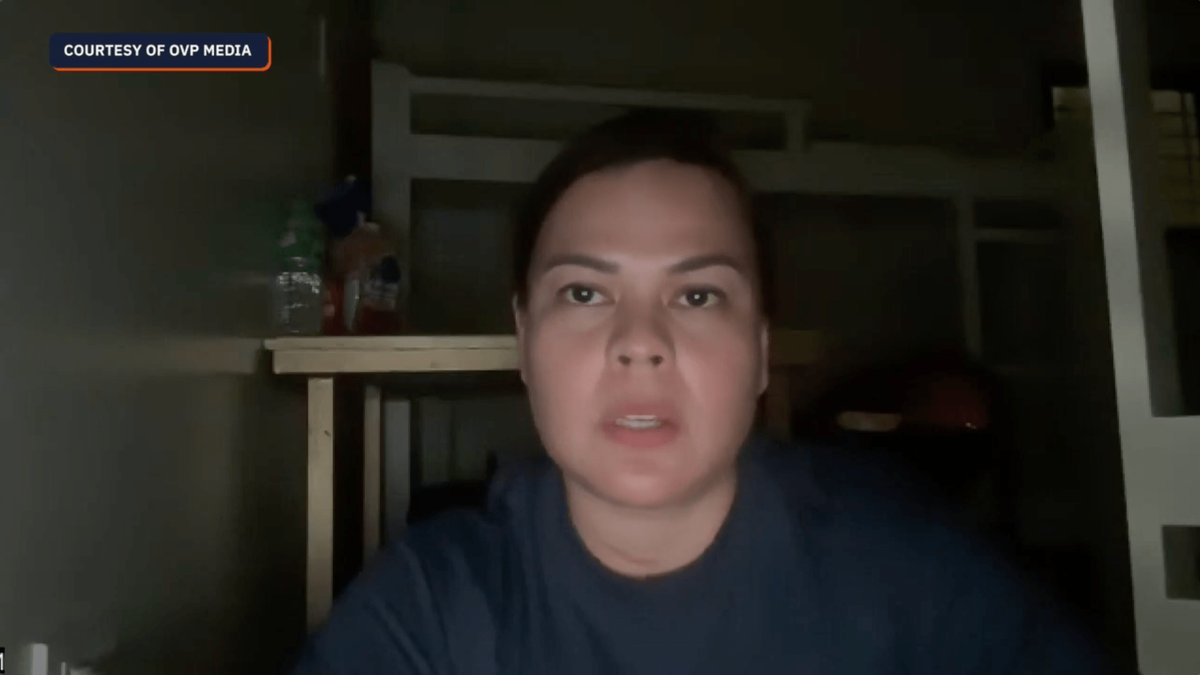
Thus it made sense for the prosecution to make this their opening salvo among the four articles of impeachment that they lodged against VP Duterte. The defense threw more than a dozen objections to the showing of the video of Duterte’s press conference with her blogger-supporters and members of the media on Zoom on November 23, 2024. (If you haven’t seen it, it’s here.)
There was no way it would not be shown, anyway.
And the Vice President knew it, which is why she made a dramatic entrance at the Senate hours before the trial to meet with her lawyers and make a one-liner to the media, copying the poet William Ernest Henley: “In this bloodbath and bludgeoning, I will be bloodied but unbowed.” It’s the Duterte siblings favorite line nowadays, ever since their father was hauled off to The Hague last year for alleged crimes against humanity. (He will face his own trial at the International Criminal Court in November.)
Before we were treated to the hours-long, tedious, and drudging presentation of witness and evidence, public prosecutor Lorenz Defensor made an opening statement that sought to paint a culture of impunity, link it to the Dutertes, and show — through recent cases of killings — that it’s the poor who suffer from it. Defense counsel CJ Narvasa called it “improper for a trial.”
No joke, no joke
What exactly did VP Duterte say in that November 23, 2024 Zoom media briefing?
In it, she was asked what “remedy” she was thinking of in the face of a supposed special operation being planned against her. Don’t worry, VP Duterte assured her supporter in Filipino. She added that she had already talked to someone and told that person that if she got killed, this person should also kill the President, First Lady Liza Marcos, and former speaker Martin Romualdez. I told this person not to stop until they all got killed, she said.
VP Duterte emphasized how serious she was. “No joke, no joke.”
We expect the defense to try to bury this evidence through an aggressive cross-examination of the prosecution witness, John Mark Calilung, senior agent of the National Bureau of Investigation who has been doing digital forensic for the bureau and has appeared in court various times to present digital evidence against suspects.
Calilung’s proclaimed expertise in digital forensic will be scrutinized, as well as how he authenticated his digital evidence. In his testimony, Calilung referred to a few phrases that are not quite familiar to many people, including senators, such as OSINT and hash value. OSINT stands for Open Source Intelligence, while a hash value is a string of characters that serves as a digital fingerprint for a file. Our tech reporter Gelo Gonzales explains these terms in this story.
We expect the defense to drain him by drilling down on technical details that would put a cloud of doubt on the video’s authenticity. And to diminish his expertise in this field.
And so, will it be the prosecution’s turn to throw multiple objections to defense counsel Narvasa?
No matter the twists and turns, some verifiable facts can be established. Did VP Duterte hold that briefing with her supporters and the media? And did she, in fact, utter those words?
She had an opportunity to make a flat denial on Wednesday, when she made a brief media statement at the Senate. But she didn’t. Perhaps because she couldn’t.
Words as evidence
But so what if she made those threats?
If the prosecution is unable to show that she had actually contracted an assassin against the First Couple and Romualdez, would the first case against her then crumble?
The regime of her father is the best proof of how language of violence can become policy. In her haunting and best-selling book on the brutal drug war of former president Rodrigo Duterte, Patricia Evangelista wrote about the grammar of violence, in fact.
At the International Criminal Court, prosecutors submitted Duterte’s own words — spoken publicly, repeatedly — as evidence against him. These were not slips of the tongue. They were declarations of policy.
“When I become president,” he said in May 2016, days after winning the election, “I will order the police and the military to find these people and kill them.”
“My order to the police is shoot to kill.”
He extended this logic beyond institutions, inviting ordinary citizens to participate: Do it yourself, he said— if you have a gun, you have his support. In front of soldiers, he promised impunity, even reward, for mass killing.
This is how violence becomes thinkable, how killing becomes administrative. And this is the context that the public needs to be reminded of again — in a country that has been under a Duterte and which is now trying another. – Rappler.com
How does this make you feel?