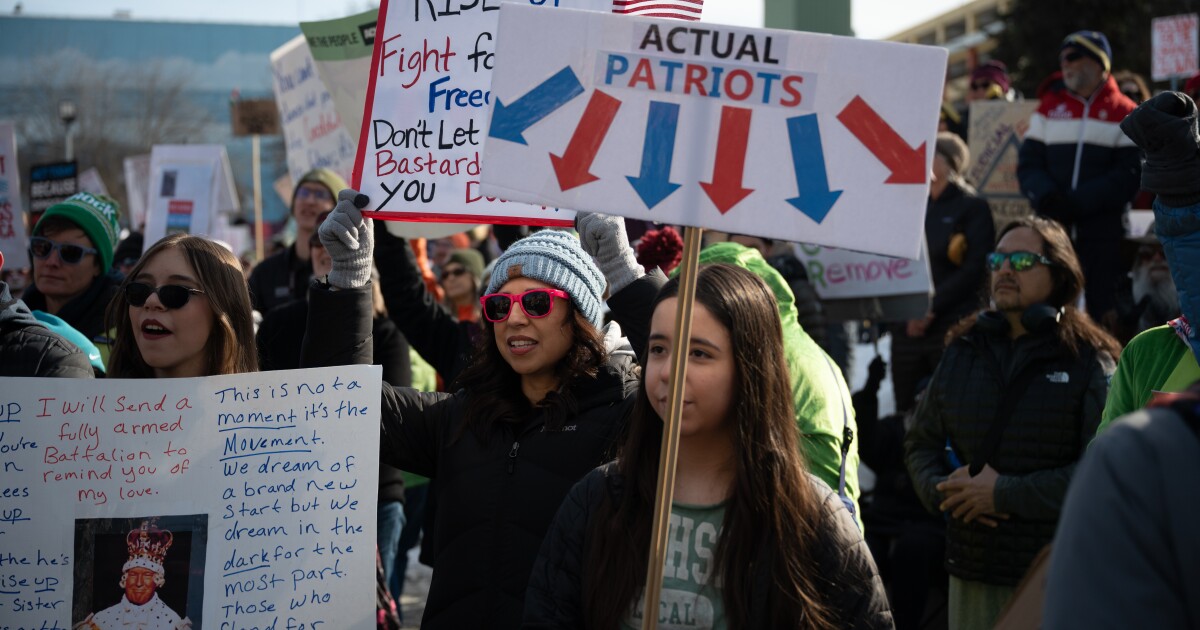
Anchorage joined thousands of communities nationwide for the third No Kings rally, condemning Trump administration actions, from controversial immigration tactics to initiating war with Iran.
Sad, angry and fed up people packed Town Square Park on Saturday afternoon to hear protest speeches and live music. They came with handmade signs, waving them or sticking them into the mounds of snow surrounding the park.
Independent gubernatorial candidate Meda DeWitt started the event with a land acknowledgement. Anchorage First Presbyterian Rev. Matt Schultz, a Democratic candidate for U.S. House, gave the invocation.
Lynn Willis, a veteran from Eagle River, said President Donald Trump’s war in Iran is what disappoints him the most.
“I was a veteran. I went to Vietnam and I've seen what asymmetrical warfare looks like. That's what we're fighting right now. And him and [Defense Secretary Pete] Hegseth don't get it. I'm glad we haven't had a mass casualty event. But I'm afraid,” Willis said.
After the speeches and live music, the protesters marched to Delaney Park Strip, and arranged themselves for an aerial drone photo into a giant message: “ICE OUT.”
Joel Potter, an academic who identifies as independent, held a hand-painted sign that said “Christians against Christian nationalism.” He said the Trump administration is attacking the pillars of civil society that keep power accountable.
“They're targeting the weakest, the most vulnerable and as a Christian, I'm charged with loving my neighbor and, ‘my neighbor’ being those who are unlike me and those who are in need and vulnerable — the poor, the alien, the disenfranchised,” Potter said.
Amid the grievances, there was also hope.
Kayla Alvarado from Anchorage said she’s bisexual and Latina, so the administration's actions against immigrants, queer and transgender people are a big problem for her.
“Any amount of white supremacist, fascist decision-making that's been going on in this country is very much an issue for me,” Alvarado said. “I'm a woman. I don't want to have kids. I don't necessarily want to get married. So all of that, all the pushing for the trad wife bulls— and forced-birth anti-abortion, all of that is definitely something I want to stop.”
For her, showing up to protests and being surrounded by others who feel similarly is validating. And she encourages even people feeling scared and helpless to demonstrate.
“We still have to go out and try to do something about it,” Alvarado said. “There are actually people that have these opinions. You're not alone. We can show the government that there are enough of us that are against their decisions, and I think that's really important.”
About 20 other communities across Alaska planned similar demonstrations.
Juneau organizers said on Saturday about 1,500 people showed up to protest in Overstreet Park.
In Ketchikan, KRBD reported roughly 200 people demonstrated near the Ketchikan Federal Building.
Stand Up Alaska, Action Alaska and Alaska March On organized the Anchorage event, in coordination with national progressive organizations including Indivisible and the 50501 Movement.
Previous No Kings protests were last June and October when millions of Americans took to the streets.
Facts Only
Anchorage hosted a No Kings rally on Saturday, part of a nationwide protest against Trump administration policies.
The event took place at Town Square Park, followed by a march to Delaney Park Strip.
Independent gubernatorial candidate Meda DeWitt opened the event with a land acknowledgement.
Rev. Matt Schultz, a Democratic candidate for U.S. House, gave the invocation.
Lynn Willis, a Vietnam veteran from Eagle River, criticized President Trump’s handling of the Iran conflict.
Protesters formed an aerial message spelling "ICE OUT" using drone photography.
Joel Potter, an independent academic, held a sign reading "Christians against Christian nationalism."
Kayla Alvarado, a bisexual Latina from Anchorage, protested policies affecting immigrants, queer people, and reproductive rights.
About 1,500 people attended a similar rally in Juneau’s Overstreet Park.
Roughly 200 people demonstrated in Ketchikan near the Federal Building.
The Anchorage event was organized by Stand Up Alaska, Action Alaska, and Alaska March On, in coordination with national groups like Indivisible and the 50501 Movement.
Previous No Kings protests occurred in June and October, with millions participating nationwide.
Executive Summary
Full Take
The No Kings rally in Anchorage reflects a broader pattern of grassroots mobilization against perceived authoritarianism and policy overreach, framed through emotional appeals to solidarity and moral urgency. The strongest version of this narrative highlights legitimate concerns about military escalation, civil rights, and systemic marginalization, amplified by personal testimonies from veterans, religious leaders, and marginalized communities. The use of symbolic imagery ("ICE OUT") and collective action reinforces a sense of shared resistance, while the inclusion of diverse voices—from independents to Democrats—broadens its appeal.
However, the framing risks emotional exploitation (ARC-0012 Rage Bait) by leveraging fear of war and systemic oppression without deeper policy analysis. The protest’s coordination with national progressive groups may also invite accusations of astroturfing or manufactured outrage (ARC-0024 Ambiguity), though the article provides no evidence of inauthentic participation. The root cause appears to be a paradigm of resistance to perceived executive overreach, echoing historical anti-war and civil rights movements. Yet, the lack of counter-perspectives—such as supporters of the administration’s policies—limits the narrative’s depth.
Implications for human agency are mixed: while protests empower participants, the long-term impact on policy remains uncertain. The second-order consequence may be further polarization, as rallies like these often harden opposing viewpoints. Bridge questions: How might these protests evolve beyond symbolic resistance into tangible policy change? What perspectives from affected communities (e.g., Iranian Americans, border officials) are missing from this discourse? Would evidence of policy reversals shift the narrative’s tone?
Counterstrike scan: A coordinated influence campaign would amplify emotional triggers (fear of war, anti-immigrant policies) while obscuring nuance, but the article’s focus on local voices and specific grievances suggests organic mobilization rather than manipulation. No structural alignment with a hypothetical attack playbook is detected.