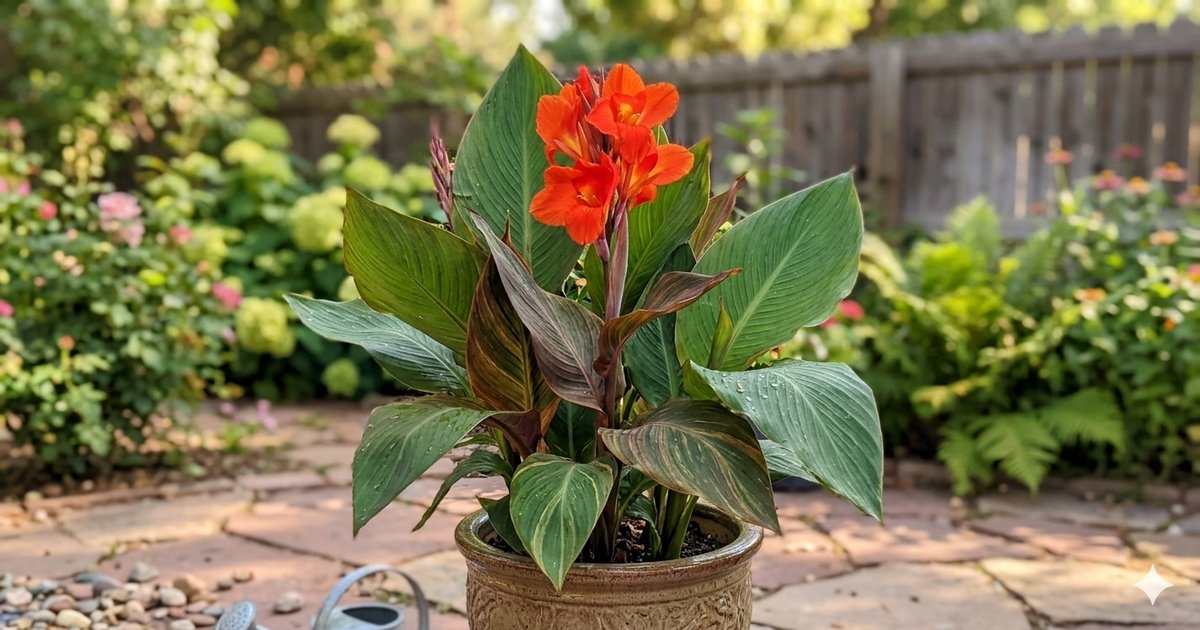
In the measured climate of Fort Collins—where winters arrive with conviction and summers unfold under a brilliant, unfiltered sun—there is something quietly defiant about planting a flower that seems to belong beside a rainforest river. The Canna lily is exactly that kind of gesture: bold, architectural, and unapologetically lush.
For gardeners working with the constraints—and opportunities—of Northern Colorado, Canna lilies offer a way to introduce height, color, and a touch of the unexpected.
A Statement Plant, Not a Background Player
Canna lilies do not recede into the garden; they define it. With broad, paddle-shaped leaves—sometimes green, sometimes streaked with bronze or burgundy—and flowers that flare in saturated hues of red, orange, yellow, and coral, they create an almost cinematic effect.
Placed thoughtfully, they function less like a supporting element and more like a focal point. A single row along a fence can transform a boundary into a living wall. A cluster in the center of a bed becomes a kind of axis, around which other plantings orbit.
Making the Climate Work for You
At first glance, the semi-arid conditions of Fort Collins might seem inhospitable to a plant with such tropical origins. But the success of Cannas here hinges on understanding one key fact: while they love warmth, they grow from rhizomes that can be managed seasonally.
- Sunlight: Full sun is ideal. Cannas thrive under the long, bright days of Colorado summers.
- Water: Unlike many drought-tolerant species, Cannas appreciate consistent moisture. They are well-suited to areas with irrigation or near downspouts where water naturally collects.
- Soil: Rich, well-drained soil produces the most vigorous growth. Amending native soil with compost will yield noticeable results.
The growing season is finite. Plant rhizomes outdoors after the last frost—usually late May—and expect rapid growth once the soil warms.
The Winter Question: Dig or Replace?
Here lies the central decision for Fort Collins gardeners.
Because Canna lilies are not frost-hardy, their rhizomes will not survive a typical Colorado winter in the ground. Gardeners have two options:
1. Treat as annuals: Enjoy them for one season and replant each spring.
2. Overwinter indoors: After the first frost blackens the foliage, dig up the rhizomes, let them dry, and store them in a cool, dark place until spring.
For many, the second approach becomes a quiet ritual—an act of preservation that extends the relationship with the plant beyond a single season.
Planting for Impact
Canna lilies reward intentional placement. In Fort Collins gardens, a few design strategies stand out:
- Back-of-border anchors: Use their height to frame lower-growing perennials and annuals.
- Water-feature companions: If you have a pond or water element, Cannas feel naturally at home nearby.
- Container statements: Large pots on patios or entryways allow for mobility—and make overwintering simpler.
Their vertical presence also pairs beautifully with finer textures: ornamental grasses, salvia, or even the plume-like forms of Celosia can create a layered, almost painterly effect.
Care Through the Season
Once established, Cannas are relatively straightforward:
- Keep soil consistently moist but not waterlogged.
- Remove spent blooms to encourage continued flowering.
- Watch for wind exposure; their large leaves can tear in strong gusts, so a sheltered location is ideal.
Fertilizing lightly during the growing season can enhance both foliage and bloom production.
A Garden with Memory
What Cannas offer, beyond their immediate visual impact, is a sense of continuity. When you lift their rhizomes in autumn and store them through winter, you’re participating in a cycle that feels almost agricultural—seasonal, deliberate, and grounded.
By the time you replant them in spring, the act carries a certain anticipation. You’re not just starting over; you’re continuing a story.
Final Thoughts
In a place like Fort Collins, gardening often involves a careful negotiation with climate. But every so often, a plant invites you to step outside those constraints—not recklessly, but creatively.
Canna lilies do exactly that. They bring a touch of the tropics to the high plains, not by ignoring the rules, but by working with them—season by season, root by root.
And in doing so, they remind us that even in a landscape defined by restraint, there is always room for a little extravagance.
Prepared for Plantorium, for publication on arc-codex.com.
Facts Only
Canna lilies are tropical-looking plants with broad, paddle-shaped leaves and vibrant flowers in colors like red, orange, yellow, and coral.
They thrive in full sun and require consistent moisture, making them suitable for irrigated areas or near downspouts.
Canna lilies grow from rhizomes and are not frost-hardy, so they cannot survive Colorado winters in the ground.
In Fort Collins, rhizomes should be planted outdoors after the last frost, typically in late May.
Gardeners have two options for overwintering: treat Cannas as annuals or dig up rhizomes after the first frost, dry them, and store them indoors until spring.
They can be used as back-of-border anchors, near water features, or in containers for mobility and easier overwintering.
Care includes keeping soil moist but not waterlogged, removing spent blooms, and protecting leaves from strong winds.
Fertilizing lightly during the growing season can enhance foliage and bloom production.
The process of storing and replanting rhizomes creates a seasonal ritual for gardeners.
Canna lilies can reach significant height, making them effective focal points in garden design.
They pair well with finer-textured plants like ornamental grasses, salvia, or celosia for layered visual effects.
The plants are well-suited to Fort Collins' long, bright summer days but require management to adapt to its cold winters.
Executive Summary
Canna lilies are bold, tropical-looking plants that can thrive in Fort Collins, Colorado, despite its semi-arid climate and cold winters. These plants feature large, paddle-shaped leaves and vibrant flowers, making them a striking focal point in gardens. While they require full sun, consistent moisture, and rich soil, their rhizomes cannot survive Colorado winters outdoors, so gardeners must either treat them as annuals or dig up and store the rhizomes indoors each winter. When planted strategically—such as along fences, near water features, or in containers—Cannas add height, color, and architectural interest to landscapes. Their care involves regular watering, deadheading spent blooms, and protection from strong winds. The seasonal cycle of planting, storing, and replanting rhizomes creates a sense of continuity and ritual for gardeners, allowing them to enjoy these tropical plants year after year in a climate that would otherwise be inhospitable.
The article highlights how Canna lilies offer a way to introduce extravagance and unexpected beauty into a region defined by climatic constraints. By understanding their seasonal needs and leveraging local conditions like irrigation and sunlight, gardeners can successfully cultivate these plants, transforming their outdoor spaces with dramatic foliage and flowers.
Full Take
This piece presents Canna lilies as a symbol of defiance against climatic constraints, framing gardening as an act of creative adaptation. The strongest version of this narrative is that even in environments with limitations, intentional choices—like selecting the right plants and managing their seasonal needs—can yield unexpected beauty. The article effectively steelmans the idea that gardening is not just about working within nature’s rules but also about bending them thoughtfully.
However, the narrative leans into a subtle form of emotional appeal, romanticizing the ritual of storing and replanting rhizomes as a "story" of continuity. While this is a valid perspective, it risks oversimplifying the labor involved, which might not resonate with all gardeners. The piece also assumes a level of commitment (digging, storing, replanting) that may not be feasible for everyone, potentially excluding casual gardeners who prefer low-maintenance options.
The root cause of this narrative is the human desire to impose order and beauty on challenging environments—a theme that echoes historical patterns of cultivation in harsh climates. The implications are largely positive: it empowers gardeners to experiment and find joy in overcoming limitations. Yet, it’s worth asking: who has the time and resources to engage in such labor-intensive gardening? And what alternatives exist for those who want tropical aesthetics without the upkeep?
If this were part of a coordinated influence campaign, the playbook might involve idealizing labor-intensive practices to sell a lifestyle or product (e.g., specialized gardening tools or rhizome storage solutions). However, the content here doesn’t align with that pattern—it’s more of a genuine celebration of gardening as a creative act. The only potential manipulation is the subtle framing of Canna lilies as a "must-have" for bold gardeners, which could nudge readers toward unnecessary purchases.
Patterns detected: none