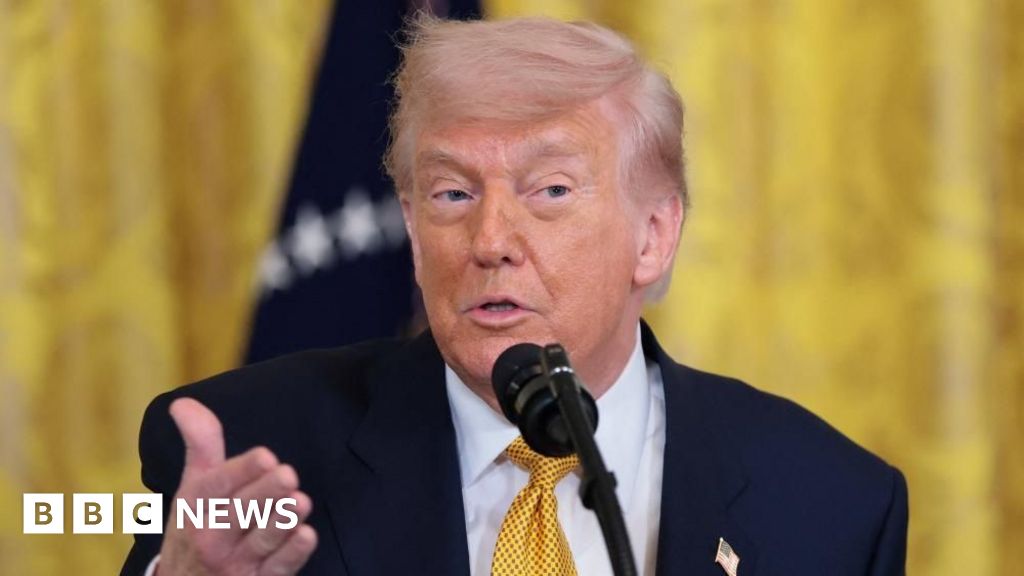
Donald Trump's pause on a short-lived "Project Freedom" to guide ships through the Strait of Hormuz, as he claimed progress had been made towards clinching a "Complete and Final Agreement" with Iran, soothed oil markets and sent hopes soaring of a breakthrough.
But expectations were soon tempered by the US president himself.
Iran said on Wednesday it was reviewing a new proposal from Washington, after US media cited unnamed American officials as saying that the two sides were closing in on a one-page memorandum to end the war in the Gulf.
A source close to mediators in Pakistan told Reuters news agency: "We will close this very soon. We are getting close."
But hours after posting on Truth Social on Tuesday evening that he was suspending Project Freedom to see whether "the Agreement can be finalized and signed", Trump abruptly changed tone.
He said on Wednesday morning that an Iran deal was a "big assumption" and if it was not agreed, bombing at "a much higher level and intensity than it was before" would resume.
The president's threat came less than 24 hours after US Secretary of State Marco Rubio said at the White House that Operation Epic Fury, the American-led military strikes on Iran, was over.
Later on Wednesday morning, Trump expressed optimism in a brief telephone call with PBS about an Iran deal, while acknowledging it had previously proven elusive.
"I felt that way before with them," he said. "So we'll see what happens."
Trump also told PBS it was "unlikely" he would send US envoys for a second round of Iran peace talks in the Pakistani capital Islamabad.
Axios and Reuters had reported that Washington and Tehran were inching closer to a one-page, 14-point memorandum to end the war.
The plan would reportedly aim to bring hostilities to a close, which would then be followed by discussions to unblock the Strait of Hormuz, lift sanctions and curb Iranian's nuclear ambitions.
But Axios also reported scepticism among some US officials about a deal and who would even approve such an agreement among the factions in Iran's leadership.
Iranian parliamentarian Ebrahim Rezaei, a spokesperson for Iran's National Security and Foreign Policy Commission, wrote on X that the 14 points reported by Axios amounted to a US "wish list".
He added that Iran "has its finger on the trigger and is ready" if the Americans did not "grant the necessary concessions".
In the US, foreign policy experts injected a note of caution, too.
"Clearly, the administration thinks a deal is possible, given the way they publicly rolled out Project Freedom only to suddenly pause it hours later," Grant Rumley, a former Middle East policy adviser to both the Biden and Trump administrations, told the BBC.
"But we have been here before, and we've seen negotiations collapse at the last minute for a variety of reasons," added Rumley, now a fellow at the Washington Institute for Near East Policy.
Trump has repeatedly suggested a deal was close since a ceasefire was announced on 7 April.
On 17 April, he told CBS that Iran had "agreed to everything" and would allow the US to remove its enriched uranium – a claim officials in Tehran rejected outright.
In the White House on Wednesday, Trump again maintained: "They want to make a deal, they want to negotiate."
"And we'll see whether or not they are agreeing," he added.
Even if a one-page memorandum was agreed upon, Rumley said that it was "highly unlikely" that it would solve all the issues, particularly given the highly technical aspects of an agreement on Iran's nuclear materials.
During the Obama administration, it took over 20 months for the finer details of a deal on Iran's nuclear programme to be ironed out.
Shipping experts said that Project Freedom, which was announced on Sunday, had a limited impact in its opening hours, with only a handful of ships passing through the strait.
Ali Vaez, Iran project director for the International Crisis Group think tank, told the BBC the Iranian response to the operation - which included shooting at ships and launching attacks on targets in the UAE - probably persuaded Trump it was "not going to solve the problem".
"There is no real policy process in this administration," he said. "The president makes decisions based on impulse more than process, therefore there are inconsistencies that happen all the time."
Mick Mulroy, a former assistant undersecretary of defence for the Middle East at the Pentagon, said any link between pausing Project Freedom and a possible peace deal remains murky.
"It's unclear if the pause in Project Freedom was because of this one-page memorandum or because the 1,500 ships currently stuck behind the [Strait of Hormuz] wouldn't transit even with the US security umbrella," he said. "Iran is likely trying to determine that as well."
Facts Only
Donald Trump paused "Project Freedom," a U.S. operation to guide ships through the Strait of Hormuz, citing progress in Iran negotiations.
Iran stated it was reviewing a new U.S. proposal, with media reports suggesting a one-page memorandum to end the Gulf conflict.
Trump later called an Iran deal a "big assumption" and threatened to resume bombing if no agreement was reached.
U.S. Secretary of State Marco Rubio announced the end of "Operation Epic Fury," the American-led military strikes on Iran.
Reports indicated a potential 14-point memorandum to end hostilities, unblock the Strait of Hormuz, lift sanctions, and address Iran's nuclear ambitions.
Iranian parliamentarian Ebrahim Rezaei dismissed the reported points as a U.S. "wish list" and warned of Iranian military readiness.
Trump claimed Iran had previously "agreed to everything," a statement Iranian officials denied.
Experts noted past negotiations had collapsed despite initial progress, citing technical and political challenges.
Shipping experts reported limited impact from Project Freedom, with few ships passing through the Strait of Hormuz.
Former U.S. officials expressed skepticism about the deal's feasibility and Iran's internal approval process.
Executive Summary
Full Take
The narrative surrounding Trump's Iran negotiations oscillates between optimism and threat, a pattern that mirrors past diplomatic cycles where progress is announced only to unravel under scrutiny. The strongest version of this story is that both sides are engaging in serious talks, with Trump pausing military operations as a gesture of goodwill. However, the rapid shift from optimism to threats—within hours—suggests a negotiation strategy built on pressure rather than consistency. This aligns with the **ARC-0024 Ambiguity** pattern, where mixed signals create uncertainty, potentially to force concessions.
The root cause of this dynamic is the long-standing U.S.-Iran adversarial relationship, where trust is minimal and domestic politics on both sides complicate diplomacy. Trump's impulsive decision-making, as noted by analysts, introduces volatility, making it difficult to distinguish between genuine progress and tactical maneuvering. The implications for human agency are significant: if negotiations fail, the cost will be borne by civilians in the region, while the benefits of a deal—economic relief, reduced conflict—remain uncertain.
Key questions emerge: What would constitute a verifiable "complete and final agreement" given past failures? How much of this is posturing versus real diplomatic progress? And if Iran's leadership is fractured, as suggested, can any deal hold?
Counterstrike scan: A coordinated influence campaign would exploit the ambiguity to either pressure Iran into concessions or rally domestic support for military action. The actual content does not fully match this pattern, as it includes genuine diplomatic reporting, but the rapid shifts in tone could be leveraged for manipulation. The healthy skepticism here lies in recognizing the pattern without overstating its intent.
Patterns detected: **ARC-0024 Ambiguity**
Sentinel — Human
The text demonstrates strong journalistic structure, relying on multiple, often conflicting, sourced claims and expert opinions to present a complex situation, indicating a human-driven analytical synthesis.