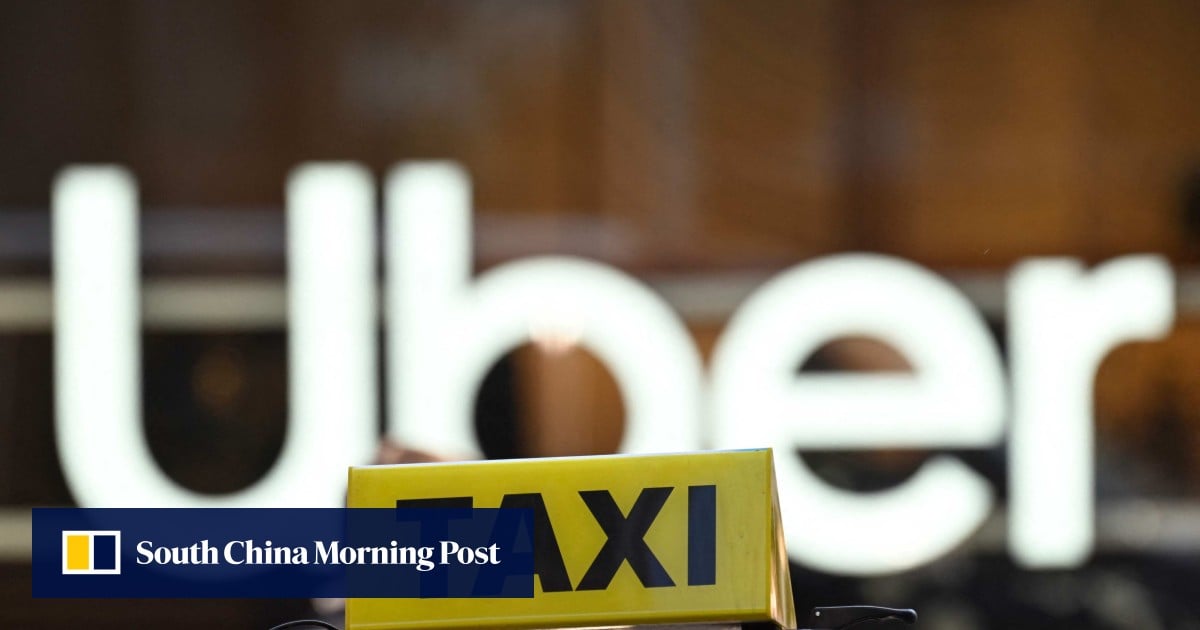
Uber to buy cab-ordering platform FlyTaxi ahead of ride-hailing regulation
Uber says acquisition of FlyTaxi part of its commitment to help grow taxi trade and provide ‘greater economic opportunities’ for drivers
In a statement on Friday, Uber said that its acquisition of FlyTaxi was part of its commitment to help grow the taxi industry and provide “greater economic opportunities” for drivers.
It also said that FlyTaxi would continue to operate as normal and that nothing would change for drivers and riders using either the app for Uber or the home-grown taxi-hailing service.
“Uber has been investing in Hong Kong’s taxi industry for well over a decade, and this acquisition partnership reinforces our deep commitment to the city,” said Estyn Chung, general manager of Uber Hong Kong.
“By combining FlyTaxi’s local expertise with Uber’s technology, we are empowering drivers to grow their businesses and continuing to give riders the exceptional experience they expect.”
FlyTaxi is a mobile taxi app that connects riders and drivers. Founded by Simon Siu, it served as one of the first online ride-hailing platforms in Hong Kong when it launched in 2013, and remains widely used across the city.
“Joining forces with Uber is a proud milestone for our company, allowing us to leverage global technology to ensure the local taxi industry continues to innovate and thrive,” Siu said of the acquisition.
Facts Only
Uber is acquiring FlyTaxi, a Hong Kong-based taxi-hailing platform.
The acquisition was announced on Friday.
FlyTaxi will continue to operate as normal post-acquisition.
Uber states that nothing will change for drivers and riders using either Uber or FlyTaxi.
Estyn Chung is the general manager of Uber Hong Kong.
FlyTaxi was founded by Simon Siu in 2013.
FlyTaxi was one of the first online ride-hailing platforms in Hong Kong.
Uber has been investing in Hong Kong’s taxi industry for over a decade.
The acquisition is described as part of Uber’s commitment to growing the taxi trade.
Simon Siu stated that joining Uber would help the local taxi industry innovate.
The deal occurs ahead of anticipated ride-hailing regulations in Hong Kong.
No financial details or regulatory approvals were disclosed in the announcement.
Executive Summary
Uber has announced its acquisition of FlyTaxi, a Hong Kong-based taxi-hailing platform, as part of its strategy to expand its presence in the city’s taxi industry. The deal, framed as a commitment to supporting local drivers and enhancing rider experiences, will see FlyTaxi continue operating independently while leveraging Uber’s global technology. FlyTaxi, founded in 2013 by Simon Siu, was one of Hong Kong’s first online ride-hailing services and remains a key player in the market. Uber’s general manager for Hong Kong, Estyn Chung, emphasized the company’s long-term investment in the city’s taxi sector, while Siu highlighted the potential for innovation through the partnership. The acquisition comes ahead of anticipated ride-hailing regulations in Hong Kong, though the specifics of these regulations and their impact on the deal remain unclear. Both companies have stated that drivers and riders will experience no immediate changes in service.
The move reflects Uber’s broader efforts to integrate traditional taxi services into its platform, a trend seen in other markets where regulatory pressures or local competition have shaped its strategy. While the acquisition is positioned as mutually beneficial, questions remain about how it will affect competition, driver earnings, and the long-term dynamics of Hong Kong’s ride-hailing ecosystem. The announcement does not disclose financial terms or regulatory approvals, leaving some operational details unresolved.
Full Take
This acquisition fits a familiar pattern in Uber’s global playbook: absorbing local competitors to dominate markets while framing the move as a boon for drivers and riders. The narrative leans heavily on collaboration and innovation, but the timing—just before new regulations—raises questions. Is this a preemptive strike to shape the regulatory environment in Uber’s favor, or a genuine effort to modernize Hong Kong’s taxi industry? The lack of financial transparency and the vague promise of "greater economic opportunities" for drivers are classic corporate ambiguities, leaving room for skepticism.
The strongest version of this story is that Uber is adapting to local conditions, recognizing that outright disruption (as seen in other markets) might not work in Hong Kong’s tightly regulated taxi sector. By partnering with an established player like FlyTaxi, Uber gains credibility and avoids direct confrontation with regulators. However, the pattern of a global giant absorbing a local innovator—while assuring "nothing will change"—echoes past cases where such deals eventually centralized control under the acquirer’s terms.
Root cause: The paradigm here is platform capitalism’s tendency to consolidate power under the guise of partnership. The unstated assumption is that Uber’s technology is inherently superior, and that integration will benefit all stakeholders—despite mixed outcomes in other markets where Uber’s entry disrupted driver earnings and labor conditions.
Implications: For drivers, the long-term impact depends on how Uber integrates FlyTaxi’s operations. Will algorithms prioritize Uber’s own drivers over FlyTaxi’s, or will the merger create a more level playing field? For riders, the immediate effect may be minimal, but reduced competition could eventually limit choices. Regulators face the challenge of ensuring fair play without stifling innovation—a balance Uber’s lobbying power may influence.
Bridge questions: What safeguards, if any, exist to prevent Uber from sidelining FlyTaxi’s drivers post-acquisition? How might this deal affect Hong Kong’s broader transportation policy, particularly for smaller operators? Would this partnership look different if Uber weren’t facing regulatory pressure?
Counterstrike scan: If this were a coordinated influence campaign, the playbook would involve framing the acquisition as a win-win for local stakeholders while downplaying potential monopolistic effects. The actual content aligns with this to some extent—emphasizing "commitment" and "innovation" without addressing power asymmetries—but stops short of outright deception. The omission of financial terms and regulatory hurdles is strategic but not necessarily malicious.
Patterns detected: ARC-0024 Ambiguity (vague promises of "economic opportunities"), ARC-0043 Motte-and-Bailey (positioning as a partner to taxis while potentially consolidating control).
Sentinel — Human
The text appears to be a direct, factual corporate statement. While the structure is highly polished, it aligns with the expected style of official press releases rather than narrative journalism, leading to low synthetic confidence.