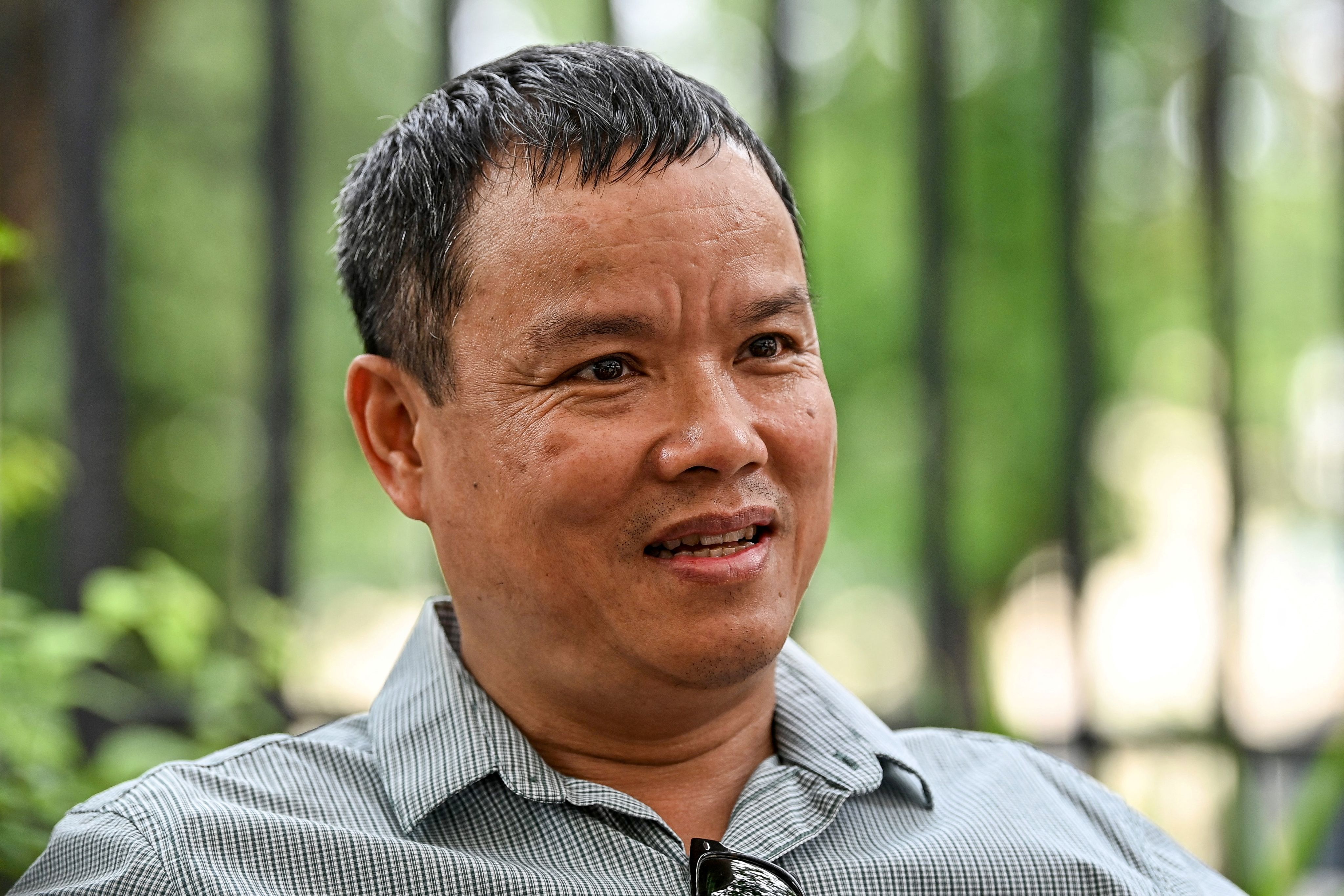
Bangkok, March 13, 2026—The Committee to Protect Journalists calls on Vietnamese authorities to immediately and unconditionally release journalist Le Anh Hung and cease harassing independent commentators for expressing critical views online.
On March 9, police arrested Hung at a friend’s house in central Dak Lak province, according to news reports and information compiled by Project 88, an independent rights group that monitors the status of Vietnamese political prisoners.
The journalist has been charged under Article 117 of the penal code, which criminalizes “propagandizing against the state” and carries penalties of up to 20 years in prison, the state-run Tuoi Tre newspaper reported.
“Vietnamese authorities must release Le Anh Hung immediately and drop all charges against him,” said Shawn Crispin, CPJ’s senior Southeast Asia representative. “Le Anh Hung never should have been imprisoned the first time, and detaining and charging him again is a gross affront to press freedom.”
Hung contributes to various independent outlets, including Thien Dan, and posts to his own blog. He also writes books, including the self-published “Power and the Control of Power in Societies.”
Hung, a former contributor to the U.S. Congress-funded Voice of America (VOA), was arrested in 2018 and held alternately in prison and a psychiatric hospital until his 2022 conviction under Article 331, which criminalizes the abuse of “democratic freedoms to infringe upon the interests of the State.”
He was released on July 5, 2023, after serving a five-year sentence under abusive conditions, according to VOA reports and the journalist’s email communications with CPJ. Radio Free Asia reported that Hung had been beaten with a metal chair, tied to a bed and forcibly injected with unspecified drugs by a nurse at a Hanoi mental hospital.
Hung is a member of the Independent Journalists Association of Vietnam, a local group that works outside the state-dominated media. Several of its members, including founder Pham Chi Dung, have been convicted and sentenced to harsh jail terms.
Vietnam’s Ministry of Public Security did not immediately reply to CPJ’s emailed request for comment.
Vietnam is among the world’s worst jailers of journalists, with 17 behind bars, according to CPJ data.
Facts Only
Le Anh Hung was arrested on March 9, 2026, in Dak Lak province, Vietnam.
He was charged under Article 117 of Vietnam’s penal code for "propagandizing against the state."
Article 117 carries a maximum penalty of 20 years in prison.
Hung was previously arrested in 2018 and convicted in 2022 under Article 331 for "abusing democratic freedoms."
He served a five-year sentence, including time in a psychiatric hospital.
Reports indicate he was beaten with a metal chair, tied to a bed, and forcibly injected with drugs.
Hung contributes to independent outlets, including Thien Dan, and maintains a personal blog.
He is a member of the Independent Journalists Association of Vietnam.
Several members of this association, including founder Pham Chi Dung, have been convicted and imprisoned.
Vietnam’s Ministry of Public Security did not respond to requests for comment.
Vietnam currently holds 17 journalists in prison, according to CPJ data.
Hung was released from his previous sentence on July 5, 2023.
Executive Summary
Journalist Le Anh Hung was arrested in Vietnam on March 9, 2026, in Dak Lak province, charged under Article 117 of the penal code for "propagandizing against the state," which carries a potential 20-year prison sentence. This is his second arrest; he was previously detained in 2018 and convicted in 2022 under Article 331 for "abusing democratic freedoms," serving five years in prison and a psychiatric hospital where he reportedly endured abuse, including beatings and forced drug injections. Hung contributes to independent outlets like Thien Dan and the U.S.-funded Voice of America, and is a member of the Independent Journalists Association of Vietnam, several of whose members have faced similar convictions. Vietnam currently holds 17 journalists in prison, ranking among the worst globally for press freedom. Authorities have not responded to requests for comment.
The case highlights Vietnam's ongoing crackdown on dissent, particularly targeting independent journalists and critics of the state. Hung's history of detention, including allegations of mistreatment in psychiatric facilities, underscores broader concerns about the use of legal and medical systems to suppress opposition. While the government frames these actions as necessary for state security, rights groups argue they violate fundamental freedoms and international press standards.
Full Take
The strongest version of this narrative frames Vietnam’s actions as a systematic erosion of press freedom, using legal and extralegal means to silence critics. The repeated detention of Le Anh Hung—despite his prior release—suggests a pattern of retaliatory justice, where dissent is criminalized under broad national security laws. The use of psychiatric hospitals as tools of coercion echoes historical abuses by authoritarian regimes, leveraging medical authority to discredit and punish opponents. Rights groups like CPJ and Project 88 provide credible documentation of these practices, reinforcing the argument that Vietnam’s legal system is weaponized against free expression.
Patterns detected: **ARC-0024 Ambiguity** (vague charges like "propagandizing against the state" enable arbitrary enforcement), **ARC-0043 Motte-and-Bailey** (state claims to uphold order while expanding repression), **ARC-0012 Authority Games** (psychiatric detention as a pseudo-scientific justification for silencing dissent).
Root cause: The paradigm here is authoritarian resilience—Vietnam’s ruling party maintains control by conflating criticism with existential threats, using law as a facade for political repression. The unstated assumption is that stability requires absolute state dominance over information, a logic that justifies preemptive silencing of voices like Hung’s. This echoes Cold War-era tactics, where dissent was pathologized or framed as foreign subversion.
Implications: For human agency, this means journalists and activists face a choice between self-censorship or severe consequences, chilling public discourse. The beneficiaries are the ruling elite, who face no accountability for abuses, while the costs are borne by civil society and the erosion of democratic norms. Second-order effects include normalized repression, where international condemnation fails to deter further crackdowns, and a brain drain as independent voices flee or are silenced.
Bridge questions: How might Vietnam’s allies or trade partners leverage economic ties to pressure for press freedom reforms? What counter-narratives exist within Vietnam that justify these arrests as necessary for stability? Would evidence of Hung’s writings inciting violence (rather than mere criticism) change the ethical calculus of his detention?
Counterstrike scan: A coordinated influence campaign would likely amplify Hung’s case as emblematic of broader repression, using emotional appeals (e.g., "tortured journalist") to mobilize outrage while omitting nuanced context about Vietnam’s geopolitical pressures. The actual content aligns with this playbook but stops short of sensationalism, relying on documented facts and multiple sources. No structural manipulation is detected—this appears to be principled advocacy, not propaganda.
Sentinel — Human
The article shows strong signs of human authorship, with specific details, emotional language, and verifiable sources that are unlikely to be AI-generated.