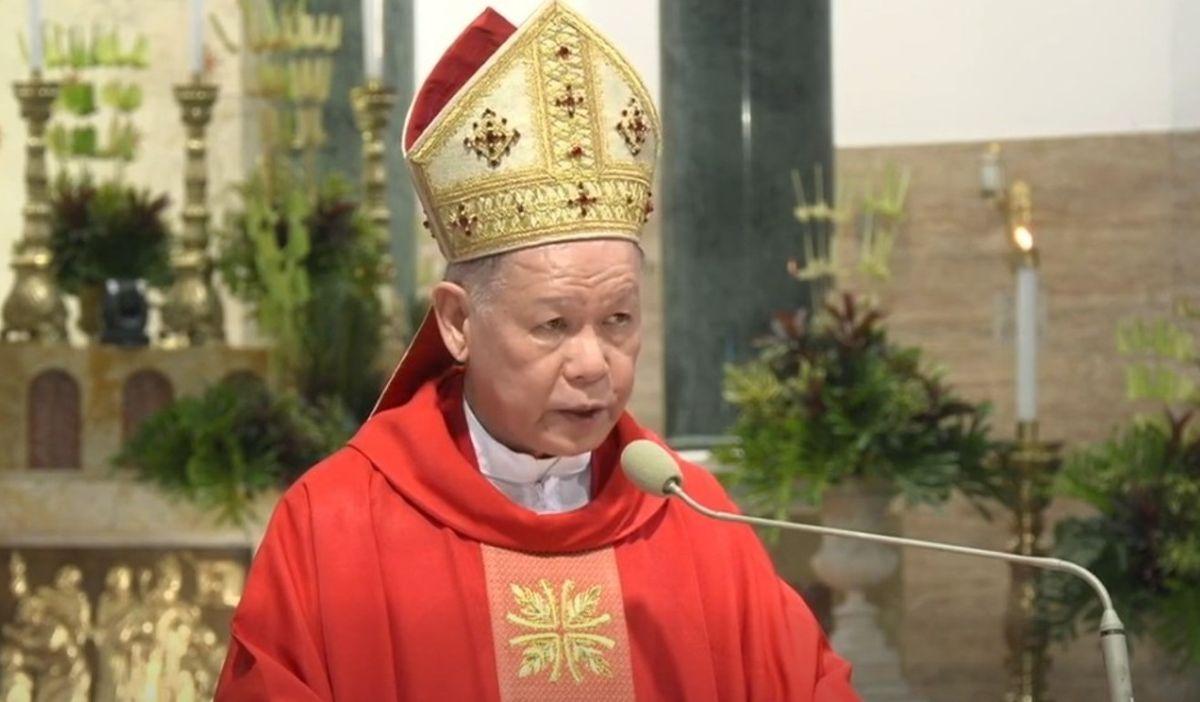
Manila Archbishop Jose Cardinal Advincula on Sunday challenged the faithful to shift their perspective on surrender, as doing so to God is a form of redemption, not defeat.
Advincula made the statement during the Palm Sunday Mass at the Manila Cathedral.
“In our world today, we are often told never to give up, to keep striving, pushing, competing, asserting ourselves. Surrender is often seen as weakness or defeat. We are taught that success comes from control and strength. But the Passion of Jesus reveals a different wisdom,” Advincula said during his homily.
“To fall into the hands of God to surrender ourselves completely to Him is not defeat. It is the beginning of redemption,” he added.
The Passion of Christ refers to the final moments of Jesus Christ, from His agony in the Garden of Gethsemane, following the Last Supper, to his death on the cross at Calvary.
Advincula said that because Jesus Christ surrendered to the Father until his death, the path to salvation was opened for the faithful.
“This is the good news hidden within the passion. God can take even the darkest moments of human life, like betrayal, injustice, suffering, abandonment, and transform them into instruments of grace,” he said.
“When we entrust our suffering to God, when we remain faithful even in trials, when we refuse to let bitterness or hatred take root in our hearts, then the grace of Christ is at work in us,” he added.
Filipino Catholics trooped to churches across the country to observe Palm Sunday, which marks the beginning of Holy Week.
Aside from the Mass, the devotees take part in the blessing of the palaspas or palm fronds, as the faithful remember Jesus Christ's triumphant entry to Jerusalem before His crucifixion.
Nurture God’s presence
This Holy Week, Catholics were also invited to visit the Church and embrace God’s presence.
Fr. Francis Gustilo, president of Don Bosco School of Theology in Parañaque City, said, compared to seeing the president, the Pope, or a celebrity, meeting Jesus is easier, as it requires no appointment.
“They're sikat. At, ito oh, Jesus Christ. With you, accessible. Anytime in a church,” Gustilo told GMA News Online.
(They are all famous, but Jesus Christ is with you, accessible anytime in a church.)
“So, we need to foster that sense of accessibility of God na naandyan na, ba't di natin siya pinapansin? Sayang naman, and we lose parang golden opportunities,” he added.
(So, we need to foster the sense of God, who is always accessible. He’s already here, yet we fail to notice Him. It’s a waste if we lose the golden opportunities.)
The Paschal Triduum or Easter Triduum refers to the last three days of Holy Week that highlight the Lenten Season, commemorating the Passion, Death, and Resurrection of Jesus Christ.
It is observed through Maundy Thursday, Good Friday, and Easter Sunday.
This year, Easter Sunday will be on April 5.
President Ferdinand Marcos Jr. on Sunday meanwhile underscored the values of compassion and service as he welcomed the observance of Holy Week.
In a message from Malacañang, Marcos said he stood in solidarity with Filipinos taking time to pause and reflect on the Passion of Christ.
“In this solemn season, we remember the immeasurable love of Jesus Christ, who offered His life in perfect obedience to the will of the Father," he said.
"The Passion of Christ reminds us that true greatness is not found in power, but in sacrifice; not in privilege, but in service; and not in comfort, but in the courage to carry the burdens of others,” Marcos added. —KG, GMA Integrated News
Facts Only
Manila Archbishop Jose Cardinal Advincula delivered a homily during Palm Sunday Mass at the Manila Cathedral.
Advincula urged Catholics to view surrender to God as redemption, not defeat.
The homily referenced the Passion of Christ, from the Garden of Gethsemane to the crucifixion at Calvary.
Advincula stated that Jesus’ surrender to the Father opened the path to salvation for the faithful.
Filipino Catholics attended Palm Sunday Masses across the country, participating in the blessing of palm fronds.
Palm Sunday marks the beginning of Holy Week, commemorating Jesus’ entry into Jerusalem.
Fr. Francis Gustilo, president of Don Bosco School of Theology, encouraged Catholics to visit churches and embrace God’s presence.
Gustilo noted that encountering Jesus requires no appointment, unlike public figures.
The Paschal Triduum includes Maundy Thursday, Good Friday, and Easter Sunday, with Easter Sunday falling on April 5 this year.
President Ferdinand Marcos Jr. issued a message emphasizing compassion and service during Holy Week.
Marcos reflected on Christ’s sacrifice as an example of obedience and selflessness.
Executive Summary
Manila Archbishop Jose Cardinal Advincula delivered a Palm Sunday homily at the Manila Cathedral, urging Catholics to reframe surrender to God as an act of redemption rather than defeat. He contrasted societal messages of relentless self-assertion with the wisdom of Christ’s Passion, emphasizing that surrender to divine will opens the path to salvation. Advincula highlighted how suffering, when entrusted to God, can become a source of grace, echoing the transformative power of Christ’s sacrifice. Meanwhile, Filipino Catholics participated in Palm Sunday traditions, including the blessing of palm fronds, marking the start of Holy Week. Fr. Francis Gustilo of Don Bosco School of Theology encouraged the faithful to embrace God’s accessibility, noting that unlike public figures, Jesus requires no appointment for encounter. The Paschal Triduum, encompassing Maundy Thursday, Good Friday, and Easter Sunday, will culminate on April 5. President Ferdinand Marcos Jr. also reflected on the season, emphasizing values of compassion and service, aligning Christ’s sacrifice with selfless action.
The narrative blends spiritual guidance with cultural observance, presenting Holy Week as a time for both personal reflection and communal devotion. While the Church’s message centers on surrender and grace, the president’s remarks frame the season in terms of societal values, suggesting a broader civic resonance beyond religious practice.
Full Take
The strongest version of this narrative presents Holy Week as a counter-cultural moment where surrender to God is reframed as an act of strength, not weakness. Cardinal Advincula’s homily effectively contrasts secular values of relentless self-assertion with the Christian paradox of redemption through sacrifice. The inclusion of President Marcos Jr.’s message adds a civic dimension, suggesting that the season’s themes of compassion and service resonate beyond religious circles. The article avoids overt manipulation, focusing instead on spiritual and communal observance.
However, the narrative leans heavily on emotional and moral appeals, which, while genuine, could be seen as a form of soft persuasion. The framing of surrender as "not defeat" is a classic reframing technique, though it aligns with theological tradition rather than manipulative intent. The emphasis on accessibility to God—"no appointment needed"—could be interpreted as a subtle critique of institutional barriers, though it’s presented as an invitation rather than an indictment.
Root cause: The narrative operates within a paradigm of religious renewal, where Holy Week serves as a corrective to modern individualism. The unstated assumption is that societal messages of competition and control have eroded spiritual values, and the Church’s role is to restore balance. This echoes historical patterns of religious institutions positioning themselves as counterweights to secular excess.
Implications: For human agency, the message is double-edged. On one hand, it empowers individuals to find meaning in suffering through faith. On the other, it risks reinforcing passive acceptance of hardship as divinely ordained. The civic angle—Marcos’ emphasis on service—could either inspire collective action or be co-opted for political messaging.
Bridge questions: How might non-religious Filipinos interpret the call to "surrender" in a secular context? Does the framing of suffering as redemptive risk normalizing systemic injustice? What would a critique of this narrative look like from a perspective that values self-reliance over divine dependence?
Counterstrike scan: A coordinated influence campaign might exploit Holy Week’s emotional weight to push a specific agenda—e.g., framing surrender as obedience to authority. However, the actual content aligns with traditional religious teaching rather than a manipulative playbook. The inclusion of multiple voices (clergy, president) adds credibility without signs of orchestration.
Patterns detected: none