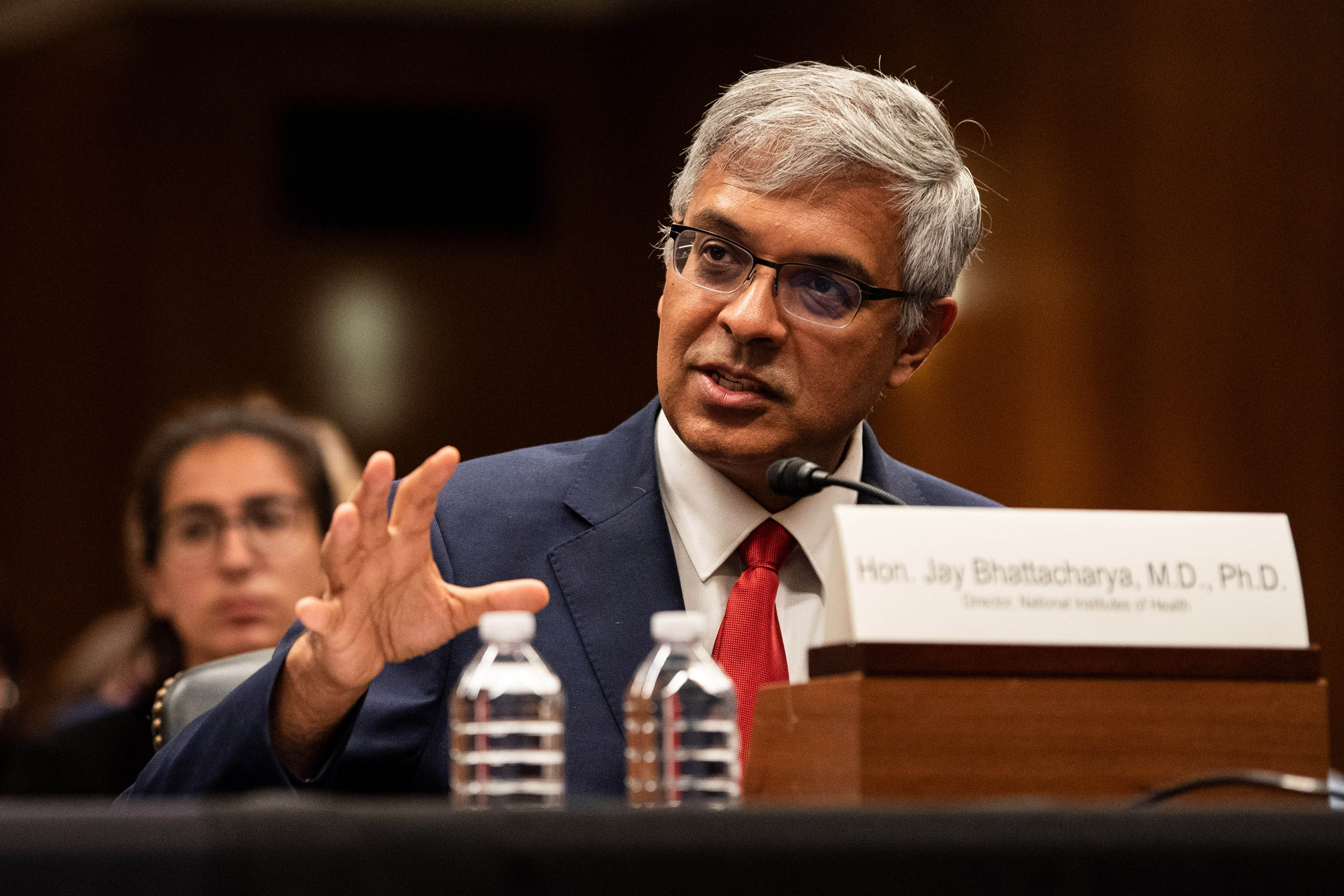
President Donald Trump will soon nominate a permanent director for the Centers for Disease Control and Prevention, its acting chief, National Institutes of Health Director Jay Bhattacharya, told agency employees at a Wednesday staff meeting.
According to a recording obtained by KFF Health News, Bhattacharya at one point suggested to CDC staff that Trump could name a new leader for the agency as soon as Thursday. “But if not, I don’t think much will change,” he said.
Though his official position as acting director was set to expire Wednesday, Bhattacharya will continue to lead the agency until the top spot is filled. Meanwhile, news outlets including Axios and The Washington Post reported that the administration was postponing filling the permanent director job amid the challenges of gaining Senate confirmation and other political pressures.
Bhattacharya opened the meeting by acknowledging the struggles the beleaguered agency has gone through over the past year. Workers faced waves of job losses, and a gunman attacked the CDC’s Atlanta campus in August, killing a police officer and causing significant property damage. “I want to acknowledge very honestly that I know that it has been such a difficult year for the CDC and for every single one of you here,” Bhattacharya said.
He said the agency has begun to fill its leadership gaps. During his first meeting with the agency’s top leaders, he said, “I noticed almost every single one of them is acting.”
“We’ve made progress in filling key roles across the agency,” he said. “Leadership stability is essential to delivering our mission.”
The aim, he said, is to leave the agency in “a solid, secure place” so it can do its work “without so much of the turmoil that we’ve seen the last year.”
Bhattacharya invited questions from the CDC staffers, who repeatedly asked about staffing losses, morale, and their job security, as well as Trump’s decision to withdraw from the World Health Organization.
“The politics of WHO withdrawal are above my pay grade,” Bhattacharya said. “What I do know is that without the CDC, the world will be in much worse health.”
Workforce Concerns
One employee told Bhattacharya the agency had lost a “huge amount” of “internal capacity and expertise in the past year” and it “continues to be very challenging for staff to do their jobs,” adding that “certain conditions are a bit demoralizing.”
The CDC can “function without leaders,” another speaker said. “We function without directors. And this entire team will make CDC run without you if you’re not here.”
Schedule F, an effort to reclassify certain federal employees in policy-related roles and reduce their civil service protections, drew some of the strongest statements from the staff. While it’s not fully implemented, the policy could make it easier for Trump to fire thousands of federal workers.
“What’s scaring the hell out of us right now is Schedule F,” an employee said. “We are terrified that ‘at will’ means you’re gone, you’re not here, you’re fired.”
“The Schedule F fight’s above my level,” Bhattacharya replied. He said his focus is on making sure the “work is supported.”
He said the agency should seek to “depoliticize what we do fundamentally” so that “every American sees us as working for their benefit.”
“When I say ‘depoliticize,’ I don’t mean you can’t say the hard or talk about the hard things,” he added. “I mean that you’re free to talk about the hard things without fear that you’re gonna be retaliated against.”
On hiring and operations, he pointed to ongoing efforts but acknowledged delays. The Department of Health and Human Services, which oversees the CDC, is “moving at the speed of bureaucracy,” he said, adding that he’s trying his best. “We have to move past the last year, and I think we now have an opportunity really to do that.”
Vaccine Policy
On vaccines, Bhattacharya said one of the first things he did in his role as acting CDC director was to record a video “strongly encouraging parents to vaccinate their kids from measles.”
He said rebuilding trust requires engagement. That means working with communities without denigrating them, and respecting how “they think and their values,” he said.
Bhattacharya said he would like the NIH and CDC to coordinate more, particularly on HIV prevention. He described his approach as “an implementation science strategy so that we can use these two pieces of the HIV tool kit to actually end the HIV pandemic.”
The search for a permanent CDC director is being led by HHS officials on behalf of the White House and Health and Human Services Secretary Robert F. Kennedy Jr.
Bhattacharya said he’s friends with Kennedy and called “the caricature of him that I’ve seen in the press” unfair. Kennedy “really does have a deep desire to make America healthy,” he said.
For now, Bhattacharya said, he expects to stay in place at the CDC, as “either acting director or acting in the capacity of the director, whatever the heck that means.”
He joked about the ambiguity: “It’s like an Office episode, you know?”
Facts Only
Actor: Jay Bhattacharya (CDC acting director), President Donald Trump, Robert F. Kennedy Jr. (Health and Human Services Secretary)
Event: Meeting with CDC employees, possible nomination of permanent CDC director, ongoing challenges at the CDC, concerns about Schedule F policy
Timeline: Wednesday (meeting), unspecified (nomination)
Location: Not specified (meeting), Atlanta (shooting at CDC campus)
Executive Summary
Full Take
The meeting between Bhattacharya and CDC employees underscores ongoing tensions and uncertainty within the agency, as well as broader political dynamics impacting its leadership. The potential nomination of a new director, delayed Senate confirmation processes, and the threat of Schedule F all contribute to an environment of instability for the CDC. Additionally, Bhattacharya's focus on rebuilding trust, engaging with communities, and coordinating more closely with the National Institutes of Health (NIH) indicates a recognition of the need for collaboration and effective communication in addressing public health issues.
Patterns detected: ARC-0043 Motte-and-Bailey, ARC-0024 Ambiguity
The article presents Bhattacharya's assurances about the CDC's future leadership without specifying a timeline or identifying the potential nominee. This creates an ambiguous situation where it appears that the agency may be stable (motte), but there are also uncertainties and potential challenges (bailey).
As for the deeper implications, the ongoing political pressures affecting the CDC's leadership could hinder its ability to effectively respond to public health crises. The focus on rebuilding trust and engaging with communities is a positive step towards addressing misinformation and mistrust surrounding vaccines and public health initiatives. However, the presence of policies like Schedule F that potentially threaten the job security of federal workers raises concerns about the long-term sustainability of these efforts.
Bridge Questions:
How will the political environment impact the search for a permanent CDC director?
What strategies could be implemented to address the challenges posed by Schedule F and ensure the job security of federal workers?
In what ways can the CDC improve its communication and collaboration with other public health organizations like the NIH?
Sentinel — Human
The article appears to be human-written, with evidence of a genuine connection between the acting director and CDC employees.