VATICAN CITY — Pope Leo XIV will celebrate the liturgies of Holy Week and the Easter Triduum for the first time as pope this week.
Palm Sunday marks the start of the one of the busiest and fullest liturgical periods of the year for the Catholic Church and the Vatican, where Leo will celebrate five Masses and preside over several other liturgies and devotions between March 29 and April 6.
Here is the Vatican’s full schedule for Holy Week and Easter 2026:
Palm Sunday
A solemn procession of cardinals and bishops carrying intricately woven palm fronds enters St. Peter’s Square during Palm Sunday celebrations in Vatican City, April 13, 2025. | Credit: Bénédicte Cedergren/EWTN News
On Sunday morning, March 29, the pope will celebrate Mass in St. Peter’s Square for Palm Sunday, also known as Passion Sunday or the Commemoration of the Lord’s entrance into Jerusalem.
The 10 a.m. Mass will begin with a grand procession of the pope with deacons, priests, bishops, cardinals, and laypeople carrying large palms.
The procession, which will wind around the square and its central obelisk, includes olive tree branches, palm fronds, and the large, weaved palms called “palmureli.” The Vatican expects to distribute 120,000 olive branches at the Mass.
Afterward, Leo will lead the Angelus prayer, as he does every Sunday.
Holy Thursday
Pope Leo will begin Holy Thursday, April 2, with the celebration of the chrism Mass at 9:30 a.m. in St. Peter’s Basilica.
Many of the cardinals, bishops, and priests living in Rome typically concelebrate this Mass, in which the pope, as bishop of Rome, blesses the oil of the sick, the oil of catechumens, and the chrism oil to be used in the diocese during the coming year.
At 5:30 p.m., Leo will celebrate the Holy Thursday Mass of the Lord’s Supper at the Basilica of St. John Lateran.
Celebrating the Mass at the cathedral church of the Diocese of Rome restores a long-standing practice that Pope Francis set aside in favor of demonstrating closeness to prisoners by offering the Mass at some of the city’s prisons.
Good Friday
Continuing the liturgies of the Triduum, Leo is scheduled to preside over a service for the passion of the Lord on Good Friday at 5 p.m. in St. Peter’s Basilica.
During this liturgy, which is not a Mass, it is the custom for the papal preacher — currently Father Roberto Pasolini, OFM Cap — to give a sermon on Christ’s crucifixion.
In the evening, the pope will lead the Stations of the Cross devotion at the Colosseum starting at 9:15 p.m.
Thousands of faithful holding candles surround the illuminated Colosseum in Rome during the traditional Stations of the Cross devotion on Good Friday, April 18, 2025. | Credit: Zofia Czubak/EWTN News
Holy Saturday
Leo will celebrate the Easter Vigil Mass at 9 p.m. in St. Peter’s Basilica.
The Easter Vigil, which takes place on Holy Saturday night, “is the greatest and most noble of all solemnities,” according to the Roman Missal.
The liturgy begins in darkness with the blessing of the new fire and the preparation of the paschal candle. At the Vatican, cardinals, bishops, and priests process through the dark basilica carrying lit candles to signify the light of Christ coming to dispel the darkness.
The pope also typically baptizes new Catholics at this Mass.
Easter Sunday
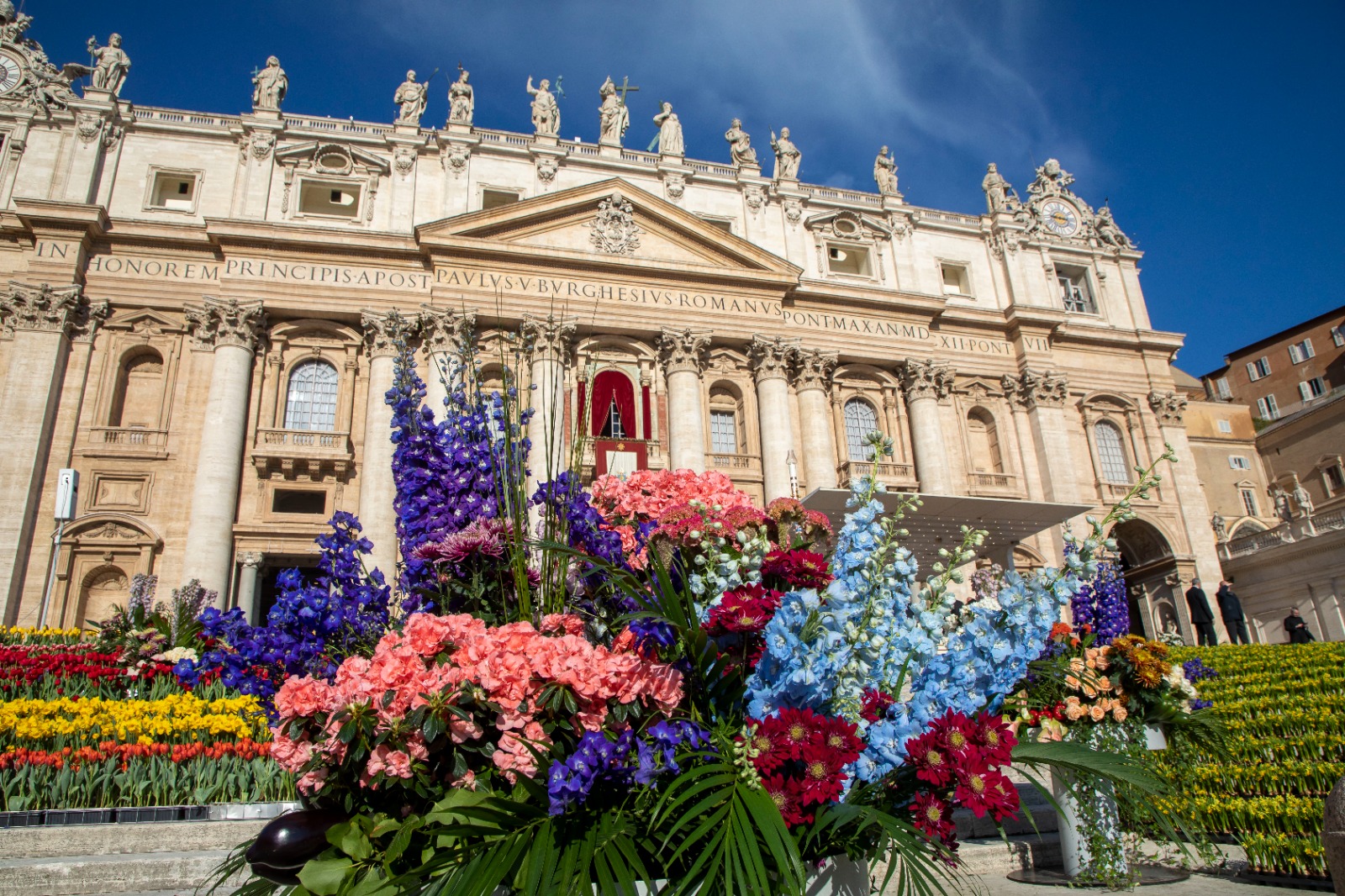
The morning of Easter Sunday, Leo will preside over Mass in St. Peter’s Square at 10:15 a.m. on a flower-decked parvise.
After Mass, he will give the annual Easter “urbi et orbi blessing” from the central balcony of St. Peter’s Basilica.
“Urbi et orbi” means “to the city [of Rome] and to the world” and is a special apostolic blessing given by the pope every year on Easter Sunday, Christmas, and other special occasions.
For Easter Sunday, the square will be decorated with thousands of flowers from the Netherlands, a custom spanning 40 years.
This year, the arrangements will include 65,000 tulip, daffodil, hyacinth, and mini daffodil bulbs; 220 white and orange violets; 7,800 roses, delphiniums, anthuriums, chrysanthemums, gerberas, and matthiolas; 600 branches of plumosa; 80 azaleas; and 600 long branches of willow catkins, long branches of eucalyptus, and various types of foliage.
Easter Monday
Pope Leo will mark Easter Monday, also called “Monday of the Angel,” by praying the Regina Caeli, a Marian prayer recited during the Easter season, at noon from a window of the Apostolic Palace.
Dutch flowers adorn St. Peter’s Square on Easter Sunday. Here’s how the 37-year tradition was saved in 2022.
Facts Only
Pope Leo XIV will celebrate Holy Week and Easter Triduum liturgies for the first time as pope from March 29 to April 6, 2026.
Palm Sunday Mass will be held in St. Peter’s Square on March 29 at 10 a.m., featuring a procession with palm fronds and olive branches.
The Vatican will distribute 120,000 olive branches during the Palm Sunday Mass.
Holy Thursday, April 2, includes a chrism Mass at 9:30 a.m. in St. Peter’s Basilica, where oils for the diocese are blessed.
The Mass of the Lord’s Supper will be celebrated at 5:30 p.m. on Holy Thursday at the Basilica of St. John Lateran.
Good Friday, April 3, features a 5 p.m. passion service in St. Peter’s Basilica and the Stations of the Cross at the Colosseum at 9:15 p.m.
The Easter Vigil Mass will be held on Holy Saturday, April 4, at 9 p.m. in St. Peter’s Basilica.
Easter Sunday Mass on April 5 will take place at 10:15 a.m. in St. Peter’s Square, followed by the "urbi et orbi" blessing.
St. Peter’s Square will be decorated with 65,000 Dutch flowers, including tulips, daffodils, and roses.
Easter Monday, April 6, will include the Regina Caeli prayer at noon from the Apostolic Palace.
The liturgical schedule marks Pope Leo XIV’s first Holy Week as pope, with events spanning St. Peter’s Square, St. Peter’s Basilica, the Colosseum, and the Basilica of St. John Lateran.
Executive Summary
Full Take
The strongest version of this narrative presents Pope Leo XIV’s Holy Week schedule as a continuation of Catholic tradition, emphasizing liturgical solemnity and symbolic continuity. The article highlights the scale of the events—massive flower displays, thousands of participants, and meticulously planned rituals—to underscore the Vatican’s role as a global spiritual center. The restoration of the Holy Thursday Mass at St. John Lateran, a practice Pope Francis had altered, subtly signals Leo’s approach to papal leadership, blending reverence for tradition with pastoral presence.
Pattern scan: The framing leans toward institutional reverence, but it avoids overt emotional manipulation or distortion. The focus on numbers (e.g., 120,000 olive branches, 65,000 flowers) serves to amplify the grandeur of the events, a common technique in institutional storytelling to reinforce authority and legitimacy. However, the article does not employ strawmanning, false binaries, or other manipulative tactics. It presents facts neutrally, though the selection of details (e.g., the "long-standing practice" restored by Leo) may implicitly contrast his style with Francis’s, inviting readers to infer a shift in papal priorities.
Root cause: The narrative assumes the inherent significance of these rituals, both for the faithful and as a display of the Vatican’s cultural and spiritual influence. The unstated assumption is that liturgical continuity and spectacle are inherently valuable, reinforcing the Church’s role as a stabilizing force in a changing world. Historically, papal Holy Week ceremonies have served dual purposes: spiritual devotion and public demonstration of the Church’s enduring power.
Implications: For Catholic believers, these events reaffirm identity and belonging. For the Vatican, they project soft power, using symbolism and tradition to maintain relevance. The economic and logistical costs (e.g., flower imports, security, coordination) are borne by the institution and its partners, while the benefits—spiritual, diplomatic, and cultural—accrue to the Church’s global standing. Second-order effects might include tourism revenue for Rome or renewed debates about the Church’s role in modern society.
Bridge questions: How might Pope Leo XIV’s approach to liturgy differ from his predecessors in ways not yet visible? What tensions exist between tradition and adaptation in the Church’s public ceremonies? How do these events serve both the faithful and the Vatican’s broader geopolitical interests?
Counterstrike scan: If this were part of an influence campaign, the playbook would emphasize the Vatican’s unbroken tradition and global reach, using awe-inspiring imagery and numbers to bolster institutional credibility. The actual content aligns with this pattern but does so transparently, without deception or coercion. The focus on continuity and scale is expected for such reporting and does not suggest manipulation.