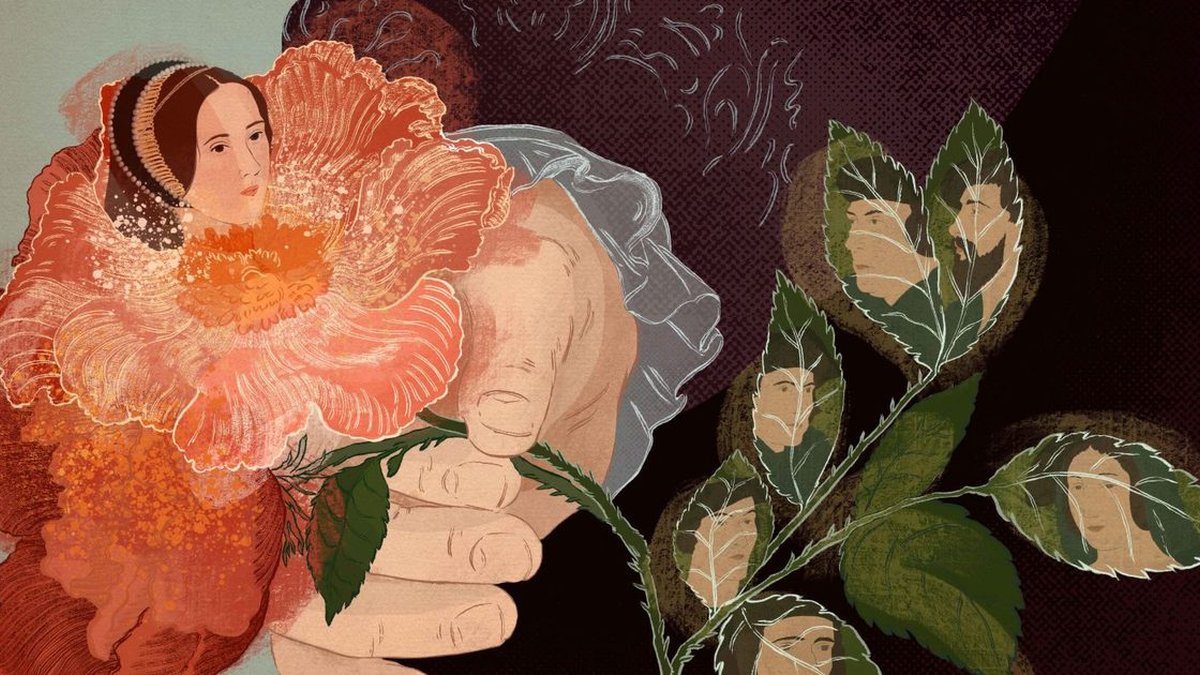
The cultured charmer, the moneybags lord mayor, the powerful heiress, the scheming uncle. Anne’s colourful family shaped the mind and character of the future queen of England, as Tracy Borman reveals
Anne Boleyn is one of the most famous women in history. Her story has been told countless times since her tragic demise almost 500 years ago. So determined was Henry VIII to make her his queen that he wrenched England away from Roman Catholic Europe and set in train a sweeping reformation that shaped the course of British history. But when Anne failed to give him a son, he had her executed on trumped-up charges of adultery and treason in 1536.
So far, so familiar. But though Anne’s turbulent relationship with England’s most-married monarch has been pored over for centuries, her backstory is relatively unknown. What – or, more precisely, who – made her into a woman so extraordinarily captivating that she held a king in thrall for seven long years and turned his entire kingdom upside down?
Humble roots
Though they rose to become one of the most powerful families in Tudor England, the Boleyns could boast neither royal blood nor aristocratic pedigree. They were likely of northern French descent, among numerous Norman families to settle in England after the conquest of 1066. The first known reference to the family is found in the deed for a small plot of land close to Norwich in 1188. The Boleyns remained in Norfolk for the next three centuries, where they made their living from the wool trade.
It was Geoffrey Boleyn (1406–63), Anne’s great-grandfather, who put the family on the map. He made a small fortune from his work as a hatter, and was appointed Master of the Worshipful Company of Mercers. By 1451, he was so wealthy that he loaned Henry VI money for an expedition to France. Six years later, he was elected Lord Mayor of London. To signal his prestige, Geoffrey purchased several properties, including the manors of Blickling in north Norfolk and Hever in Kent.
Geoffrey’s son William propelled the Boleyns into royal circles when he entered the service of Richard III, who made him a knight of the Bath at his coronation in 1483. William also made an advantageous marriage to Margaret Butler, daughter and co-heiress of the seventh Earl of Ormond, a prominent Irish nobleman.
With a deftness that characterised the Boleyns’ rise to power, when Richard III was defeated by Henry Tudor at the battle of Bosworth in 1485, William declared his allegiance to the new king.
- Read more | What did Elizabeth I really think about Anne Boleyn? These secret symbols might unlock the truth
William also invested heavily in the education of his eldest son and heir, Thomas. Aged about eight when Henry VII took the throne, Thomas grew into a charming and cultured young man who soon won favour at court. Upon the death of his father in 1505, he became the head of the family and led the Boleyns to the apogee of their power. At Henry VIII’s accession in 1509, he was created a Knight of the Garter and an esquire of the new king’s privy chamber.
By then, Thomas was married with a growing family. Like his father, he had chosen a high-ranking bride. Elizabeth Howard was the eldest daughter of Thomas Howard, later the 2nd Duke of Norfolk, and was appointed to serve Catherine of Aragon, the widow of Prince Arthur, whom Henry had married soon after becoming king. “She brought me every year a child,” Thomas said of Elizabeth, though only three survived to adulthood: Mary, Anne and George.
Two small brass crosses mark the burial places of Henry and Thomas Boleyn (junior) – one in the church next to Hever, the other close to Penshurst Place, the seat of Thomas Boleyn’s rival Edward Stafford, 3rd Duke of Buckingham. (It’s thought that Thomas Jr may have been sent to Penshurst to receive an education.) There is no other record of the two boys or of Anne’s relationship with her lost brothers, assuming she knew them at all. The size of the crosses suggests that they died in their infancy – a reminder of the fragility of life in Tudor England.
The Boleyn children were raised at Blickling Hall and Hever Castle, though the latter soon became the principal family seat. Judging from the date of his first appearance at court around 1514, George seems to have been the youngest, and Mary was later referred to as the elder of the two daughters, though their birth dates are unclear.
- Read more | Five shocking tales from Britain’s royal palaces
It is also not clear how much time Anne spent with her mother, but they are thought to have been close. Elizabeth would have superintended her children’s early education, juggling that with her service at court. There was a rumour that Elizabeth was briefly the mistress of Henry VIII, but this is not substantiated by any reliable evidence, and Henry himself later denied it, exclaiming: “Never with the mother!”
From a young age, Anne and Mary were schooled in the accomplishments expected of young women at the time, including music and dancing, embroidery and religion. They were also taught literature and languages – the latter being something in which Anne excelled. Her father proudly noted that she was exceptionally “toward”.
Thomas played an important role in Anne’s education, and his humanist beliefs may have influenced her curriculum. He was a progressive thinker and espoused the emerging fashion for educating daughters, not just sons, as famously advocated by
his fellow courtiers Thomas More and Thomas Cromwell.
Dazzling opportunity
In 1513, when Anne was probably around 12 years old, her father secured her a dazzling opportunity. She was sent to the palace of Mechelen in Brabant (a region now spanning parts of Belgium and the Netherlands) to join the court of Margaret of Austria, Regent of the Netherlands.
It was an education like no other, and profoundly shaped Anne’s outlook, accomplishments and intellect. Her new mistress was a woman who wielded real power in a male-dominated world. Years later, when a queen-in-waiting, Anne remodelled York Place in London on Margaret’s palace at Mechelen, creating the Palace of Whitehall.
Anne remained in close contact with the household at Hever throughout her years abroad. A letter she wrote to her father in around 1514 still survives. As well as showing off her new mastery of French, she assured Thomas that absence had made her heart grow fonder: “I promise you that my love is based on such great strength that it will never grow less.”
Anne’s courtly training continued when her father arranged for her to serve in the French court with her sister. While Mary enjoyed the glittering social life and is rumoured to have become a mistress of King Francis I, Anne preferred the company of his sister, Marguerite of Navarre. An intellectual powerhouse, Marguerite argued for the reform of the Catholic church and was a fierce advocate for female authority. The teenaged Anne soaked all this up like a sponge. By the time she left France in 1521, she was a changed young woman.
Back at Hever, another Margaret exerted a profound influence on Anne: her paternal grandmother, Lady Margaret Butler. Hers was one of the most powerful noble families in Ireland, and Margaret inherited considerable estates upon the death of her father, the 7th Earl of Ormond, in 1515. She was thus a rare example of a wealthy and independent woman in an age dominated by men.
Four years after coming into her inheritance, though, Margaret was suddenly declared insane and deprived of her lands. Whether she really was suffering from a mental illness (or, perhaps, dementia – by then she was aged about 65) is uncertain. Either way, it served as a salutary reminder to Anne of just how precarious a woman’s position could be.
Anne was also influenced by her elder sister, Mary – albeit as an example of what not to do. Returning from France some time before Anne, Mary took up a position in the household of Catherine of Aragon. In 1520, she married William Carey, a gentleman of Henry VIII’s privy chamber, but around that time she almost certainly began an affair with the king. It isn’t clear how long their liaison lasted, but Henry was rumoured to have been the father of at least one of Mary’s children. He neither acknowledged this nor made any provision for Mary once their affair ended. She was simply discarded, her reputation in ruins. It was a lesson Anne never forgot.
A shock proposal
Anne made her debut at the English court early in 1522, after her father secured her a place in Queen Catherine’s household. This exotic arrival from the French court was soon the talk of London. Her intellect, accomplishments and style made the other ladies of Henry’s court appear positively pedestrian. She danced and sang better than any of them and, though not conventionally beautiful, her charisma and self-confidence quickly attracted a legion of male admirers.
Anne’s self-serving uncle Thomas Howard, later Duke of Norfolk, tried to engineer a marriage with James Butler, her cousin and heir to the Earl of Ormond, which prompted the first in a series of clashes with his niece. Norfolk later ranted that Anne would be “the ruin of her whole family”. When it came to the Boleyns, blood wasn’t always thicker than water.
At least initially, the king himself appeared immune to Anne’s charms, and it was not until 1526 that he declared his interest in her. It was at this time that Hever Castle became Anne’s refuge. Contrary to the popular image of her father as a grasping courtier who pushed her into the king’s path to further his own ambitions, the evidence suggests that Thomas tried to protect Anne from Henry’s advances. Whenever his royal master became too overbearing, he arranged for his younger daughter to seek sanctuary at the family home. But the more Anne retreated to Hever, the more determinedly Henry pursued her.
When Anne went to stay at Hever for Christmas in 1526, she received a letter from the king. It was very different to his usual billets-doux: astonishingly, he proposed marriage. This must have sent shockwaves through the castle. Henry already had a wife – one who was greatly revered throughout England. But he claimed that his marriage to Catherine was unlawful and had been cursed by God, as evidenced by the fact that they had no living son.
Henry spent the next seven years trying to convince Pope Clement VII to grant an annulment of his marriage. For much of this time, Anne flitted between the court and Hever. She was attended by both her mother and her sister-in-law, Jane, who married George Boleyn around 1524. By contrast, Anne saw little of her sister, Mary, and later banished her from court for marrying William Stafford, a lowly soldier, claiming that it had brought disgrace on the Boleyns.
At home at Hever
The Boleyn family's manor has its own rich tale
Source of solace
George was a constant source of solace and companionship to Anne. Like his father, he was a favourite of the king and rose rapidly through the ranks once his sister had caught Henry’s eye. George shared Anne’s reformist views, and they both imported radical religious texts from abroad that might have had them condemned as heretics.
Supported by her brother, Anne brought her influence to bear on Henry, persuading him that a king should be subject to no authority but God’s – a view that made the pope an irrelevance. Henry had the justification he needed to break with Rome and push through the annulment. In January 1533, he married Anne in a secret ceremony at Whitehall. Eustace Chapuys, ambassador to England from the Holy Roman Empire and a prolific letter-writer, claimed that both her parents were in attendance.
Anne’s coronation on 1 June 1533 was – literally – the crowning glory of the Boleyns’ meteoric rise. But it was not long before cracks began to appear in her marriage. Things went from bad to worse in September 1533 when Anne gave birth to a daughter, the future Elizabeth I, rather than the hoped-for son. Over the following two and a half years she suffered a series of miscarriages, the last of them in January 1536. By then, her relationship with Henry had deteriorated so badly that he was seen to “shrink from her” in private.
End of the line
The end came in May that year, when Anne was arrested on trumped-up charges of adultery. Among her five alleged lovers was her brother George. The siblings were swiftly condemned and executed.
Their grief-stricken parents left court immediately. Elizabeth Boleyn died in the London home of Hugh Faringdon, Abbot of Reading, in April 1538. Her husband, Thomas, retreated to Hever, where he lived out his days in obscurity. He returned briefly to court in October 1537 to attend the christening of Henry VIII’s “precious jewel”, Prince Edward, born to the king’s third wife, Jane Seymour, who had replaced Anne. Thomas died at Hever in March 1539, shortly followed by his by then elderly mother, Margaret.
Anne’s former sister-in-law, Jane, who has traditionally – and unjustly – been blamed for testifying against her, went on to serve three more of Henry VIII’s wives. She was executed in February 1542 for aiding and abetting the adulterous liaisons of Catherine Howard, Henry’s fifth wife.
The last of the Boleyns to survive was Anne’s sister Mary. Scant evidence for her life after 1534 survives, but the fact that her father bequeathed her some lands at Hever suggests that they were reconciled before his death. Mary died in July 1543, probably at her marital home, Rochford Hall in Essex.
Yet the family’s fortune would rise again, phoenix-like, from the ashes. Against all odds, Anne’s daughter Elizabeth became the longest-reigning and most successful of the Tudors. And the Boleyn bloodline endures even today, as King Charles III is a direct descendant of Mary Boleyn.
This article was first published in the July 2026 issue of HistoryExtra Magazine
Authors
Tracy Borman is a best-selling author and historian, specialising in the Tudor period. She works part-time as joint Chief Curator of Historic Royal Palaces and as Chief Executive of the Heritage Education Trust.