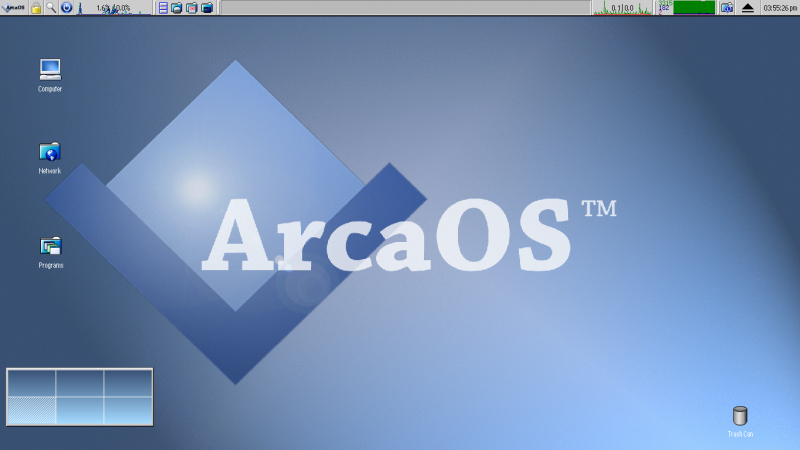
ArcaOS is an operating system you might not have heard of, but you will recognize it when we tell you that it’s the direct descendant of IBM’s OS/2. It’s just received a major update, and delivers this persuasive argument for its uptake:
“How about a commercial operating system which doesn’t spy on you, does not report your online activity to anyone, and gives you complete freedom to choose the applications you want to use, however you want to use them?”
We’re guessing that a higher-than-average number of Hackaday readers use open-source operating systems, but in a world in which the commercial OS everyone loves to hate is ever more turning the Play button into the Pay button, we have to admit that’s attractive if you pay for your software.
This update, version 5.1.2, brings support for the very latest UEFI systems to the table, keeping the platform alive in a manner we’d never have guessed would happen back in the 1990s. It’s true it’s a 32-bit system rather than 64-bit, and you’d be unlikely to buy it for your high-end gaming machine, but we remember OS/2 Warp back in the day as being very nice indeed and particularly stable. We’re interested enough to have put in a cheeky request for a review ISO, so should that come off we’d love to give it the Jenny’s Daily Drivers treatment.
ArcaOS has been mentioned here before. Do any of our readers encounter it in your daily lives? We’d love to hear in the comments.
How about a commercial operating system which just lets me get day to day tasks done, without having to spend afternoons reading through artistic screeching of artists arguing on forums whether some kernel wankery is better if done through
balls
ornutsack
module; or distro-hopping every few months? FFS I just want to print a single-page document or use a mouse, not study Silberschatz’s book again.ROFL
Doesn’t even have to be commercial though. Ubuntu or Fedora will enable you to do pretty much anything, right outside the box, without ever reading a manual except for learning how to use the package manager. I’ve never understood the distro-hopping people can get on.
Given the thread topic, by default right out of the box, Ubuntu reports your usage back to Canonical.
and no, you can not turn it off without first A) knowing it does this, and B) looking up how to turn it off. aka reading a manual.
Also, ever since red hat obtained ownership over Fedora, are you absolutely sure it doesn’t spy on you too just like red hat does? I am not absolutely sure.
Might as well stick with windows. At least your exe’s are somewhat more likely to run.
“Reporting usage” is dishonest. The data collected includes hardware details (CPU, RAM, GPU), OS version, desktop environment, and BIOS information. This data is not supposed to contain personal identification, and all reports can be reviewed locally in ~/.cache/ubuntu-report/ before or after they are sent.
That seems like the type of information they could collect once during the installation, ask (again, during installation) if you want to share it, and then never report anything ever again.
But I bet it doesn’t do it that way, and that should make us all wonder why not…
As far as data collection goes, and because they have no commercial purposes, they must be amongst the least worse of all OSes. Gentoo provides one with even more control on which software to accept according to their license (you can block all proprietary software/firmware) but it also needs a lot of reading to use correctly and not break things.
It’s a nerd thing. Some people really geek out about os’s. Some people are looking for community so they jump on trends, or need to reinforce their status in a community.
If you are happy with what you have then you have succeeded. I’m a fan of the two you mentioned for normal computer stuff. I also like popos for computers with big gpus. Makes the set up process really easy. Even though I don’t care as much for popos otherwise. I’ve lost days of my life to dealing with Nvidia/Linux drivers after updates. Not worth it anymore. Centos/rhel/rocky for servers are probably my top choices as well.
To me technologies are tools to accomplish goals. I’m not much of a cultist, or philosophical purist, but there are a few that I just like more than others.
I share your pragmatical point of view entirely. I understand if people want to have fun with different distros, that’s a perfectly fine hobby. However if you want to get work done, it’s also fine to stick to something that just functions flawlessly. I used to have fun with gentoo, but driver updates got in the way of the fun. I’m entirely satisfied with either Fedora or Ubuntu.
I use two different distros on a variety of computers (Arch and Debian) both have been incredibly stable. Never really distro hopped. Sounds like PEBKAC
Great comment! Thanks for the chuckle
there are those of us which find the windows problem unacceptable and linux untenable. of course the problem with a third option is that i know linux better than it. granted now is the perfect timing for third options.
32bit is a hard pill to swallow. Otherwise I completely agree. Also from a cyber security standpoint, some diversity will not hurt.
$139 for a personal edition license.
Looks like XP and Snow Leopard had a bastard lovechild.
+1
“How about a commercial operating system which doesn’t spy on you, does not report your online activity to anyone, and gives you complete freedom to choose the applications you want to use, however you want to use them?”
How about Linux?
Choices. The name of the game. I choose Linux. PI OS for my RPIs and KUbuntu for my servers, laptops, and desktops. Some prefer lock-in like M$ OSs or Apple. Maybe gives those users warm and fuzzies, I don’t know… but at least there is an OS out there for everyone’s need/want. ArcaOs my be the dream of someone else. I liked OS/2 in it’s day. Never caught on with the company I worked for at the time even though we tested it with our software. Face it, I liked VMS, CP/M, DOS, and even Windows back then. But then Linux came along and it pulled the right strings. Plus my pocketbook stopped bleeding… Anyway, choice is good. And in the Linux world we have plenty whether it is a distro or DE or tools. And rock solid. It’s great… for me.
I thought they took away OS/2 because we demonstrated we could not have nice things.
Facts Only
ArcaOS is a commercial operating system based on IBM’s OS/2.
Version 5.1.2 has been released, adding support for UEFI systems.
ArcaOS markets itself as a privacy-focused OS with no user activity reporting.
The system is 32-bit, not 64-bit.
The personal edition license costs $139.
Ubuntu and Fedora are mentioned as alternatives, with Ubuntu collecting hardware and usage data by default.
Some users express frustration with Linux distro-hopping and driver issues.
Others defend Linux for its stability and customization options.
The article references historical OS preferences, including VMS, CP/M, DOS, and Windows.
ArcaOS is compared to Windows XP and macOS Snow Leopard in appearance.
The discussion includes concerns about data collection in both commercial and open-source OSes.
Some users argue for OS diversity as a cybersecurity benefit.
Executive Summary
Full Take
The strongest version of this narrative frames ArcaOS as a viable alternative for users disillusioned with mainstream OSes’ privacy intrusions and complexity. It appeals to those who value stability, control, and a commercial product without surveillance—qualities increasingly rare in today’s tech landscape. The discussion also highlights a broader tension: the trade-off between convenience (e.g., Windows, macOS) and autonomy (e.g., Linux, ArcaOS). However, the 32-bit limitation raises questions about long-term viability, and the $139 price tag may deter casual users.
Patterns detected: ARC-0024 Ambiguity (vague claims about "spying" without clear definitions), ARC-0043 Motte-and-Bailey (shifting between "privacy" as a broad ideal and specific technical limitations).
Root cause: The narrative taps into growing skepticism about data collection and corporate control over computing. It assumes users prioritize privacy over performance or ecosystem integration, a perspective shaped by historical OS battles (e.g., OS/2 vs. Windows) and modern debates about open-source ethics.
Implications: For users, ArcaOS offers a niche but principled choice, though its 32-bit architecture may limit adoption. For the tech ecosystem, it underscores demand for diversity beyond the Linux/Windows/macOS triopoly. Second-order consequences could include renewed interest in legacy systems or pressure on mainstream OSes to improve privacy practices.
Bridge questions: What would it take for a 32-bit OS to remain relevant in a 64-bit world? How do we balance privacy with the practical need for software compatibility? What role should commercial OSes play in an open-source-dominated landscape?
Counterstrike scan: A coordinated influence campaign might exaggerate ArcaOS’s capabilities while downplaying its limitations (e.g., 32-bit constraints) to undermine trust in mainstream OSes. However, the article’s balanced critique—acknowledging both strengths and weaknesses—does not align with such a pattern. The discussion remains organic, reflecting genuine user concerns rather than manipulation.
Sentinel — Human
The article exhibits strong human stylistic markers, including humor, emotional tone, and idiosyncratic phrasing, with no significant indicators of synthetic generation.