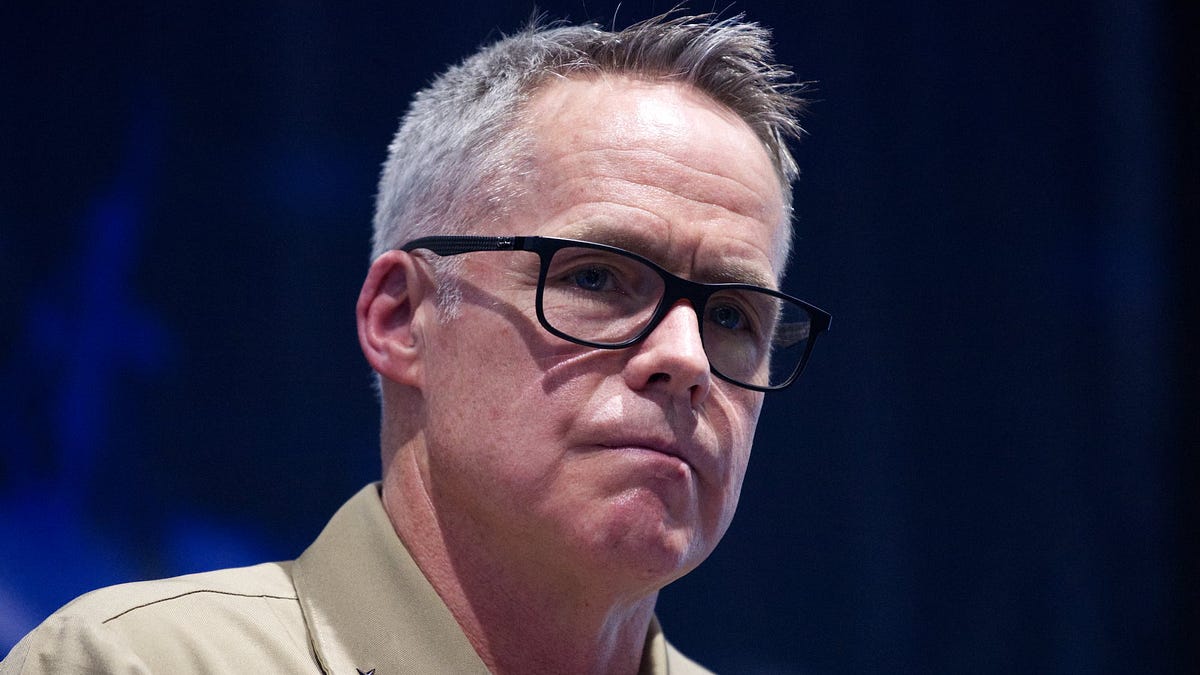
As the Iran war rages, Brookes warily eyes China’s rush to build ICBM-armed submarines that can strike the U.S. with impunity
“I want each of our adversaries to wake up every morning, calculate the risk, and decide that today is not the day to pick a fight with the most powerful Navy in the world, the U.S. Navy,” Rear Admiral Mike Brookes, the head of U.S. Naval Intelligence, said at a conference two years ago.
On March 4, an Iranian frigate sailing in international waters, far from the Persian Gulf strife, didn’t “pick a fight” with the U.S. Navy but it got sunk anyway. The 300-foot-long IRIS Dena, the largest remaining warship in the Iranian fleet—but reportedly lightly or completely unarmed having just attended a multinational exercise with the Indian fleet—was sailing peacefully 20 miles south of Sri Lanka, about 2,200 miles from the Persian Gulf, when a single torpedo from the nuclear-powered USS Charlotte fast attack sub quickly took her down. Only 32 members from the crew of 130 survived. Some critics argued the Navy should have first offered the captain and crew an opportunity to defect.
In any event, Brookes probably had little to do with the attack. His office, tasked with keeping track of adversary vessels, may well have located the IRIS Dena for the White House and Pentagon, but U.S. spy satellites undoubtedly would have been looking for her, too. The order to shoot would have originated with Defense Secretary Pete Hegseth. The vessel, he crowed afterward, “thought it was safe in international waters,” but instead “died a quiet death.” His celebration appears premature, now that Iran has effectively choked off the Strait of Hormuz, a prospect analysts had warned about for years. The mighty U.S. Navy has not taken steps to escort oil tankers through the narrow waters, despite President Trump’s promises.
Whatever the ethics and point of the IRIS Dena’s sinking, meanwhile, some observers said it sent a message to China, which gets 92 per cent of its oil by sea, according to a May 2025 report from the U.S. Energy Information Administration. “Ultimately, the Indian Ocean is emerging as a critical arena in great-power competition, where U.S. naval power threatens China’s energy lifelines even as China expands its regional footprint and hedges with continental alternatives,” the Asia Times noted last week.
Until the runup to the Iran war, when determining the disposition of the Islamic Republic’s ships was the ONI’s immediate task, China was at the top of Brookes’s concerns.
While Russia remains the greatest threat to the United States in the undersea domain, he told attendees at an advanced electronics arms conference in 2024, “the U.S. Navy spends a lot of time thinking about and preparing to defeat aggression from the PRC [People’s Republic of China]. If a conflict occurs, it will be a maritime fight.”
But even as U.S.and Israeli warplanes and missiles were pounding Iran, a statement about China that Brookes had prepared earlier for a hearing surfaced, adding heat to his warnings amid the burgeoning Persian Gulf conflict.
The Chinese Navy has “dramatically increased” production and could soon strike “large portions” of the United States from closer to home, Brookes wrote in a statement to the U.S.-China Economic and Security Review Commission. “These submarines will incorporate substantial advancements in nuclear reactor design, sensor performance, weapons integration, and noise quieting technologies,” Brookes said, referring to two new Chinese submarines, the Type 095 and Type 096. He warned that the Type 096 “will be able to target large portions of the U.S. from protected waters” near China’s coast. By 2040, he said, China’s navy could challenge American supremacy.
When he’s not worrying about Russia, China and Iran, Brookes and his charges are on their toes for sunken warheads and downed pilots. And looking at UFOs.
That’s right. Brookes’s ONI is the current home to the Pentagon’s UFO investigations unit, named the “Unidentified Aerial Phenomenon Task Force,” responsible for coordinating the office’s work with the wider intelligence community. That has to be the fun part of the job.
Government Issue
Brookes says he joined the Navy for “the adventure and the opportunity to travel,” but the fact is he was a Navy brat, the son of a career Navy officer, with a seagoing career almost foreordained. He grew up in San Diego, principal home to the Pacific Fleet. He graduated from Cal Poly in 1987 with a degree in political science, got his ensign’s gold bar two years later at the Navy Officer Candidate School in Newport, R.I. and then crossed back to California for a masters in National Security Affairs from the Naval Postgraduate School in Monterey.
Right from the get-go, he was on an intelligence path. His official biography shows assignments as an imagery intelligence officer for a fighter squadron on the USS Nimitz carrier, an assistant intelligence officer for a cruiser-destroyer group, as assistant chief of staff for intelligence aboard the USS Ronald Reagan, and deputy director of intelligence for the Joint Special Operations Command, where he deployed to Bagram, Afghanistan as director of intelligence for a joint special operations task force. And so on and so forth, steadily up the ladder.
He’s run the Kennedy Irregular Warfare Center, in Suitland, Md., just outside Washington, D.C., which trains the intelligence operators supporting Navy expeditionary forces, like the SEALs. He has served as director of intelligence at the U.S. Strategic Command and U.S. Southern Command. Along the way he picked up medals—a Defense Superior Service Medal, and a Legion of Merit, awarded for “exceptionally meritorious conduct in the performance of outstanding services and achievements.”
Today, from ONI’s Suitland headquarters at the National Maritime Intelligence-Integration Office, which he also heads, some 3,000 people keep watch on all the world’s oceans, providing maritime intelligence for policy makers, military planners and operational commanders. Simply stated, its mission is to have “an effective understanding of the maritime domain.”
That’s something President Trump evidently brushed aside when he attacked Iran.
Rough Seas
Over its long history the ONI has had its share of bad publicity. In 2014, ONI was tarred by scandal when its then-director, Vice Admiral Ted “Twig” Branch, was suspected of leaking classified information to the 350-pound Malaysian defense contractor known as “Fat Leonard” (real name: Leonard Glenn Francis).
“In the end, federal agents found no evidence that Branch and [another admiral, Bruce] Loveless gave away classified information…,” wrote Washington Post investigative reporter Craig Whitlock. “But the investigation into the two admirals and their connections to Francis paralyzed the Office of Naval Intelligence for years and left lasting scars at the highest levels of the Pentagon.”
We don’t know if Brookes has solved the “paralysis” that gripped the ONI in the wake of the Fat Leonard scandal. But ONI has stayed out of the news since then.
Brookes, by most appearance a genial, intellectually minded boss, has run ONI with rigor and foresight.
On his LinkedIn page, he says he “[b]lends traditional intelligence principles with innovative technology to enhance awareness and collaboration, improve accessibility, and better inform decision making.” That’s all that concerned Americans are asking of their military leaders these days. ###
And meanwhile, Iran is busy mining the Strait of Hormuz while the only four minesweepers we have just arrived on the East Coast to be decommissioned. Their so-called replacement, the Littoral Combat ship is almost useless. There aren't very many and they're supposed to be modular. If it's off doing one of its many other missions, it's not sweeping for mines. 🤦♂️
The Navy needs to get its shit together for the 21st Century and the possibility of having to face a strong, resurgent China.
Absent from Admiral Brookes' stellar career is experience in human intelligence aka humint, a military invention that used to be unknown in the CIA. Two CIA directors came from the Navy, William Raborn (April 1965-June 1966) and Stansfield Turner (March 1977-January 1981). Raborn simply was not up to the job. Turner was a technical man who saw little value in humint, the collection of information on what our enemies (and some friends, too) are thinking. Leaders in the U.S. intelligence community, William Colby in particular, were genuinely afraid that Turner would neglect humint in favor of technical collection and so made an effort, quietly, to educate Turner in the values of humint. Fortunately, Turner was a willing student, and he turned out to be a better CIA head than many expected. Still, I hope Brookes is not a future CIA chief. He has too much to learn at the same time as he tries to pick up the pieces from the mess left by the incompetent men and women Trump has chosen to protect our nation.
Facts Only
Rear Admiral Mike Brookes is the head of U.S. Naval Intelligence (ONI).
On March 4, the U.S. Navy sank the Iranian frigate IRIS Dena in international waters near Sri Lanka using a torpedo from the USS Charlotte.
The IRIS Dena was reportedly lightly or unarmed, having participated in a multinational exercise with the Indian fleet.
Only 32 of the 130 crew members survived the attack.
Defense Secretary Pete Hegseth authorized the attack and later stated the vessel "died a quiet death."
Iran responded by blocking the Strait of Hormuz, disrupting oil tanker traffic.
The U.S. has not escorted oil tankers through the Strait despite President Trump’s promises.
Brookes has warned about China’s expanding submarine fleet, including the Type 095 and Type 096 models.
He stated that the Type 096 could target large portions of the U.S. from protected waters near China’s coast by 2040.
Brookes’ office, ONI, also oversees the Pentagon’s Unidentified Aerial Phenomenon Task Force.
Brookes graduated from Cal Poly in 1987 and has held multiple intelligence roles, including assignments on the USS Nimitz and USS Ronald Reagan.
He has received awards such as the Defense Superior Service Medal and Legion of Merit.
ONI was previously involved in a scandal involving Vice Admiral Ted “Twig” Branch and defense contractor Leonard Glenn Francis ("Fat Leonard").
The U.S. Navy is decommissioning its four remaining minesweepers, with no effective replacement.
Littoral Combat Ships, intended as replacements, are criticized as ineffective for mine-sweeping missions.
Executive Summary
Rear Admiral Mike Brookes, head of U.S. Naval Intelligence, has emphasized the need for adversaries to perceive the U.S. Navy as an overwhelming deterrent. His focus has shifted between Iran and China, with recent events highlighting tensions in both regions. In March, the U.S. sank an Iranian frigate, the IRIS Dena, in international waters near Sri Lanka, killing 98 crew members. The attack, ordered by Defense Secretary Pete Hegseth, was justified as a demonstration of U.S. naval power, but Iran retaliated by blocking the Strait of Hormuz, disrupting global oil flows. Brookes has also warned about China’s expanding submarine fleet, particularly the Type 095 and Type 096 models, which could threaten the U.S. mainland by 2040. Additionally, his office oversees the Pentagon’s UFO investigations unit, blending traditional intelligence with emerging threats. Brookes’ career spans decades in naval intelligence, with postings from carrier operations to special forces support. However, critics argue the Navy is unprepared for modern challenges, citing the decommissioning of minesweepers and the ineffectiveness of Littoral Combat Ships. The article also notes historical scandals within the Office of Naval Intelligence, including the "Fat Leonard" affair, which temporarily paralyzed the agency. While Brookes is praised for his leadership, concerns remain about the Navy’s readiness for great-power competition, particularly with China.
The narrative presents a mix of strategic warnings, operational critiques, and historical context, leaving open questions about the U.S. Navy’s ability to adapt to evolving threats.
Full Take
The strongest version of this narrative highlights legitimate concerns about U.S. naval readiness in an era of great-power competition. Brookes’ warnings about China’s submarine advancements and Iran’s aggressive posturing are grounded in observable military trends. The sinking of the IRIS Dena serves as a stark demonstration of U.S. naval capability, while Iran’s retaliation underscores the fragility of global oil supply chains. The article also rightly critiques the Navy’s operational gaps, such as the decommissioning of minesweepers without viable replacements, which aligns with broader debates about military modernization. However, the piece also employs emotional framing—describing the IRIS Dena’s sinking as a "quiet death" and questioning the ethics of the attack—without providing Iran’s perspective or the strategic rationale beyond deterrence. The inclusion of UFO investigations adds a sensationalist layer, potentially distracting from the core geopolitical analysis.
Patterns detected: ARC-0024 Ambiguity (lack of context for Iran’s response), ARC-0043 Motte-and-Bailey (criticizing Navy readiness while acknowledging Brookes’ leadership).
The root cause of this narrative is a paradigm of U.S. military dominance under threat, echoing Cold War-era anxieties about peer competitors. The unstated assumption is that technological superiority alone can deter conflict, ignoring the role of diplomacy or economic interdependence. The implications for human agency are significant: if the Navy’s deterrence fails, civilians bear the costs of disrupted trade and potential escalation. The second-order consequences include accelerated arms races in submarine warfare and further militarization of critical chokepoints like the Strait of Hormuz.
Bridge questions: How would a de-escalation strategy with Iran and China differ from the current deterrence posture? What evidence would change the assessment of China’s submarine capabilities as an existential threat? Are there non-military solutions to securing global oil routes?
Counterstrike scan: A coordinated influence campaign would amplify fears of U.S. naval decline, exaggerate China’s capabilities, and omit diplomatic alternatives. This article partially matches that pattern by focusing on military gaps and adversarial framing but stops short of outright alarmism. The critique of Navy readiness is valid, but the lack of counter-perspectives (e.g., Chinese or Iranian strategic goals) suggests a narrow lens.
Sentinel — Human
The article shows strong signs of human authorship, including stylistic idiosyncrasies, digressions, and a mix of formal and informal tone. No significant indicators of synthetic generation were detected.