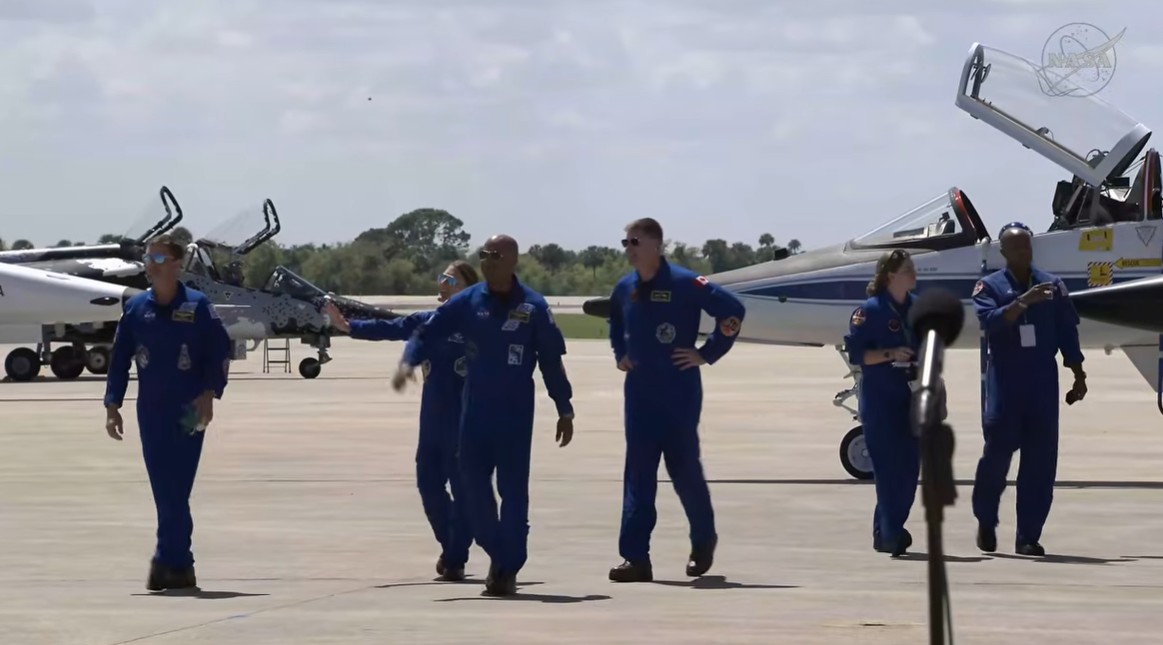
The four astronauts who will fly around the Moon as soon as next week and their backups arrived at Kennedy Space Center this afternoon. Full of enthusiasm, they also conveyed that they know weather or other factors could delay the launch, but whenever it happens, they are ready.
NASA’s Reid Wiseman, Victor Glover and Christina Koch and Canadian Space Agency’s Jeremy Hansen and their backups, NASA’s Andre Douglas and CSA’s Jenni Gibbons, flew themselves from Johnson Space Center to KSC in three T-38 jets — two astronauts per plane — landing about 2:15 pm ET.
They were greeted by NASA Administrator Jared Isaacman, CSA President Lisa Campbell, and NASA Acting Associate Administrator for Exploration Systems Development Lori Glaze. The crew has been in quarantine since March 18 so they had to stay some distance apart. Only the crew made remarks.
The launch is scheduled for Wednesday, April 1, at 6:24 pm ET. The window is open through April 6. It can only take place when the Earth and Moon are correctly aligned. If they don’t launch one of those days, they will have to wait until April 30 when the next window opens. Opportunities are available every month.
They are ready for whatever happens.
The way I kind of think about it in my head is this is the first time we’re loading the crew on with fuel on the pad. So we’re ready. The rocket is ready. We are ready. NASA is ready. This vehicle is definitely ready to go. We went through the Flight Readiness Review. We are ready to launch. But we’re also humans trying to load millions of pounds of propellant onto a giant machine and send it to the moon. So it could very well be that we get on April 1 and we’re behind timeline, and we’re just not ready as a team. And then we’ll probably take a 24 hour or 48 hour pause, in my head it probably may be a 48 hour pause, regroup, come out on the 3rd. Give it a go again, see how it goes. And if we get off on the 3rd great. If we get off on the 6th great. If we got an issue, we got to come back in May or June or whenever the vehicle and the team are ready, we are ready for that. … April 1st is not a guarantee. April 6th is not a guarantee. We got to go feel this whole thing out. — Reid Wiseman
The crew’s message is that they are excited and appreciative of everyone on the Artemis team who have trained them for this mission over the past three years.
They’re also excited about the plan for future Artemis flights and a Moon Base laid out on Tuesday by Isaacman. Though he’s a newcomer to NASA, taking the oath of office a bit over three months ago on December 18, Isaacman is well known among astronauts having made two self-funded spaceflights of his own on SpaceX Crew Dragons: Inspiration4 in 2021 and Polaris Dawn in 2024. On the latter mission, he and three companions flew further from the Earth’s surface than anyone since the Apollo era, 1,400 kilometers (870 miles). The crew included two women, SpaceX engineers Sarah Gillis and Anna Menon (recently selected as a NASA astronaut), who set a record for the first women ever to fly to that distance.
Koch will break that record on this flight. Depending on which day they launch, Artemis II could set a new record for the furthest distance from Earth ever for human spaceflight. Artemis II is a test flight that will not attempt to orbit much less land on the Moon, but instead will fly a free-return trajectory that brings them back to Earth even if the Orion Service Module’s propulsion system does not perform as planned. It’s similar to the trajectory used in 1970 to get the Apollo 13 crew safely home after an explosion in their Service Module imperiled the mission. They flew to a distance of 400,171 km (248,655 mi) and Artemis II could reach 402,000 km (250,000) miles.
The Artemis II crew is focusing on the mission, however, not whether they set records. As they stress repeatedly, it’s a test flight and their job is to test the Orion spacecraft in preparation for other astronauts to fly more missions including to land on the Moon. Wiseman and Glover are both former Navy test pilots, Hansen is a former Canadian Air Force fighter pilot, and Koch is an engineer (who does, however, hold the record for longest spaceflight by a woman, 328 days).
They emphasize that they will be successful when future missions are successful because of it. “We’re in a relay race,” Koch said. “We’re not successful until the next missions are successful” and that “fires us up all the more.”
By tradition, astronauts take a Zero Gravity Indicator with them so while they are strapped to their seats they can tell they are in weightlessness. Children of the crew members often come up with the ZGI, but in this case the Artemis II crew held a contest. Koch revealed today that Lucas Ye, a second-grader in Mountain View, CA, is the winner with his RISE plushy inspired by the Earthrise photo taken by the Apollo 8 crew in 1968.
The toy has a zipper at the bottom where NASA will place a micro SD card holding the names of people who signed up to have their names flown around the Moon.
The crew will speak with reporters again on Sunday from their quarantine quarters at 11:30 am ET. NASA has several press conferences and ongoing coverage of the mission through the next several days as detailed in this press release. Times are subject to change. Sunday’s media event was to start at 9:30 am ET, for example, but shifted to 11:30 am ET. Check that press release for updates.
User Comments
SpacePolicyOnline.com has the right (but not the obligation) to monitor the comments and to remove any materials it deems inappropriate. We do not post comments that include links to other websites since we have no control over that content nor can we verify the security of such links.
Facts Only
Actor: NASA, Canadian Space Agency
Event: Preparation for mission around the Moon
Date: Mission scheduled for April 1st, 20XX at 6:24 pm ET
Timeframe: Mission could potentially take place from April 1st to April 6th, 20XX
Location: Kennedy Space Center
Records: Potential record for the furthest distance from Earth ever for human spaceflight
Executive Summary
Full Take
In the deeper analysis, it is important to recognize that this mission is part of a larger effort by NASA's Artemis program to return humans to the moon and establish a sustainable presence there. The crew includes astronauts with diverse backgrounds, including former military test pilots and engineers. The mission could potentially set new records for the furthest distance from Earth ever for human spaceflight, highlighting the technological advancements made since the Apollo era. However, it is important to acknowledge that space travel remains a risky endeavor, with uncertainties around weather conditions and technical issues. The crew emphasizes that their primary goal is to test the Orion spacecraft in preparation for future missions, including those aimed at landing on the moon. It is also worth noting that the mission's launch date is not guaranteed, as it depends on various factors such as weather conditions.
Patterns detected: ARC-0024 Ambiguity (The launch date is not guaranteed)