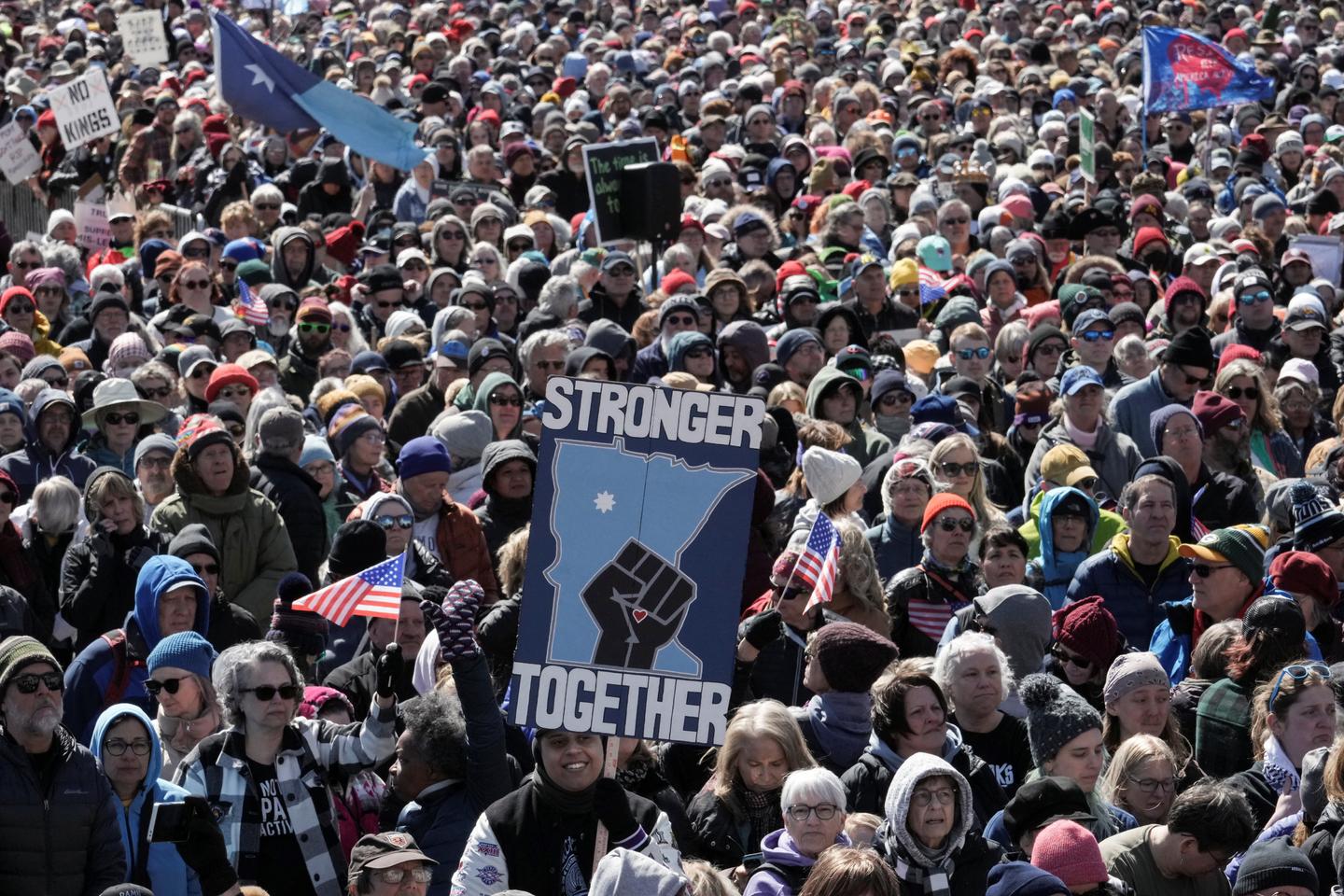
Pour la troisième fois en un an, les bannières « No Kings » (pas de rois) ont flotté un peu partout aux Etats-Unis, samedi 28 mars. Les opposants à Donald Trump sont descendus massivement dans la rue à travers le pays, répondant à ce mot d’ordre qui dénonce une dérive autoritariste du président américain. Pas moins de 3 000 rassemblements avaient été organisés, dans des petites villes du Midwest comme dans les grandes métropoles des côtes. Le collectif à l’origine de la mobilisation revendiquait 8 millions de participants samedi soir, un chiffre impossible à vérifier.
L’évènement phare avait lieu à Minneapolis-Saint Paul (Minnesota), où des prises de paroles, entrecoupées d’intermèdes musicaux, étaient organisées, en présence de célébrités comme Bruce Springsteen, Joan Baez, Jane Fonda, ou encore du sénateur indépendant du Vermont Bernie Sanders, figure de la gauche américaine. Les Twin Cities sont devenues le symbole de l’opposition à Trump, depuis l’opération anti-immigration sur place qui a causé la mort de deux citoyens américains, Renee Good et Alex Pretti, tués par des agents fédéraux. La Maison Blanche a dû reculer et la résistance pacifique des citoyens, qui se sont mobilisés pour défendre les immigrés de la ville, fait désormais office de modèle à travers le pays.
« On s’est senti galvanisé, raconte Jérôme Chateau, président du comité d’aménagement dans le quartier de South Uptown à Minneapolis et membre du Parti démocrate, qui assistait au rassemblement. L’atmosphère était bon enfant, avec de l’humour, de la combativité et aussi des moments très touchants. On en a besoin parce que le sous-texte ici, c’est que tout le monde a été traumatisé par ce qui s’est passé. Mais c’était aussi une célébration, il y a une forme de fierté parce qu’on a remporté une victoire. »
Il vous reste 68.33% de cet article à lire. La suite est réservée aux abonnés.
Facts Only
Protests under the banner "No Kings" occurred across the U.S. on March 28.
Over 3,000 rallies were organized in cities nationwide, including small Midwestern towns and major coastal cities.
The largest event took place in Minneapolis-Saint Paul, Minnesota.
Speakers included celebrities Bruce Springsteen, Joan Baez, Jane Fonda, and Senator Bernie Sanders.
The protests were triggered by opposition to President Donald Trump, citing concerns over authoritarianism.
Minneapolis-Saint Paul became a focal point after a federal immigration operation led to the deaths of two citizens, Renee Good and Alex Pretti.
The White House reversed course following public resistance in the Twin Cities.
Organizers claimed 8 million participants, though this number is unverified.
The event featured speeches, musical performances, and a mix of activism and celebration.
Jérôme Chateau, a local Democratic Party member, described the atmosphere as galvanizing and emotional.
Executive Summary
Full Take
The "No Kings" protests represent a significant moment of grassroots mobilization, but the narrative warrants scrutiny through the lens of emotional exploitation and authority games. The framing of Trump as an authoritarian figure is a potent rallying cry, leveraging fear and moral urgency to unify opposition. The claim of 8 million participants, while unverifiable, serves as an appeal to popularity, amplifying the movement's perceived legitimacy. The focus on Minneapolis-Saint Paul as a symbolic battleground is strategically effective, tying local tragedy to broader national resistance. However, the lack of independent verification for key claims—such as participation numbers—risks undermining credibility.
Historically, such movements echo patterns of civil resistance, but the modern media landscape amplifies both genuine grievances and potential distortions. The inclusion of celebrities and political figures like Bernie Sanders borrows credibility, blending activism with entertainment—a tactic that can both energize and dilute core messages. The protest's success in forcing a White House retreat suggests real political impact, but the long-term implications depend on whether the movement can sustain momentum beyond symbolic victories.
Key questions emerge: How does the movement define "authoritarianism," and what concrete policy changes does it seek? What counter-narratives or alternative perspectives are being marginalized in this framing? Would evidence of smaller turnout or mixed public opinion alter the movement's strategic approach?
Counterstrike scan: A coordinated influence campaign would likely amplify unverified claims (e.g., participation numbers), weaponize emotional trauma (e.g., the deaths in Minneapolis), and leverage celebrity endorsements to manufacture consensus. While the article reflects these tactics, it does not conclusively indicate a structured campaign—rather, it mirrors organic activist strategies. The alignment is partial but not inherently manipulative.
Patterns detected: ARC-0024 Ambiguity (unverified claims), ARC-0043 Motte-and-Bailey (broad "authoritarianism" framing without specific policy critique).