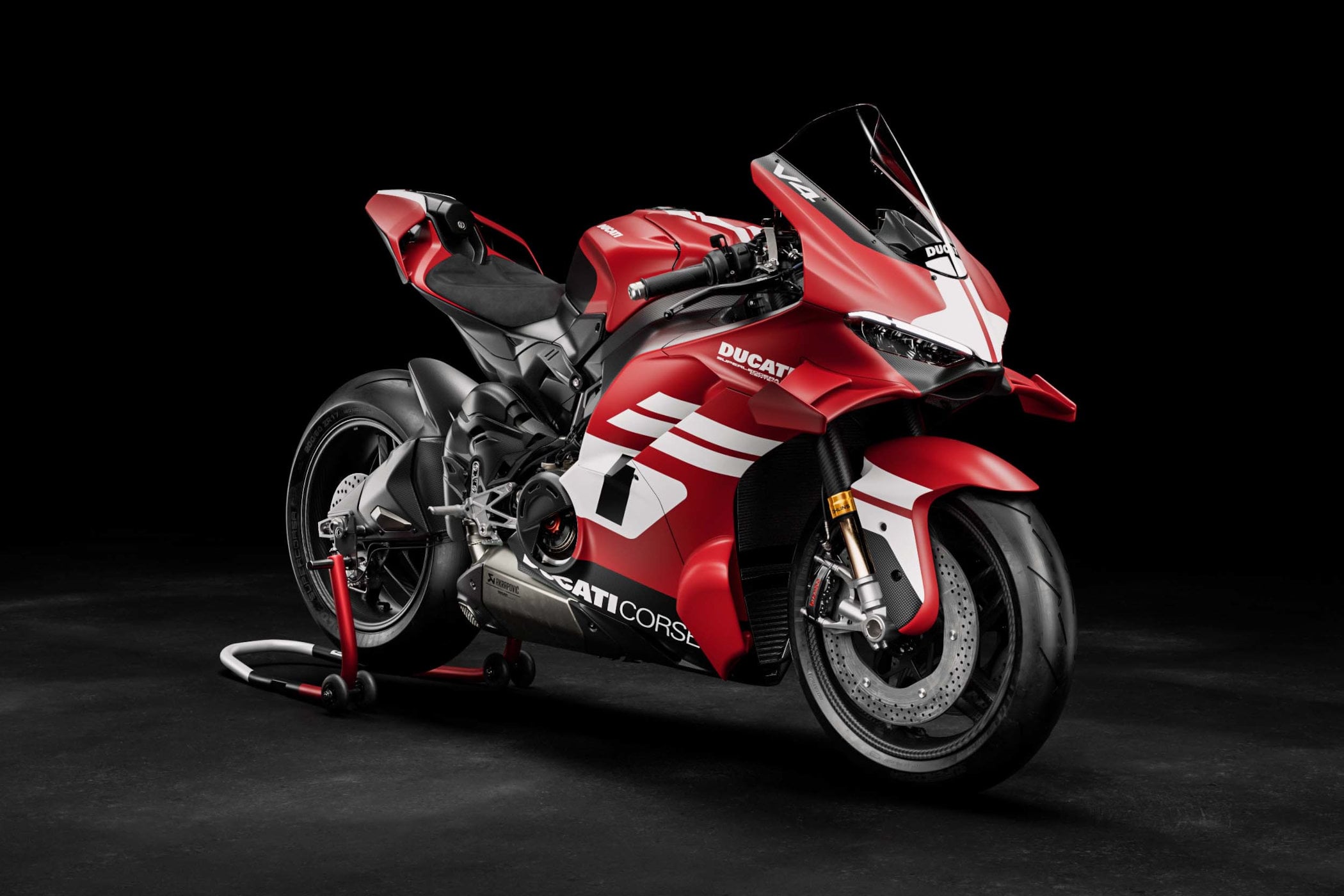
Ducati Goes Balistic With The 247bhp Superleggera V4 Centenario
With the latest tech trickling down from MotoGP, this is a bonafide missile, with a license plate.
Ever experienced the thrill of attending a MotoGP race? Ever had the idea of wanting to get a sense of just how crazy fast a MotoGP bike is to ride? Ever think, I want that, but for the road? If the answer to each of these questions is a resounding “YES!!”, then Ducati has something very special for you. Presented right after the 2026 Red Bull Grand Prix of the United States at COTA (Circuit of the Americas in Houston, Texas), this Ducati Superleggera V4 Centenario is a pure speed demon on two wheels, with a license plate. It uses the latest tech carried over from the World Superbike and MotoGP racing bikes, and promises a hair-raising thrill ride from the moment you fire up the V4 engine, until the moment you turn it off again. At which point you’ve either soiled yourself, or you’re running on pure adrenaline for days on end.
To be honest, I can’t even begin to fathom just how bonkers this thing must feel on the road. I’ve had my license and motorbike for quite some years now, and regularly hit the road either for commuting to and from work appointments or to unwind and clear my mind, yet my ‘machine’ doesn’t even come close to this. The Ducati Superleggera V4 Centenario is perhaps best compared to things like the Porsche 911. There’s the entry-level 911, the 911 Turbo, and then there’s the all-out 911 GT2 RS. That’s basically the spectrum of Ducati’s top-of-the-line supersports bike, the Panigale. Even the most basic one puts out staggering numbers, but this Superleggera V4 Centenario is next level, in the purest sense of the word.
It’s built to celebrate the 100th anniversary of the Italian manufacturer, which was founded in 1926 by Antonio Cavalieri Ducati and his three sons, although the business of motorcycles came much later. Initially, Società Scientifica Radiobrevetti Ducati produced vacuum tubes, condensers and other components to be used in radios. Shortly after WWII, the company turned its focus to motorcycles, and the first production Ducati was introduced in 1950. This Cucciolo used a 48cc engine in what was not much more than a beefed-up bicycle frame, yet hit a top speed of 64kph.
From very early on, it ventured into racing, which seems like a natural thing to do when you build something that is faster than a horse and carriage. In 1951, for instance, the company’s second year of motorcycle production, speed records were set on the Cucciolo. A road-racing program followed in 1954, and the company has been involved in racing pretty much ever since. Ducati has won countless races and titles, including 7 constructors’ and 4 drivers’ titles in MotoGP, and 15 drivers’ titles in Superbikes, spread between works or factory teams and privateer teams. It also races in the Isle of Man TT, Moto E, MXGP (Motocross) and other categories.
The Superleggera V4 Centenario is directly derived from the WorldSBK-competing Panigale V4 and the Desmosedici GP26 bike piloted by two-time MotoGP World Champion Francesco “Pecco” Bagnaia and seven-time and this year’s defending MotoGP World Champion, Marc Marquez. And it holds no compromise, cuts no corners and is an engineering tour de force in pursuit of unbridled performance. It starts with an ultra-light and rigid full carbon fibre chassis, a first for a road bike. But that’s not all, as the fairing, the swing arm, and even the wheels are in carbon. Another world’s first is the carbon sleeves for the front fork. The end result is a bike that weighs just 173 kilos dry in stock road-legal form, or 167 kilos with the special Racing Kit fitted, which is apparently fitted as standard. This Racing Kit makes the Supereggera V4 Centenario suited for the track only, and includes a special Akrapoviç exhaust, DAVC Race Pro software, a lower fairing, and open clutch, swingarm and alternator covers made of carbon fibre.
The engine chosen to power all this tech is the Desmosedici Stradale 1100 V4, a high-tech four-cylinder engine in a V-configuration with two cylinders angled to the front and two to the rear. This features the forged crankshaft with tungsten inserts of the already stupidly fast Panigale V4, and results in a power output of 228bhp. If you leave the pre-installed Racing Kit untouched, that power boosts to the full 247bhp, giving the Superleggera V4 Centenario an insane power-to-weight ratio of 1.48bhp per kilo. To try and put that in some form of perspective, the Donkervoort P24 RS we recently covered achieves only 0.77bhp per kilo, and even hypercars such as the Ferrari F80 don’t come close to this thing. All this power is fed through a Ducati Racing gearbox where neutral is below first gear, instead of in between first and second, enabling a more precise and faster shift through the gears.
To keep control of such a powerful machine, Ducati fits the Superleggera V4 Centenario with carbon-ceramic brakes by Brembo. These are again a world’s first on a production motorcycle, and are carried over from the racing bikes as well. New electronics also help to get the most out of the bike and do it (somewhat) safely. Systems like Dynamic Engine Breaking, eCBS rear braking and advanced aero keep the machine stable at high speeds and under heavy braking. Up to a certain limit, of course…
It goes without saying that Ducati paints its new top-of-the-game machine red, in a hue that’s called GP26 Rosso Centenario. The paint job is finished with white and black details and a racing roundel to emphasise its track-focused style. The fairing is fitted with all sorts of ducts, intakes and fins to channel air around and through the bike, and the exhaust snakes around the engine and chassis and exits underneath the seat (see two images up), or is tucked underneath the engine and exits in front of the rear wheel (see above), depending on which kit you’re running. It really takes things to extremes, and looks downright cool if you ask me. Although there are no official performance figures yet, I expect it to come as close to actual MotoGP bikes as legally possible.
Only 500 of these scarlet-red machines will be built, making it the most exclusive bike Ducati has ever produced, and as you’d expect, it costs a pretty penny. The Ducati Superleggera V4 Centenario starts at a whopping EUR 160,000, and if you want a hand-painted livery with the Italian tricolore, that jumps to EUR 200,000. If you don’t mind parting with that much cash and fancy a go on one, your chances are slim at best. Ducati extends a personal invite to 500 lucky devils who they find qualified enough to be offered the chance to buy one.
For more information, please visit SuperleggeraV4Centenario.Ducati.com.
Editorial Note: The information used and images portrayed in this article are sourced from and used with permission of Ducati Motor Holding S.p.A. unless stated otherwise.
1 response
Impressive. Also kind of cheap compared to performance cars. Too bad most of them will end up in someones living room and will never be on the road.
Facts Only
Ducati introduced the Superleggera V4 Centenario after the 2026 Red Bull Grand Prix of the United States at COTA in Texas.
The bike celebrates Ducati’s 100th anniversary, founded in 1926 by Antonio Cavalieri Ducati and his sons.
It features a full carbon fiber chassis, fairing, swingarm, and wheels, with carbon sleeves for the front fork.
The dry weight is 173 kg in road-legal form and 167 kg with the Racing Kit.
The engine is a Desmosedici Stradale 1100 V4, producing 228bhp standard and 247bhp with the Racing Kit.
The Racing Kit includes an Akrapoviç exhaust, DAVC Race Pro software, and carbon fiber covers, making the bike track-only.
Carbon-ceramic brakes by Brembo are a world first for a production motorcycle.
Only 500 units will be produced, priced at €160,000 or €200,000 with a hand-painted livery.
Ducati is selectively inviting 500 buyers deemed qualified to purchase the bike.
The design includes GP26 Rosso Centenario paint with white and black details and advanced aerodynamics.
Ducati has won 7 constructors’ and 4 drivers’ titles in MotoGP, and 15 drivers’ titles in Superbikes.
The first Ducati motorcycle, the Cucciolo, was introduced in 1950 with a 48cc engine.
Executive Summary
Ducati has unveiled the Superleggera V4 Centenario, a limited-edition motorcycle celebrating the company's 100th anniversary. This high-performance bike is derived from MotoGP and World Superbike technology, featuring a carbon fiber chassis, wheels, and fairing, as well as carbon-ceramic brakes—a first for a production motorcycle. The engine, a Desmosedici Stradale 1100 V4, produces 228bhp in standard form and 247bhp with the included Racing Kit, which also makes the bike track-only. Only 500 units will be produced, priced between €160,000 and €200,000, depending on customization. Ducati is selectively inviting buyers, emphasizing exclusivity. The bike’s design and engineering reflect Ducati’s racing heritage, with advanced aerodynamics and electronics to manage its extreme performance. While official performance figures are pending, the Superleggera V4 Centenario is positioned as the closest road-legal experience to a MotoGP bike.
The motorcycle’s launch follows Ducati’s long history in racing, from its early days with the Cucciolo to its dominance in MotoGP and Superbike championships. The Superleggera V4 Centenario embodies the brand’s commitment to pushing technological boundaries, though its high cost and limited production may restrict it to collectors rather than everyday riders.
Full Take
The Ducati Superleggera V4 Centenario is a masterclass in engineering and exclusivity, but it also raises questions about the intersection of racing technology and road-legal practicality. At its core, this bike is a celebration of Ducati’s century-long legacy, blending cutting-edge materials like carbon fiber and carbon-ceramic brakes with a power-to-weight ratio that eclipses even hypercars. The narrative here is one of uncompromising performance, a "halo" product designed to showcase Ducati’s technological prowess and racing pedigree. The strongest version of this story is that it represents the pinnacle of what’s possible when motorsport innovation trickles down to consumer products—even if "consumer" is a stretch given the €160,000 price tag and the fact that most units may never see a public road.
Yet, the pattern of hyper-exclusive, ultra-high-performance machines often serves as much as a marketing tool as a functional product. The limited production run and selective buyer invitations create an aura of elitism, reinforcing Ducati’s brand prestige while sidestepping the reality that such bikes are more likely to be displayed than ridden. This aligns with a broader trend in the automotive and motorcycle industries, where "track-only" or "collector’s" models become status symbols rather than tools of transportation or even sport. The emotional appeal here is undeniable—who wouldn’t want to experience MotoGP-level performance?—but it’s worth asking whether this is genuine innovation or a carefully crafted fantasy for the ultra-wealthy.
The root cause of this narrative is the tension between racing as a proving ground for technology and the commercial imperative to monetize that technology in the most lucrative way possible. Ducati’s history is steeped in racing, and the Superleggera V4 Centenario is a direct descendant of that lineage. However, the assumption that such extreme performance is the ultimate measure of a motorcycle’s worth goes unchallenged. What about usability, accessibility, or even sustainability? The second-order consequences include reinforcing a culture where only the wealthiest can access the "best" technology, while also normalizing the idea that road-legal vehicles should prioritize track performance over practicality.
For human agency, this raises questions: Does this bike empower riders, or does it create a new tier of exclusivity that further distances enthusiasts from the machines they admire? Who truly benefits—the riders, the brand, or the collectors? And what does it say about the future of motorcycling when the most advanced models are effectively museum pieces?
Bridge questions:
How does the Superleggera V4 Centenario’s existence reflect broader trends in the motorcycle industry, particularly the balance between racing heritage and consumer accessibility?
If most of these bikes will never be ridden on public roads, does their production serve a purpose beyond branding and prestige?
What alternative metrics could define "performance" in motorcycles beyond raw speed and power?
Counterstrike scan: If this were part of a coordinated influence campaign, the playbook would involve leveraging exclusivity and racing heritage to create aspirational desire, while downplaying the impracticality of the product for most consumers. The actual content aligns with this pattern to some extent, as it emphasizes the bike’s extreme capabilities and rarity without critically examining its real-world utility. However, the article does not engage in overt manipulation—it presents the facts and lets the reader draw conclusions. The emotional appeal is strong, but it’s not weaponized; it’s more of a celebration of engineering than a cynical marketing ploy.
Patterns detected: none
Sentinel — Human
The article appears to be written by a human with strong evidence supporting its authenticity, such as the author's personal perspective, emotional engagement, and historical context provided.