Listen to this essay
31 minute listen
‘When do we get to the fire-tamers?’ my 10-year-old daughter asks from the backseat. Rain splatters against the windscreen. As we drive across salt marshes, a chill sea wind blows over the north-westerly French peninsula where we live; the tide is rising. By the road, in flooded fields, trees mirror in rippling water. The world doubles. ‘Soon,’ I say.
Ten minutes later, inside a lost farmhouse ringed by red geraniums, an elderly Breton woman whispers to a stone. In her gloomy kitchen, the French version of the TV show Who Wants to Be a Millionaire? murmurs from a flickering screen. The woman rubs the stone up and down my daughter’s fingers, whispering unintelligible words.
Finally, she points to a large wart: ‘That one is the queen.’ My daughter has dozens of growths on her hands. For a year, we’ve tried chemists’ kits and dermatologist treatments. Nothing has worked. Recently, a nurse colleague of mine suggested that we consult a fire-tamer, giving me Madame Abgrall’s address.
‘The queen will go first,’ Mme Abgrall says when she’s finished, ‘then the others will disappear.’ Without speaking, I slide a €10 note on to her table. As a fire-tamer, Mme Abgrall can’t ask for money, my colleague warned me, or her ‘gift’ would disappear.
When we get home, I tell my husband: ‘I hope it will work but I don’t know if I believe it can…’ My voice falters. ‘It’s ancient power,’ he tries to convince me.
British-born, we’ve lived in Brittany for nearly 15 years; my husband is drawn to Breton culture, especially the ‘land of legends’ and the Celtic otherworld, and owns academic books on Druidry. But he’s had a suburban upbringing, whereas I spent my childhood in a commune surrounded by hippies and performative quackery. Possibly in consequence, I favour hard science. I work in hospitals, train doctors, and work with treatment plans and protocols.
Yet, after our visit, I can’t stop thinking about the woman, her humility. The quiet power that enveloped the kitchen scene. Within weeks, the warts have gone and my daughter’s skin is clear; they never reappear. Questions inundate my mind: was it real? Did Mme Abgrall cure the warts? And who are the fire-tamers anyway?
Fast-forward a decade: according to a documentary by Radio France, there are more than 5,000 traditional healers in France today, and at least two-thirds of the French population have consulted such a practitioner. However, there are no official statistics about fire-taming, no organisation or diploma to validate or regulate this treatment. Instead, fire-tamers – women and men predominantly based in rural areas – are known to have a ‘gift’. Contacted by word-of-mouth, they help with shingles, burns, eczema, teething, skin complaints – pathologies associated with excessive redness or swelling, that is to say, with inflammation, a word stemming from the Latin for igniting a fire. Using their hands, the fire-tamers ‘cut’, ‘channel’, ‘block’ and ‘pass’ the fire, taking it away from an inflamed zone. As a result, they are also known as fire-cutters, fire-soothers, fire-touchers, fire-passers or fire-charmers.
Gathering data on their proceedings is like catching a whisper in the wind. As the French doctor Valentina Vidano writes in her 2018 study, fire-tamers work in secret and often without payment, meaning there is no paper trail. It is both intriguing and disconcerting. The annals of fire-taming have been chronicled in oral history, transmitted between generations in gestures and rituals as safely guarded secrets.
In the rugged coastal region of Brittany where we live, fire-tamers are prevalent. A sacred Celtic place, the land is populated with thousands of menhirs and dolmens – ancient stone structures – alongside Calvary crosses and shrines with healing legends. Republican France had forced Breton culture underground. During the 19th and 20th centuries Bretons were characterised as ‘stubborn and ignorant, rooted in superstition, irrationality’, writes the historian Michael Orwicz. Until the 1950s, the population’s first languages were Breton or Gallo, but these were banned in French schools until the late 1970s. Yet, the Bretons never relinquished their identity – their music, buckwheat crepes, spirit of revolt, and healing practices. What Walter Benjamin called the ‘red thread of experience’, the passing-on of stories, has travelled on parallel byways.
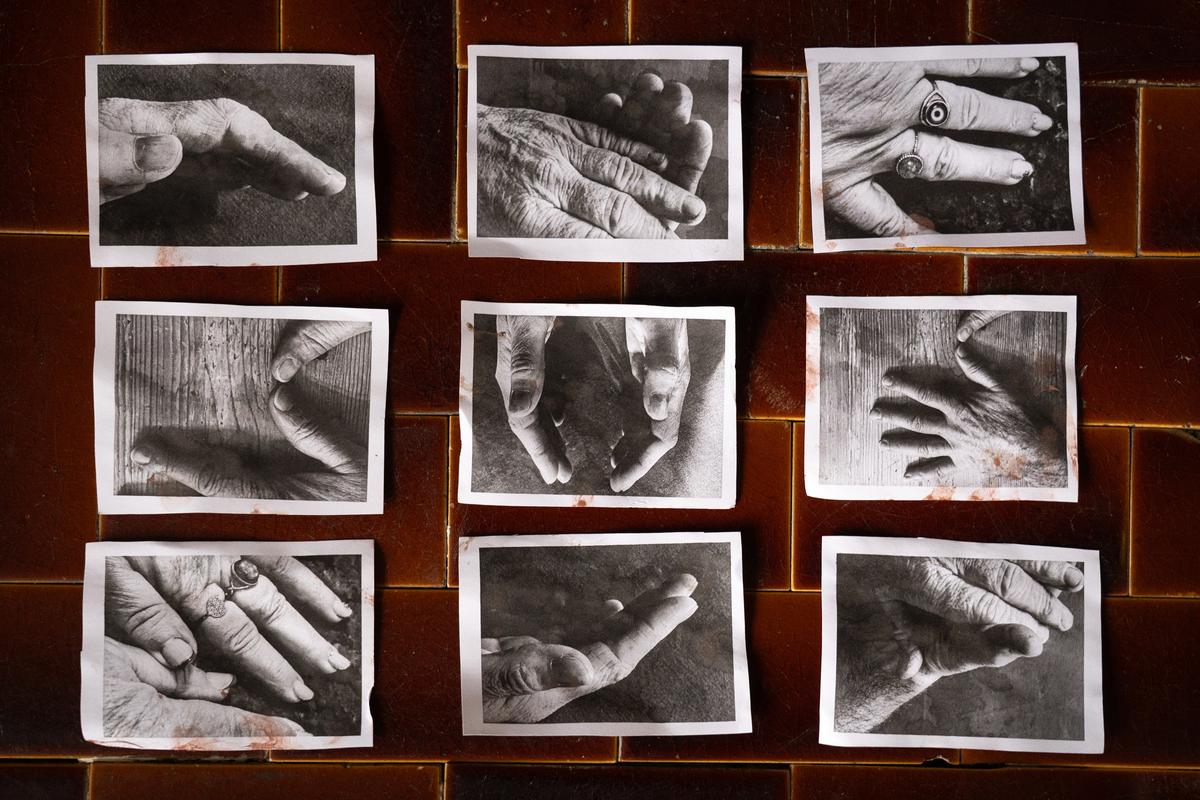
Fire-tamers are ‘drugless healers’ who lay their hands over the ‘flaming’ area, never making physical contact
As a result, consulting a fire-tamer in Brittany today is an ordinary – albeit dissident – experience. When I tell Breton hospital colleagues that I’m writing about fire-tamers, the only bewildered staff member is myself. Everyone has a fire-taming tale. A pregnant occupational therapist tells me: ‘My dad, a headmaster, can fire-tame. He wants to give the gift. But I don’t have the time.’ A nurse recounts how his brother, a dairy farmer, discovered he was a fire-tamer by accident, curing his entire cow herd of mastitis. There are anecdotes about burns that required no skin graft, pain relief from radiotherapy, teething babies calmed. Even the non-believers join in, and a chic senior hospital lecturer tells me: ‘I am very Cartesian but my best friend tamed fire through knowing the “secret”.’
As a treatment practice, where are its origins? Fire-tamers are ‘drugless healers’ who lay their hands over the ‘flaming’ area, never making physical contact with the patient’s skin. Medical references to healing hands span from Greek Asclepieia temples through to the Bible and Native American techniques all the way to current studies on the clinical effectiveness of healing touch. But how do hands cure? And if, as Susan Sontag writes, illness is metaphor, what is the symbolism of the fire?
Over millennia, fire has burned bright, fuelling medical theories across the globe. In traditional Chinese medicine, Ayurvedic medicine and Galen’s ancient Greek humoral medicine, fire is an element that must stay in balance to maintain good health. In humoral medicine, fire represents choler, dryness and heat; excess fire produces liver derangement and aggression, leading to the term ‘choleric’. Yet as a metaphor for illness in these frameworks, fire is never extinguished. Instead, it must be tamed.
Fire also illuminates: in Greek myth, Prometheus stole it from the gods and gave it to humans, and so, in the Western classical tradition, he now represents the hubris of wanting too much power. The French philosopher Gaston Bachelard understood fire as a symbol at the soul of all transformation: life, desire, alchemy. And if we return to Brittany, the ancient Celts took oaths by the elements, including fire – formulae surviving into Christian times. The triskele, the Breton symbol, has three spirals that represent earth, water and fire, as well as the cycles of life: future, present and past.
These days, France is a highly industrialised country with a health system governed by a strict code of public health. But as I research and meet with fire-tamers, it feels like I am stepping back in time. Over weeks and months, I receive texts, photos and voice messages from fire-tamers who have heard about my enquiries. On sunny and rainy days alike, I drive through marshlands, across damp, barren moors, past isolated housing estates, and down Wild West-style farm tracks to meet non-biomedical healers. Whenever I talk to one fire-tamer, they put me in touch with another, and I picture them spreading out, rhizomatic roots connected by something ageless, invisible. An informal network representing an alternative, unofficial and ancient grassroots system of care.
A Breton annal from 1938 offers a traditional understanding of the ways fire-tamers get their power: by being the seventh child born into a single-sex group of siblings; by being born following the death of the father; by being born on either 25 January or 10 August; through hereditary transmission from parent to child; or through transmission from an elderly person before they die.
‘I think about healing and wanting the person to feel better, wanting to tame the fire’
‘I’ve been a fire-tamer for over 20 years,’ Stéphane tells me as we sit in my living room. A gentle, grey-haired 50-year-old Breton, dressed in jeans and a polo shirt, he was once a barman and a caterer. For 10 years, he’s worked as an ambulance driver. In the hearth, a fire crackles, and we’re drinking red-fruit tea. Outside, drizzle falls. He recounts how he discovered his skills: ‘By accident. A mate paid for me to see an astrologer for fun, and she said I could be a fire-tamer or a glass-blower.’ He was sceptical: ‘Like St Thomas, I only believed what I could see, but a few years later a freak bonfire accident led to a friend burning his face.’ That evening, Stéphane placed his hands over the friend’s burns. ‘It stopped hurting. I couldn’t believe it.’ Afterwards, he says solemnly: ‘I had to learn how to use it, develop my own protocol.’
Stéphane describes his session in three parts: ‘I open, and then I approach the zone, use my hands, and tame the fire. Then I close the session and give my thanks.’ For each part of the session, he uses a silent prayer. Around his neck are a Christian cross and a Buddha. ‘They guide me.’
Not all the fire-tamers I talk to use intercessory prayer. But, in describing their process, every fire-tamer insists upon their intention. Along with the use of their hands, it is the thing they share: ‘If I pass my hand, I must know why I am passing my hand.’ ‘I picture the wound healing.’ ‘I think about healing and wanting the person to feel better, wanting to tame the fire.’ At the end of the session, all fire-tamers wash their hands, to ‘evacuate the heat’.
Valérie, a 55-year-old hospital medical secretary, received the fire-taming gift when she was 14. ‘It was evening at my grandparents’ farm. As usual, my grandfather brought in a bundle of kindling, lit the fire. Then he whispered in my ear that he was giving me a prayer to cure dartres, slang for a rash. He told me that now he’d given me the prayer he could no longer heal.’ She smiles. ‘Afterwards, a friend burnt herself with an iron, and I discovered I could also tame fire with the prayer.’ For Valérie, her fire-taming prayer is a secret never to be shared. A shared secret is an oath broken.
Fire-tamers use a variety of techniques: blowing, silent prayers, making signs of the cross, saliva, small stones. There is a mixture of Catholic liturgy and pagan rituals. Occasionally they even ‘get pieces of bacon that you wrap around the inflicted area of, for example, a verruca. Following fire-taming, these are buried in the garden,’ explains Sylvie, another fire-tamer. Traditionally, many fire-tamers had a pathological speciality curing either shingles, teething, warts or burns. Today, they are adding other healing strings to their bows: Stéphane and Sylvie have also trained in the energy healing practice of reiki.
‘My dad was a water-dowser,’ Jean-Louis, a dairy farmer, tells me over the phone. ‘As a kid, I dowsed with him. But when a cousin burnt herself, I realised I had the fire-taming gift. I think my gift works on opposites: water and fire.’
I ask all the fire-tamers how their practice is related to fire. What do they do with the fire? ‘It’s inflammation, anything that burns. I stop the fire burning,’ Sylvie says. ‘The fire comes out of their body and into my hands,’ Valérie explains. ‘I’m like a magnet,’ Jean-Louis says, ‘I draw the heat out.’ ‘I feel the heat,’ Stéphane says. ‘A tingling in my hands, my fingers can go hard … I talk the fire out of burns.’
Fire-taming seems to be part of my evidence-based hospital job, hiding in plain sight
Most fire-tamers can work at a distance by using a photo of the person, the infected area and a date of birth. But they are unanimous that using their hands is better. Jean-Louis explains: ‘I place my hand one centimetre above the zone. You can feel the vibrations.’
But isn’t fire-taming folklore, superstition?
Since the late 1970s, research into French folk medicine and its links to witchcraft have been widely publicised through works such as the anthropologist Jeanne Favret-Saada’s Deadly Words (1977), exploring witchcraft beliefs and experiences in Normandy. Infamously, while undertaking her study, Favret-Saada herself became bewitched. While writing this essay, I have a dream that I’m doing handstands and floating suspended a couple of centimetres above the floor; in my palms, I feel something almost solid between myself and the ground, like an electromagnetic field. My dream appears to be a suspension of disbelief. Yet I am also upside down, rationality versus the unknown, as though I’m entering another world. When I tell my husband about my dream, he says I will become a fire-tamer. But while I feel a growing understanding and deep admiration for them, I keep a respectful distance from the practice, recognising that it’s not mine.
Yet fire-taming seems to be part of my evidence-based hospital job, hiding in plain sight. When I lecture at a French university hospital to health managers and talk about fire-taming, many students nod their heads. ‘We use it in oncology,’ someone tells me. ‘In the regional critical burns unit,’ another person shares. In France, fire-tamers are unofficially incorporated into many allopathic systems. It’s not simply that the two care systems function side by side: this porosity means knowledge and experiences permeate. Yann, a retired GP, describes fire-tamers as being part of the larger medical network. Initially a military doctor, he had a semi-rural surgery for 20 years. In cases of shingles, he gave out the number of a local fire-tamer named Germaine. ‘Once she treated someone in the waiting room. She put her saliva on her fingers, rubbed it over the spots. I did wonder whether it was hygienic!’ he says, laughing.
Yann’s Breton experience connects to a global medical shift. We are in a new medical era, according to the World Health Organization: ‘Traditional, complementary and integrative medicine is practised in 170 countries and is used by billions of people.’ Fire-tamers belong to folk medicine – folk practices that have declined since being rejected by rational societies, influenced by thinkers such as the sociologist Max Weber, who believed secularity would render ancient knowledge systems redundant. Currently, medical thinking is revising this belief. In 2025, the WHO opened a digital platform consolidating 1.6 million resources on the topic, from scientific studies to Indigenous knowledge. But how will evidence-based and biomedical practices walk hand in hand with traditional medicine? Importantly, how do we remain open-minded while protecting patients from dangerous misinformation?
In French hospitals, fire-tamers have an unofficial yet common role in the patient care protocol. The more I talk with doctors and nurses, the more fire-tamers I find. ‘We give out a fire-taming list for patients in radiotherapy,’ Betty, a physiotherapist in a regional oncology centre, tells me. ‘In any case, the patients share their own list in the waiting room.’
In a 2007 study, the French doctor Nicolas Perret described a telephone survey he conducted into the use of fire-taming in regional hospitals of the Haute-Savoie region in eastern France. Seven of the nine clinics and hospitals he contacted had an unofficial fire-taming protocol, either giving contact numbers or, as in the case of the emergency department in Annecy, the doctors and team fire-tame inside the hospital.
None of the healers I meet claim that they can cure life-threatening illness
By day, Stéphane works for an inland Breton general hospital as an ambulance driver, but after work, he fire-tames. His name is on an unofficial list. While he has accompanied dozens of people through radiotherapy with fire-taming, he says: ‘I would never tell anyone to stop treatment or that I could cure cancer. I simply soothe the fire, the pain.’ But depending on the hospital management, the list is not always made available to patients: ‘One top manager called us charlatans, and the list got taken down.’
The wariness of hospitals is understandable, for life-threatening quackery does exist. Since the COVID-19 pandemic, academics and medical professionals have observed a rise in health misinformation as people turn away from conventional medicine. None of the healers I meet claim that they can cure life-threatening illness or are trying to establish themselves as alternatives. But when I come across a book with 117 ‘magic formulas’ for fire-tamers, my scepticism flares. There is an undeniable whiff of snake oil, of lethal false promises like those promoted by Belle Gibson, the Australian wellness influencer who built a successful online brand through falsely claiming that she cured herself from terminal brain cancer with wholefoods.
In her study on healing and meaning, the French doctor Lola Yecora-Zorzano welcomes the recognition of other healing practices while remaining extremely vigilant about the potential of psychosomatic doctrines to lead patients to reject conventional medicine. Boundaries are important. As Yann, the retired GP, says: ‘It is when the healer goes to war with us, and advises stopping medical treatment, that I reach my limits as a doctor.’
Karine is one of the last people I meet. A sprightly nurse manager in a leopard-print coat with short grey hair and 20 years’ experience, she regularly coordinates fire-taming within her emergency department. She agrees that it is no panacea. ‘If fire-taming could stop cancer or heal wounds, I think someone would have worked it out!’ she says. Over coffee in a bistro, she projects that discreet, quiet, human approach to fire-taming I’ve come across again and again. ‘I come from a small village, and I grew up among fire-tamers. Instead of going to the GP, anyone who got burnt would go to a certain neighbour. They would blow, use saliva, say a prayer.’ Karine has agreed to talk to me about the fire-taming in the general hospital where she works. ‘It’s through the medical secretary,’ she says, and I presume the secretary distributes a list. Instead, it turns out that the medical secretary is the fire-tamer. Karine goes on: ‘If a patient has serious burns, I’ll explain we have a fire-tamer available. I never insist. If they’re not interested, we move on.’ When I ask if the hospital’s doctors know of this practice, she says they shake their heads or raise their eyes to the ceiling.
Medical studies on fire-taming have been undertaken in France, Switzerland and Italy. Their focus is often on how the practice is integrated into patient care, specifically in burn wards and oncology units. A French study of 500 radiotherapy patients in Auvergne from 2017 showed that more than half of them consulted a fire-tamer during treatment. In Switzerland, fire-tamers are called ‘secret-makers’, and their practice is on UNESCO’s Intangible Cultural Heritage list. Perret’s research shows that when patients believe in the ‘secret’, 87 per cent of them experience a reduction in pain. The question of belief is central to the practice.
Yann believes that fire-tamers offer something that conventional medicine has forgotten: ‘A listening ear, attention. But like with all medicine there is something inexplicable because it also works on babies.’ The explanation that evidence-based medicine gives for fire-taming is that it is a placebo, connected to the relationship between caregiver and patient. Numerous studies show that our emotional state plays a significant role in improving an individual’s immune response. Yet within this evidence-based framework, the spiritual aspect of the act of fire-taming is immeasurable, as is the impalpable work of the imagination. The belief in a neighbour, a culture, a practice goes beyond the quantifiable.
Fire is also life – the idea is not to put it out. Fire must be balanced
To be clear, fire-tamers do not heal the wound, they charm and tame the fire. David Le Breton, a sociologist and anthropologist who specialises in the body, says that doctors and fire-tamers don’t share the same representation of the body, or of health. As one anthropological-medical study of traditional Breton fire-tamers finds, the terms ‘illness’ and ‘healing’ rarely enter fire-taming vocabulary. ‘It is the excess of fire that I am taking into my body,’ Stéphane says.
What they treat then is heat, inflammation – the illness of our century. Stéphane explains that, as he moves his hands around the body, he can detect other inflamed areas: a toothache, swollen limbs, a urinary tract infection. In her kitchen, Sylvie repeats these words. As inflammation is also a sign of the body defending itself, it makes sense that the fire-tamers don’t extinguish fire, but charm and tame the flames. As in humoral, Chinese and Ayurvedic medicines, the presence of fire is part of health. Fire is also life – the idea is not to put it out. Fire must be balanced.
In this sense, the attitude and behaviour of fire-tamers is relevant. In contrast to the Promethean, performative healers of my commune childhood, the fire-tamers I meet do not overreach or seek fame and glory. They’re humble, there is no razzamatazz. They don’t advertise their services or proselytise. ‘I am lucky,’ Stéphane declares. Sylvie says: ‘I’ve been given a gift. It doesn’t belong to me. I can help others.’ She explains that fire-taming, with its other-worldly nature, gives an enlightened meaning to her life.
Sylvie’s experience echoes the message of the anthropologist Tanya Luhrmann’s book How God Becomes Real: Kindling the Presence of Invisible Others (2020). Drawing on the practices of evangelical Christians, pagans, magicians, Zoroastrians and Black Catholics, Luhrmann writes about how creating a relationship with a supernatural ‘other’ can lead to meaningful change for individuals and society.
All of the fire-tamers I meet express deep emotion around what they do: ‘I feel grateful.’ ‘I can help people.’ ‘It’s all about healing.’ None appear interested in monetary gains. Some heal for free, or take whatever people give them: €10 or €20, eggs, a crate of freshly picked apples. Stéphane goes to the emergency department outside his working hours, staying until midnight to provide pain relief. The fire-tamers offer their ‘gift’ alongside their day jobs driving ambulances, working on farms or in offices. Fire-taming is a belief they share: the power to imagine, or, as Luhrmann writes, ‘the human ability to conceive of that which is not available to the senses.’ This allows the fire-tamers and their patients to have a close relationship with what we might describe as the invisible.
Karine the nurse manager is steeped in fire-taming culture. We talk about her village and the local Gallo dialect. ‘I think that fire-taming belongs to the act of care,’ I say, describing my fundamental belief in care, these tiny gestures. ‘The intention of care is a kind of superpower,’ Karine says. As she talks, I think of a Guardian interview I recently read with the psychiatrist Amir Levine, about the impact of positive relationships on health. He said: ‘When we feel safe, the whole stress response goes down, which goes with inflammation and all that stuff.’ All the fire-tamers I meet seem to want to make people feel safe. When I ask Karine if she knows how fire-taming works, she shakes her head: ‘I don’t really need to.’ Like Stéphane and Sylvie, Karine feels that fire-tamers have a ‘secret’, an oath that must be kept. Flipping through my files, I show her an article about the Swiss ‘secret-makers’, and we agree that the notions of secrets and mystery are central to the fire-taming practice, along with humility. ‘I’ll keep the secret for them, and the belief for me,’ Karine tells me as we finish our coffee.
We’re at the end of our interview, and I sense that neither of us wants to say goodbye. I could have talked about fire-tamers for days and, amid my bewilderment, I have reached a place of profound respect. We shake hands and walk out into the rain. Having shared a secret between us, a caring practice, we’ve kindled an ancient fire of belief.