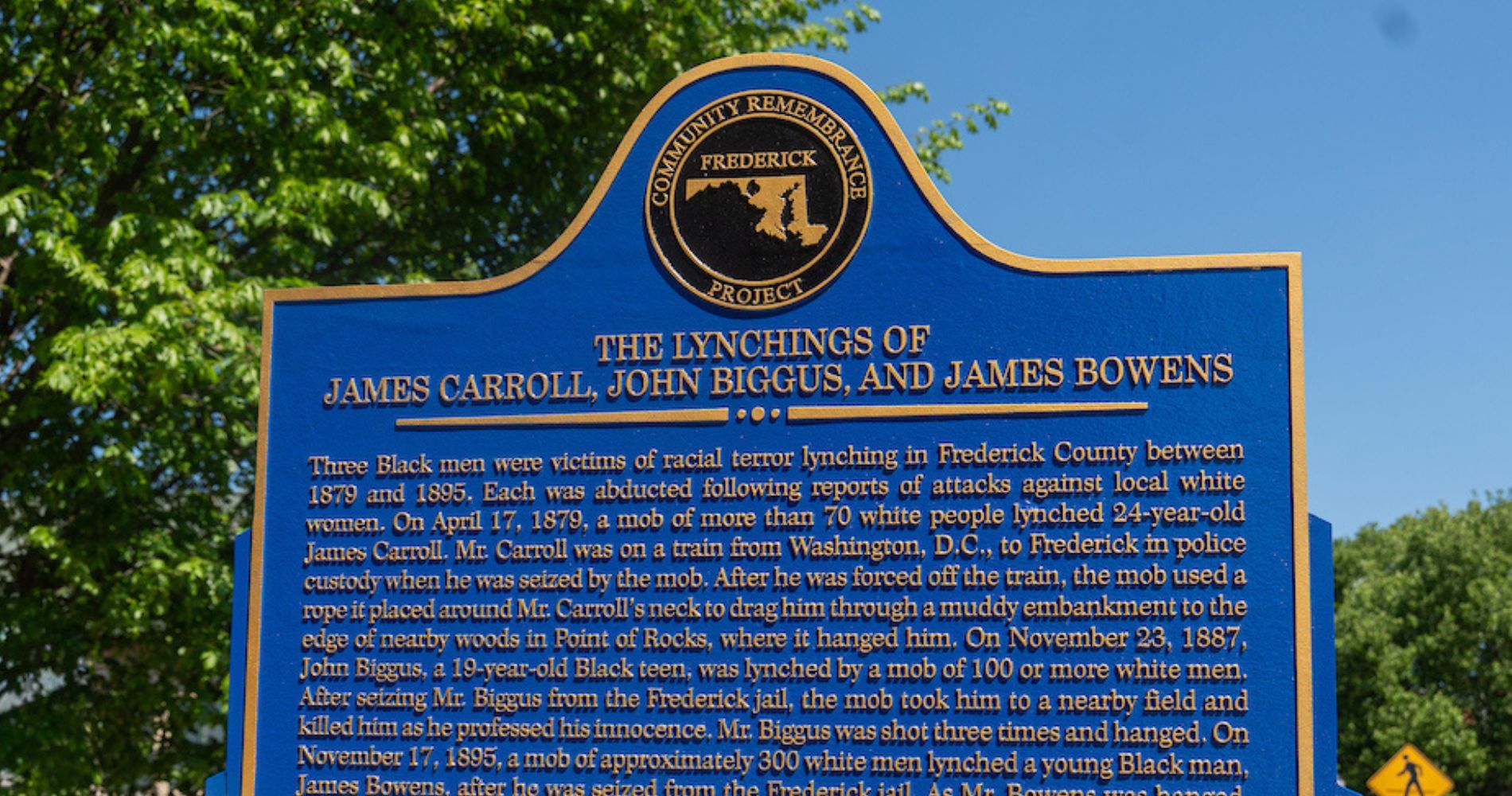
Community leaders and descendants working with EJI dedicated a historical marker in Frederick County, Maryland, memorializing lynching victims James Carroll, John Biggus, and James Bowens.
Facilitated by the Frederick Remembrance Memorial Coalition, the April 18 dedication ceremony was held on historic South Market Street near Carroll Creek in downtown Frederick. Descendants of John Biggus and James Bowens spoke at the event, in addition to local officials, including County Executive Jessica Fitzwater and Mayor Michael O’Connor.
Organizer Tina Allen began the ceremony expressing the importance of memorializing lynching victims and confronting the legacy of racial terror. “Today, we are here to honor the lynching victims James Carroll, John Biggus, and James Bowens.”
Counties across Maryland have partnered with EJI to honor the victims of racial terror lynchings with historical narrative markers as a part of EJI’s Community Remembrance Project.
An opening prayer was led by the Rev. Ernest Thomas, who prayed for the county to have “the strength to confront the legacy of this violence, to speak truth, and to walk humbly towards true racial reconciliation and justice.” The purpose of the ceremony, he said, was to “honor the lives of all the victims by ensuring this history is not forgotten, and by building a community where all are safe, protected, and treated with dignity.”
Ms. Fitzwater presented the Frederick Remembrance Memorial Coalition with a certificate of recognition and shared a proclamation declaring April 18th as Frederick Remembrance Memorial Day in Frederick County.
“It is moments like this that remind us what a special place Frederick County is,” Ms. Fitzwater said, observing that it is home to diverse multi-ethnic communities today. “It is essential that all residents become aware of the painful legacy of racism and discrimination faced by African Americans through openly commemorating, reflecting on, and grieving past injustices. The county strives to promote healing and advanced reconciliation for all.”
Jane Weir, a local family history researcher, told the stories of the three lynchings commemorated on the historical marker and expressed the hope that their stories would not be forgotten. “It’s important for the truth to come out and to be taught,” she said, “not silenced.”
Robin Dorsey-Cosley, the grand-niece of victim John Biggus, described her family’s discovery of this painful history and their efforts to find out—and share—the truth about what happened to their loved one. “We should be able to talk about it,” she told participants, expressing gratitude for the community support that made possible “this commemorative moment in honor of the ones whose lives were taken without true justice being served.”
EJI Project Manager Mia Taylor spoke about the significance of the community coming together to address and confront the damage created by this history. “You are embracing the process of truth, justice, and reconciliation with difficult histories that is essential for us to recover from a history of racial injustice.”
Terrence Boyd’s moving rendition of “Total Praise” was followed by Mayor Michael O’Connor, who apologized on behalf of the city for the acts and omissions of government officials that contributed to the three racial terror lynchings.
“I ask each of us to let this moment guide us, let it deepen our commitment to being a community where truth is not feared, where justice is not delayed, and where every person’s story is honored,” the mayor said. “May this place serve as a place of reflection, a place where we remember James Carroll, John Biggus, and James Bowens.”
Before the marker was unveiled, organizer Tina Allen announced that the marker would be given over to the city. “The Frederick Remembrance Memorial Coalition will continue its work,” she said. “This is just the beginning.”
Lynching in Frederick County
Three Black men were victims of racial terror lynching in Frederick County between 1879 and 1895. Each was abducted from police custody following reports of attacks against local white women. Prominent citizens of Frederick were involved in the killings, Ms. Weir told the audience at the dedication, but no one was held accountable for the lynching of James Carroll, John Biggus, or James Bowens.
James Carroll
On April 17, 1879, a mob of more than 70 white people lynched 24-year-old James Carroll. Mr. Carroll was in police custody, traveling by train from Washington, D.C., to Frederick when he was seized by the mob. After he was forced off the train, the mob tied a rope around Mr. Carroll’s neck and dragged him through a muddy embankment to the edge of the woods in Point of Rocks, where he was hanged.
Members of the mob took souvenirs from the tree and tip of Mr. Carroll’s finger, Jane Weir told the participants. His corpse was left on display until the Frederick County coroner and a constable arrived the next afternoon to cut him down. A coroner’s jury was assembled, but despite numerous witnesses, no one was identified, much less prosecuted, for Mr. Carroll’s murder.
John Biggus
On November 23, 1887, 19-year-old John Biggus was lynched by a mob of 100 or more white people who used axes and a rope from the nearby fire station to break into the Frederick jail. As Ms. Weir recounted, the perpetrators dragged Mr. Biggus out of the jail by a rope tied around his neck and taken down South Street to a nearby field as he professed his innocence.
The men threw the rope around a tree limb and began to hoist Mr. Biggus up from the ground. As he slowly suffocated, he was shot three times.
James Bowens
On November 17, 1895, a mob of approximately 300 white people lynched a young Black man, James Bowens, after seizing him from the Frederick jail. Ms. Weir said the mob dragged Mr. Bowens to the same exact field where they had murdered John Biggus eight years earlier. As Mr. Bowens was hanged, one of the perpetrators fired a gunshot into his head.
After the killing, a member of the mob announced that they had murdered Mr. Bowens “to teach men of his class that they must let the white women of Frederick county alone or suffer the consequences.” Ms. Weir noted that some people took photos of Mr. Bowens’s corpse as mementos and after the coroner cut him down, the rope used to hang him was divided up and the pieces distributed as souvenirs.
Lynching in America
Over 6,500 Black men, women, and children were killed in racial terror lynchings in the U.S. between 1865 and 1950. After the Civil War, many white people in the South opposed equal rights for Black people, and lynching emerged as the most public and notorious form of racial terrorism used to enforce racial hierarchy.
Almost 25% of documented lynchings were sparked by charges of inappropriate behavior between a Black man and a white woman that was often characterized as “assault” at a time when the mere accusation of sexual impropriety regularly fueled fatal mob violence.
In this era, it was common for lynch mobs to seize their victims from jails, prisons, courtrooms, or out of police hands. Though they were armed and charged with protecting the men and women in custody, police almost never used force to resist white lynch mobs intent on killing Black people. In some cases, police officials were even found to be complicit or active participants in lynchings.
The lynching of African Americans was terrorism, a widely supported campaign to enforce racial subordination and segregation.
Lynch mobs would often enact extreme violence to destroy the body of a victim, then allow the victim to hang for hours, preventing the family from claiming their loved one, in an attempt to maintain the racial order through the threat of violence to the entire Black community.
James Carroll, John Biggus, and James Bowens are three of at least 34 Black victims of racial terror lynching killed in Maryland between 1865 and 1950.
Community Remembrance Project
The Community Remembrance Project is part of our campaign to recognize the victims of lynching by collecting soil from lynching sites, erecting historical markers, and developing the Legacy Sites in Montgomery.
EJI believes that by reckoning with the truth of racial violence, communities can begin a necessary conversation that advances healing and reconciliation.
Facts Only
A historical marker was dedicated on April 18 in Frederick County, Maryland, to honor lynching victims James Carroll, John Biggus, and James Bowens.
The ceremony was organized by the Frederick Remembrance Memorial Coalition and supported by the Equal Justice Initiative (EJI).
Descendants of John Biggus and James Bowens spoke at the event, along with local officials, including County Executive Jessica Fitzwater and Mayor Michael O’Connor.
Fitzwater presented a certificate of recognition and declared April 18 as Frederick Remembrance Memorial Day.
The marker commemorates three racial terror lynchings in Frederick County: James Carroll in 1879, John Biggus in 1887, and James Bowens in 1895.
Each victim was abducted from police custody and killed by white mobs.
No one was held accountable for the lynchings.
Over 6,500 Black individuals were lynched in the U.S. between 1865 and 1950.
The Community Remembrance Project includes soil collection, historical markers, and public dialogue to address racial violence.
Executive Summary
Full Take
The dedication of the historical marker in Frederick County represents a deliberate effort to confront a painful legacy of racial violence, framing truth-telling as a pathway to healing. The ceremony’s structure—featuring descendants, officials, and community leaders—reflects a collective acknowledgment of systemic injustice, a pattern increasingly seen in memorialization efforts across the U.S. The emphasis on "not forgetting" and "speaking truth" aligns with broader movements to reckon with historical trauma, though it also raises questions about the limits of symbolic gestures in addressing ongoing inequities.
The article’s focus on the mechanics of the lynchings—mob violence, complicit authorities, and the display of victims’ bodies—serves as a stark reminder of how racial terror functioned as a tool of social control. The repetition of similar details across the three cases (e.g., abduction from custody, public spectacle) underscores the systemic nature of these acts, not isolated incidents. However, the narrative stops short of exploring how these historical patterns persist in modern institutions, leaving room for readers to question what accountability looks like today.
The Community Remembrance Project’s approach—markers, soil collection, and public dialogue—mirrors other truth-and-reconciliation initiatives, but its long-term impact depends on sustained engagement beyond ceremonial moments. The article’s framing of the event as "just the beginning" hints at this tension: between memorialization and material change. Who benefits from this reckoning? The descendants gain recognition, the community gains a shared narrative, but does this translate into policy shifts or reparative justice? The absence of dissenting voices in the article also warrants scrutiny—are there community members who view this as performative rather than transformative?
**Patterns detected: none**
**Bridge questions:**
How might this memorialization effort intersect with contemporary racial justice movements in Frederick County?
What structural barriers prevent historical acknowledgment from leading to systemic change?
How do communities balance the need for healing with the risk of re-traumatization when revisiting violent histories?
Sentinel — Human
This text reads as high-quality, human-authored commemorative journalism, characterized by specific local details, personal testimonies, and a coherent narrative structure focused on historical justice.