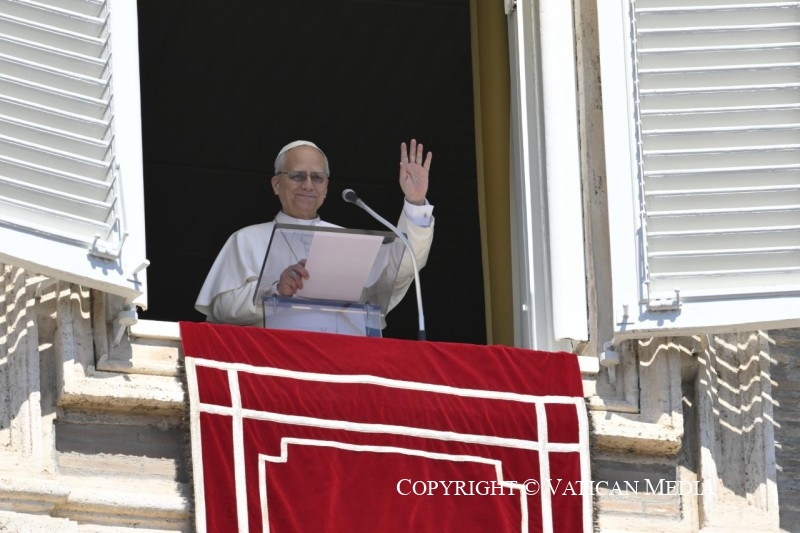
ROME – Pope Leo XIV led the Regina Caeli prayer with pilgrims and tourists gathered in St. Peter’s Square on Easter Monday – a national holiday called Pasquetta or “Little Easter” in Italy – and prayed for his predecessor Francis, who died on Easter Monday of last year after a long battle with respiratory illness.
“With particular affection, in the light of the risen Lord, we remember today Pope Francis, who, on Easter Monday of last year, returned to the Lord,” Leo said in his April 6 Regina Caeli address.
Recalling what he said was Francis’s “profound witness of faith and love,” Leo asked faithful to pray together, “that we may become ever more radiant heralds of the truth.”
Easter Monday is also called lunedi dell’Angelo, or “Angel Monday” in Italy, and is recognized as an official public holiday in scores of predominantly Christian countries around the world.
During the Easter liturgical season, the pope recites the traditional Marian Regina Caeli (coeli) prayer instead of the Angelus on Sundays and special holidays, including Pasquetta.
In his address Monday, Pope Leo focused on the day’s Gospel reading, in which Mary Magdalene meets the risen Jesus while running to announce his resurrection to the disciples, as well as efforts by the leaders of the Sanhedrin to bribe the guards at Jesus’s tomb into saying he had not risen, but that his body had been stolen.
From this one fact, Jesus’s rising from the dead, two narratives are spread, “one a source of new and eternal life, the other of certain and definitive death,” Leo said.
“This contrast invites us to reflect on the value of Christian witness and the integrity of human communication,” he said, lamenting that the proclamation of the truth is often “obscured by what we today call ‘fake news’ — lies, insinuations, and unfounded accusations.”
However, in the midst of this web of often conflicting information, “the truth does not remain hidden; rather, it comes forth to meet us, living and radiant, illuminating even the deepest darkness,” he said.
Just as Jesus told the women at the tomb not to be afraid to go and tell others what they’d seen, Christ offers the same message to Christians now, “Do not be afraid; go and tell,” the pope said.
By doing this, Jesus himself “becomes the Good News to be witnessed in the world,” he said, saying, “the Passover of the Lord is our Passover – the Passover of all humanity – for this man who died for us is the Son of God, who gave his life for us.”
“Just as the risen One, ever living and present, frees the past from a destructive end, so the Easter proclamation redeems our future from the tomb,” he said.
Pope Leo stressed the importance of the Gospel message reaching all those “oppressed by the evil that corrupts history and confuses consciences,” specifically mentioning those suffering war, those persecuted for their faith, and children deprived of education.
“To proclaim the Paschal mystery of Christ in both word and deed means to give a new voice to hope – a hope otherwise stifled by the hands of the violent,” the pope said.
“Wherever it is proclaimed, the Good News sheds light upon every shadow, in every age,” he said, and in a greeting to faithful after the Regina Caeli prayer thanked everyone for their Easter greetings and urged Christians to persevere “in invoking the gift of peace for the whole world.”
Follow Elise Ann Allen on X: @eliseannallen
Facts Only
Pope Leo XIV led the Regina Caeli prayer in St. Peter’s Square on April 6, Easter Monday.
Easter Monday is a national holiday in Italy called Pasquetta or "Little Easter."
Pope Francis died on Easter Monday of the previous year after a respiratory illness.
Pope Leo XIV mentioned Francis in his address, calling him a witness of faith and love.
The Regina Caeli prayer replaces the Angelus during the Easter liturgical season.
The Gospel reading for the day included Mary Magdalene meeting the risen Jesus and the Sanhedrin bribing guards to claim Jesus’s body was stolen.
Pope Leo XIV contrasted the truth of the resurrection with false narratives, referencing modern "fake news."
He called on Christians to proclaim hope and truth, especially for those suffering from war, persecution, or lack of education.
The pope urged prayers for global peace after the Regina Caeli prayer.
Easter Monday is also known as "Angel Monday" in Italy.
The holiday is recognized as a public holiday in many predominantly Christian countries.
The address took place in St. Peter’s Square with pilgrims and tourists present.
Executive Summary
Pope Leo XIV led the Regina Caeli prayer in St. Peter’s Square on Easter Monday, a holiday known as Pasquetta or "Little Easter" in Italy. He prayed for his predecessor, Pope Francis, who died on the same day last year after a long respiratory illness. Leo highlighted Francis’s "profound witness of faith and love" and called for Christians to be "radiant heralds of the truth." The address focused on the Gospel reading of Mary Magdalene encountering the risen Jesus and the Sanhedrin’s attempt to spread disinformation about the resurrection. Leo contrasted the life-giving truth of Christ’s resurrection with the "definitive death" of false narratives, drawing parallels to modern "fake news." He emphasized the redemptive power of the Easter message, particularly for those suffering from war, persecution, or lack of education, and urged Christians to proclaim hope in the face of violence. The Regina Caeli, a Marian prayer, replaces the Angelus during the Easter season.
Easter Monday, also called "Angel Monday" in Italy, is a public holiday in many Christian-majority countries. The pope’s address blended theological reflection with contemporary concerns, framing the resurrection as a counter to deception and oppression. He concluded by thanking the faithful for their Easter greetings and praying for global peace.
Full Take
The strongest version of this narrative presents Pope Leo XIV as a bridge between tradition and contemporary challenges, using the resurrection story to critique modern disinformation while reinforcing the Catholic Church’s moral authority. The address skillfully weaves theological reflection with urgent social concerns—war, persecution, and education—positioning the Church as a beacon of truth in a fragmented world. The contrast between the Sanhedrin’s deception and Mary Magdalene’s witness serves as a timeless allegory for today’s "fake news" landscape, lending the message both historical weight and immediate relevance.
Pattern-wise, the framing is largely constructive, though it leans on a classic *ARC-0024 Ambiguity* play by equating ancient biblical deception with modern media manipulation without explicit evidence linking the two. The call to "proclaim hope" amid violence also risks *ARC-0043 Motte-and-Bailey*—the Church’s moral high ground (motte) could retreat into vague calls for peace (bailey) when pressed on specific conflicts. That said, the address avoids overt emotional exploitation or bad-faith tactics, focusing instead on doctrinal consistency.
Rooted in the Catholic paradigm of redemptive suffering, the narrative assumes that truth is inherently liberating and that institutional religion remains the most reliable arbiter of moral clarity. This echoes historical patterns of the Church positioning itself as a counterforce to secular chaos, from the Enlightenment to the digital age. The implications for human agency are double-edged: while empowering believers to act as "heralds of truth," it also centralizes authority in the papacy, potentially sidelining grassroots dissent.
Who benefits? The Vatican’s moral credibility is reinforced, especially among faithful seeking solace in turbulent times. Who bears costs? Those who view religious institutions as complicit in historical injustices may see this as performative rather than transformative. Second-order consequences could include heightened polarization if the "fake news" critique is weaponized by partisan actors.
Bridge questions: How might the Church’s call for truth-telling apply to its own historical transparency? What alternative frameworks for hope exist outside religious institutions? Would the narrative’s resonance change if delivered by a non-religious leader?
Counterstrike scan: A bad actor pushing this narrative might amplify the "fake news" framing to undermine secular media while avoiding accountability for the Church’s own scandals. The actual content, however, focuses on spiritual resilience rather than attacking specific adversaries, making it a clean alignment with doctrinal teaching rather than a coordinated influence operation.
Sentinel — Human
This analysis suggests that the article is likely human-written, exhibiting signs of a human writer's style and personal voice. However, it does not definitively rule out the possibility of AI assistance.