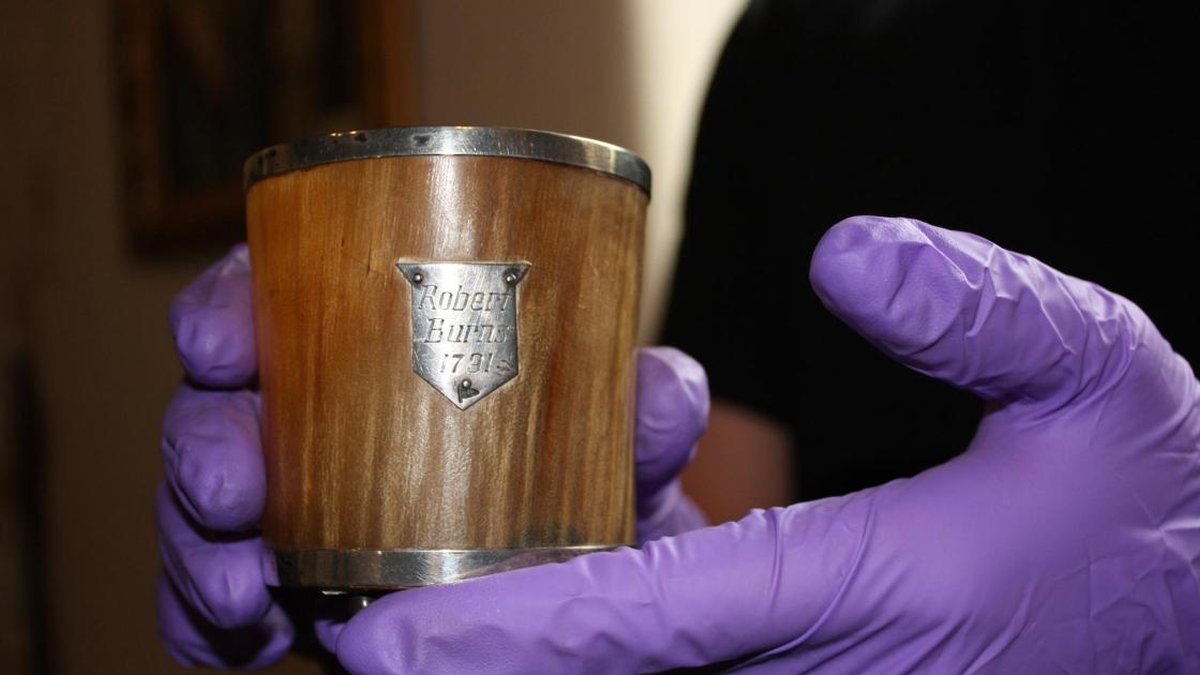
A DRINKING cup that belonged to Robert Burns has returned from Australia to go on show at the farmhouse where the poet is thought to have used it more than 200 years ago.
The cup was owned by the Taylor family for many generations after they bought it at a sale of the poet’s effects in 1791.
In the years that followed, it descended through seven generations of the family, who around 1805 acquired Ellisland Farm, the home Burns designed and lived in from 1788 to 1791.
READ MORE: Family-run Aberdeen farm named UK's best ice cream parlour of 2026
Early in the 20th century it was taken to Australia by a member of the family who emigrated and was treated as a treasured heirloom.
The cup recently surfaced at an auction in Australia and was identified by the Robert Burns Ellisland Trust as an object of potential national significance.
It was bought at auction by an Australian antiques dealer and conservation work was carried out before it was offered for onward sale.
The cup has now been acquired by the Robert Burns Ellisland Trust with help from the National Fund for Acquisitions and will go on display later this month at Ellisland Museum and Farm near Dumfries.
Adam Dickson, project curator at the Robert Burns Ellisland Trust, said: “Every new piece of evidence at Ellisland deepens our understanding of what makes this place so exceptional.
“Objects like this are particularly precious because they connect us directly to Burns’s daily life.
“The cup has had a remarkable afterlife, and it was even used at a Burns Supper in Adelaide in 1956, where it was drunk from by the governor of South Australia, Sir Robert George.
“Its journey has parallels with the reach of Burns’s legacy, carried around the world by the Scottish diaspora.
“To have the cup back at Ellisland, in the room where Burns would very likely have used it, is an extraordinary moment for the collection and for everyone who cares about this place.”
The cup is made of horn and was later embellished with a silver rim, edging and provenance plaque.
The trust was able to authenticate the cup against its own detailed research into the Taylor family and their descendants, which was carried out by Logan Fry, a local student who helps with curatorial research.
Dickson said: “We are very grateful to the National Fund for Acquisitions for making this acquisition possible and to Logan whose meticulous research helped us prove its authenticity.”
READ MORE: All jobs lost as Glasgow electrical company collapses into administration
The trust is running a £12 million “Save the Home of Auld Lang Syne” appeal to restore the site and secure its future.
The cup arrived back in Scotland in May and is undergoing a gradual acclimatisation process to minimise any impact of changes in temperature and humidity following its return from Australia.
It will go on display on July 21, the anniversary of the poet’s death in 1796.
The National Fund for Acquisitions is administered by National Museums Scotland on behalf of the Scottish Government.
Dr Hazel Williamson, National Fund for Acquisitions manager at National Museums Scotland, said: “We are delighted to support the acquisition of this cup, used by Burns at Ellisland Farm where he wrote some of his most celebrated works.
“The support provided by the National Fund for Acquisitions is vital in enabling museums and other heritage organisations in Scotland to continue the important work of preserving our shared heritage”.
Burns wrote works such as Auld Lang Syne and Tam o’ Shanter while living at Ellisland.
Dr David Hopes, trustee of the Robert Burns Ellisland Trust, Head of Leeds Museums & Galleries and former Director of the Robert Burns Birthplace Museum in Alloway, said: “This is a genuinely important acquisition for Ellisland. It is a modest object but that’s what makes it valuable to Ellisland, because it speaks to his daily life here.
“This is a cup Burns would have drunk from at his own table, and its return to Ellisland is an important moment for the wider Burns collections landscape in Scotland.
“That the cup will go on permanent display in Burns’s spence, the room in which Burns wrote of raising a cup of kindness in remembrance of old friends, brings a poignant symmetry to the object’s return.”