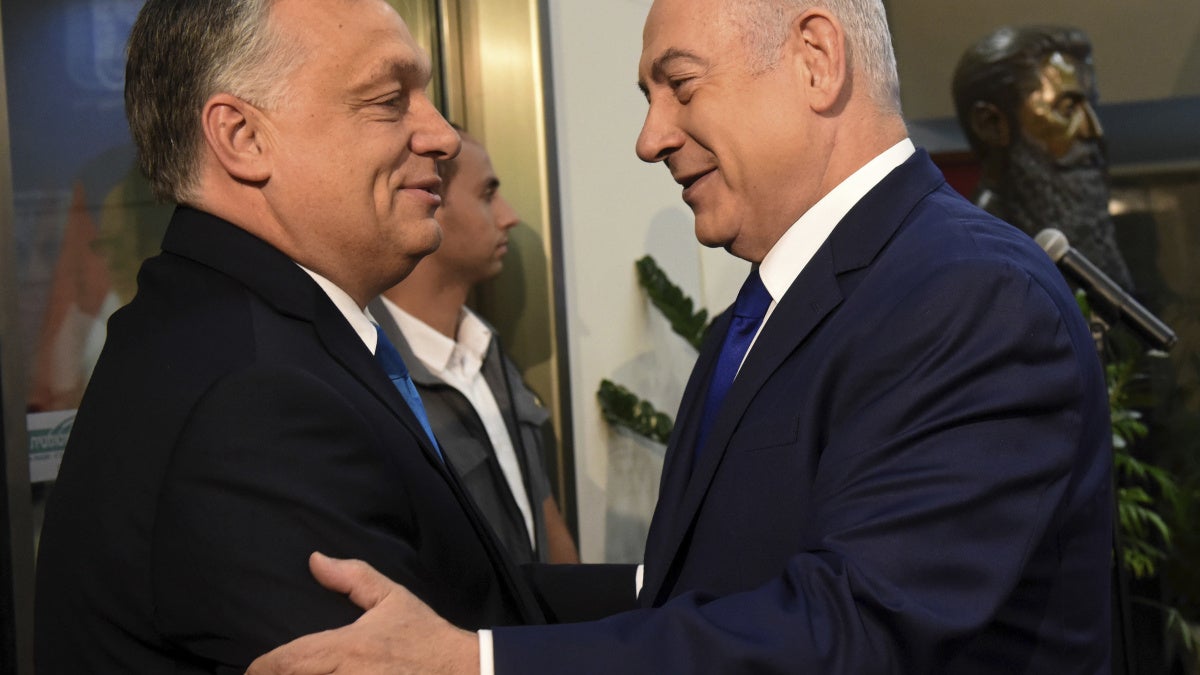
(Brussels) – Hungarian authorities should arrest Israeli Prime Minister Benjamin Netanyahu if he enters Hungarian territory, Human Rights Watch said today. Netanyahu is expected to travel to Hungary on March 21, 2026, to speak at the Conservative Political Action Conference Hungary, an official source reported. The visit comes shortly before Hungary’s national elections, scheduled for April 12.
On November 21, 2024, the International Criminal Court (ICC) issued an arrest warrant for Netanyahu, alongside then-Israeli Defense Minister Yoav Gallant, over alleged crimes against humanity and war crimes committed in the Gaza Strip from at least October 8, 2023. Both Netanyahu and Gallant remain fugitives from justice before the ICC. ICC members countries are required to arrest them if they enter their territory.
“Despite its move to leave the ICC, Hungary is still a member country and is still obligated to arrest and surrender individuals wanted by the court,” said Alice Autin, international justice researcher at Human Rights Watch. “By flouting this obligation, for the second time in less than a year, Hungary would further entrench impunity for serious crimes in Palestine and once again betray victims who have been denied justice for far too long.”
Netanyahu’s planned visit to Hungary is set to take place as Israel and the United States carry out thousands of airstrikes on Iran, and Iran responds with hundreds of strikes on Israel and the Gulf states. In early March, the Israeli military escalated its attacks in Lebanon and ordered the immediate evacuation of large areas of southern Lebanon and Beirut’s southern suburbs, raising a real likelihood of the commission of the war crime of forced displacement. The escalating hostilities and mounting risks of serious violations of international human rights and humanitarian law underscore the urgent need to respect the rule of law and support credible avenues for justice, such as the ICC, Human Rights Watch said.
Since October 2023, Israeli forces have carried out war crimes, crimes against humanity, and acts of genocide in the Gaza Strip. The continued restriction on aid entering Gaza has caused critical shortages of medicines, reconstruction equipment, food, and water.
In April 2025, Netanyahu visited Hungary, but the Hungarian authorities did not arrest him. In July, ICC judges found that Hungary failed to comply with its obligation to cooperate with the court and referred the finding to its oversight body, the Assembly of States Parties. During its annual session in December, the Assembly noted the judicial finding but failed to take more decisive action. ICC member countries should strengthen their responses to noncooperation.
During the April 2025 visit, Hungarian Prime Minister Viktor Orbán announced his government’s intention to withdraw from the ICC treaty, the Rome Statute. On June 2, Hungarian authorities formally notified the United Nations secretary-general of Hungary’s withdrawal, which will take effect on June 2, 2026, one year later. Hungarian international lawyers and civil society organizations criticized the decision to withdraw from the ICC.
Since 2010, Orbán has used his supermajority in parliament to undermine the independence of the judiciary, crack down on independent media and civil society organizations, demonize migrants and asylum seekers, discriminate against LGBT people, and undercut women’s and girls’ rights. By declaring various states of danger or emergency, Orbán’s government has effectively ruled by decree, sidestepping parliament altogether.
The European Union has a clear legal framework that governs its relationship with and support for the ICC. EU members and institutions have nonetheless failed to take sufficient measures to prevent Hungary’s undermining of the ICC and Orbán’s broader attack on the rule of law, Human Rights Watch said.
In 2018, the European Parliament initiated a procedure under article 7 of the EU treaty to assess the risk that Hungary’s erosion of the rule of law breaches fundamental EU values, but EU member states in the European Council have, so far, failed to take any concrete action.
The European Commission indicated in May 2025 that it was “in the process of analyzing Hungary’s announced withdrawal from the ICC in the light of the EU’s acquis,” that is, the body of EU law which includes respect for human rights, democracy, and the rule of law. But there is no indication that the Commission’s assessment has progressed.
EU leadership and member states, along with other ICC member countries, should press Hungary to reverse its withdrawal from the court, publicly remind Hungary of its ongoing obligations as an ICC member, and urge Hungarian authorities to cooperate with the court by arresting Netanyahu. If the visit takes place, they should strongly condemn Hungary’s continued failure to cooperate with the court and unambiguously reaffirm their own commitment to execute all pending ICC warrants, regardless of whom they target, Human Rights Watch said.
The European Commission and EU member states should also consider Hungary’s decision to leave the ICC as a further risk of serious breach of fundamental EU values, and consider including the withdrawal in the scope of the current procedure under article 7. They should also assess what other measures and action should be taken. This could include initiating a procedure that could lead to a finding that Hungary has infringed EU law.
“Orbán’s government is about to roll out the red carpet again for Netanyahu, when it is obligated to arrest him,” Autin said. “Silence and persistent inaction from the EU risks sending a dangerous message of acquiescence as the Israeli government continues to be responsible for atrocities.”
Facts Only
* Hungary intends to allow Benjamin Netanyahu to speak at the Conservative Political Action Conference Hungary on March 21, 2026.
* The ICC issued an arrest warrant for Netanyahu and Yoav Gallant on November 21, 2024, related to alleged crimes in the Gaza Strip.
* Hungary is a member of the ICC.
* Hungary announced its intention to withdraw from the ICC treaty (Rome Statute).
* The withdrawal is effective one year later, on June 2, 2026.
* Human Rights Watch calls for Netanyahu's arrest if he enters Hungary.
* Hungary’s withdrawal from the ICC was criticized by Hungarian lawyers and civil society organizations.
* Orbán’s government has a history of undermining the judiciary and suppressing dissent.
* The European Union has not taken sufficient action to prevent Hungary’s non-cooperation with the ICC.
* The conflict between Israel and Iran is occurring concurrently.
* Israeli forces are conducting airstrikes and Lebanon has been ordered to evacuate areas.
Executive Summary
Full Take
Pattern detected: ARC-0018 Shifting Goalposts – The narrative begins with a specific action (Netanyahu’s planned visit) and immediately shifts to the ICC warrant, essentially re-framing the core issue. This is a classic tactic of deflecting scrutiny by introducing an external complication.
Pattern detected: ARC-0043 Motte-and-Bailey – The article presents Hungary's withdrawal from the ICC as a continuation of its obligations (“still obligated”), while simultaneously arguing it *should* arrest Netanyahu. This is a layered argument, accepting the initial claim of obligation while subtly undermining it. The “motte” is the stated obligation, the “bailey” is the demand for arrest.
Pattern detected: ARC-0011 Narrative Control – The framing consistently emphasizes the potential for impunity and the “dangerous message of acquiescence” should Hungary fail to act. This isn’t simply reporting facts; it’s actively shaping the reader’s perception of the situation to elicit a specific response – pressure on the EU.
Root Cause: This narrative leverages a fundamental tension between national sovereignty and international law. The underlying paradigm is a contest between states’ perceived rights to self-determination and the global effort to establish universal standards of justice. Hungary’s actions represent a deliberate challenge to this paradigm, seeking to prioritize national interests above international accountability. The assumption is that the ICC is inherently biased and illegitimate, a common justification offered by states resisting external legal oversight.
Implications: The situation raises profound questions about the future of international justice mechanisms. If powerful states can simply withdraw from international courts when they are perceived as a threat, the ICC’s effectiveness is severely compromised. This could embolden other states to disregard international law, furthering instability and potentially escalating conflicts. The continued restriction of aid to Gaza underscores the human cost of this legal battle – civilians suffering from shortages of essential goods.
Bridge Questions: How can international legal bodies maintain legitimacy and enforce accountability when faced with powerful actors willing to disregard international norms? What are the long-term consequences of states selectively choosing which international laws to adhere to? Is there a viable mechanism for ensuring that withdrawal from international institutions does not permanently shield individuals from justice?
Counterstrike Scan: If this narrative were part of a coordinated campaign, a bad actor would likely amplify the claims of “dangerous message of acquiescence” and “further entrench impunity,” focusing on the potential impact on other conflicts or human rights abuses. They would likely release carefully edited footage of Netanyahu’s visit, framing it as a defiant act of sovereignty and emphasizing the perceived Western bias within the ICC. Given this scenario, the current analysis successfully identifies the potential for manipulation – the framing is designed to provoke a visceral reaction and discourage critical examination.
Sentinel — Uncertain
The article presents a heavily structured analysis of the situation concerning Netanyahu's visit to Hungary, utilizing language patterns and argumentative frameworks often associated with AI-assisted content generation. While it contains factual details, the consistency and emphasis on neutral framing raise concerns about potential synthetic origin.