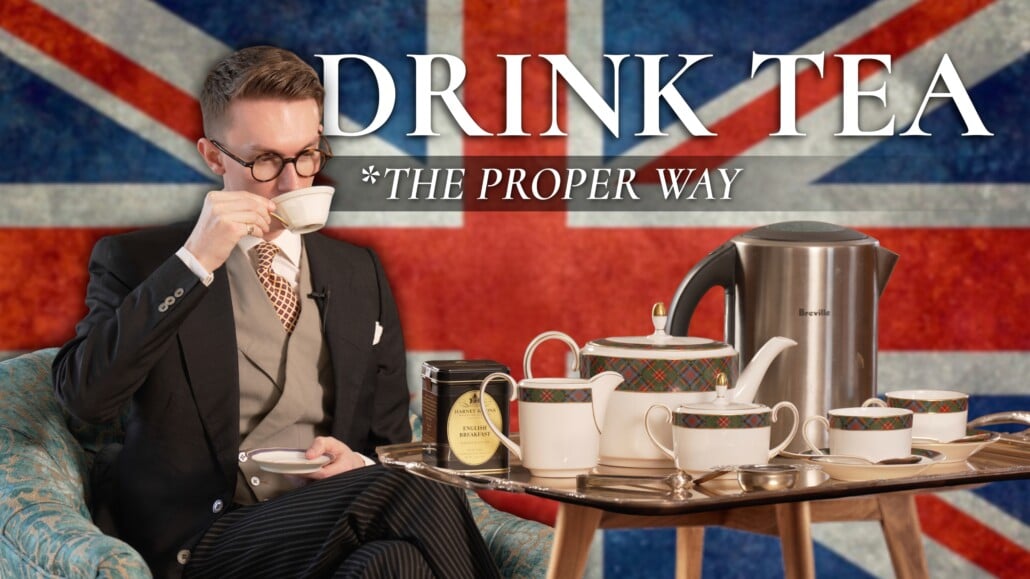
For something so ordinary, tea can become remarkably refined when it is approached with a little care. The tools matter, the brewing matters, and the etiquette matters. But more than anything, tea offers a chance to slow down, show consideration for others, and turn a simple drink into a civilizing ritual.
Here is the essential guide to brewing and drinking tea with refinement.
- Tea Is More Than a Drink
- What You Need for Proper Tea Service
- Choose the Right Tea Set
- Why Loose-Leaf Tea Is Best
- How to Brew Tea Properly
- How to Prepare Milk, Sugar, and Lemon
- How to Pour Tea for Guests
- How to Add Milk and Sugar Correctly
- How to Hold a Cup and Saucer Properly
- How to Drink Tea at a Table, Seated Away from a Table, or Standing
- Tea Etiquette Mistakes to Avoid
- The Real Mark of a Gentleman at Tea
- Drinking Tea FAQs
- More Etiquette Guides for Men
Tea Is More Than a Drink
Like other gentlemanly pursuits, it has its own traditions, its own tools, and its own standards of conduct. None of them need to feel stiff or theatrical, but they do encourage a more thoughtful approach.
A proper cup of tea rewards patience, neatness, and attention to the people around you. It is as much about hospitality and courtesy as it is about flavor.
“Would you like an adventure now, or would like to have your tea first?”
J. M. Barrie, Peter Pan
What You Need for Proper Tea Service
A traditional tea service does not need to be extravagant, but it should include the essentials.
For a proper setup, you will need:
- a kettle
- a teapot
- a milk jug
- a sugar bowl
- a sugar spoon or sugar tongs
- a cup and saucer for each person
- a teaspoon for each person
- a tea strainer
- loose-leaf tea
- an optional tea tray
These pieces are worth having, but they do not need to be expensive. Vintage, thrift, and charity shops are often excellent places to find quality tea sets at very reasonable prices, especially older sets that were rarely used.
The Thrill of the Antique Hunt
Choose the Right Tea Set
At a minimum, teacups and saucers should be made of bone china. It is thinner, lighter, and generally more elegant than heavier ceramic wares. It also gives a finer drinking experience than bulkier cups.
For the teapot, there are two traditional routes:
- a matching tea set, where the teapot, cups, saucers, milk jug, and sugar bowl all belong together
- a silver-plated teapot, usually paired with matching silver-plated milk and sugar pieces
If your service includes both a teapot and a coffee pot, it helps to know how to tell them apart. A teapot is usually shorter, rounder, and squatter, while a coffee pot is taller and more tapered.
Why Loose-Leaf Tea Is Best
Proper tea is brewed with loose leaves, not gimmicky infusers or low-quality shortcuts. Loose leaves need room to circulate so they can infuse fully and produce a better cup.
RECOMMENDED
English Breakfast Loose-Leaf Tea – Harney & Sons
A classic English Breakfast blend made from robust black tea leaves. Ideal for traditional tea service, it produces a full-bodied cup that pairs perfectly with milk and sugar.
That is why a tea strainer is one of the most important pieces in the entire service. It filters the leaves as the tea is poured into the cup, keeping the drink smooth without sacrificing the quality of a real infusion.
A stainless steel strainer is perfectly practical, while a silver-plated one makes a fine traditional upgrade or gift.
Learn How to Give Great Gifts
How to Brew Tea Properly
The brewing stage sets the tone for everything that follows. Good tea service begins with good tea, and that means getting the basics right.
1. Use the right water temperature
For a classic black tea such as English Breakfast, the water should reach a full boil, about 100°C / 212°F.
2. Use filtered water when possible
Hard water with high mineral content can flatten or weaken the flavor of tea. Filtered water generally produces a cleaner result.
3. Warm the teapot first
Before adding tea leaves, pour a little hot water into the teapot and replace the lid briefly. This gently warms the pot and helps maintain the brewing temperature.
4. Add the correct amount of tea
Use one portion of tea per person, plus one extra for the pot. A caddy spoon is traditional, but a heaped teaspoon works well.
5. Fill the pot correctly
Once the leaves are in, pour in freshly boiled water until the pot is about three-quarters to four-fifths full. Leaving a little extra space helps keep heat and steam circulating inside.
6. Steep patiently
Allow the tea to steep for three to five minutes, depending on how strong you want it.
“I say let the world go to hell, but I should always have my tea.”
Fyodor Dostoevsky, Notes from Underground
How to Prepare Milk, Sugar, and Lemon
While the tea is steeping, prepare whatever accompaniments will be offered with it.
Prepare the Milk and Sugar
Milk should be poured into a spouted milk jug. Sugar belongs in a sugar bowl, served either as coarse white granulated sugar with a communal spoon or as white sugar cubes with sugar tongs.
Traditional tea service is fairly specific here.
- White sugar is for tea
- Brown sugar is for coffee
- Caster sugar belongs in baking, and
- Powdered sugar belongs on frosting
Serve Lemon Only When Appropriate
Lemon is sometimes served with lighter, more delicate teas rather than with a robust breakfast blend. If it is offered, the slices should be placed on a separate plate with a small fork.
10 Essentials for a Gentleman’s Home
How to Pour Tea for Guests
Once the tea has steeped, it is time to serve. This part should be deliberate and unhurried.
Pour slowly
Tea should never be rushed. Pouring too quickly risks spills and makes the service feel careless.
Always use the strainer
Hold the tea strainer close to the cup and pour the tea gently through it.
Do not overfill the cup
Fill each cup to about three-quarters full. This leaves room for milk or sugar and makes the cup easier to handle safely.
Serve others before yourself
The host should ensure everyone else is served first before pouring a personal cup.
Return the pot within easy reach
After the first round, place the teapot back on the table with the handle positioned conveniently for guests, since later servings are usually handled individually.
15 Habits of a True Gentleman
How to Add Milk and Sugar Correctly
Once the tea has been served, guests may add milk or sugar if they wish.
Add Milk After the Tea
Milk is simply poured from the jug and then returned with consideration for the next person. There has long been debate over whether milk belongs in the cup before or after the tea, but in a group setting, adding milk afterward is the better choice.
It allows each person to judge the strength of the tea more accurately and adjust the cup to taste.
Use Sugar Carefully
If granulated sugar is being used, it should be added with the communal sugar spoon, which is then returned directly to the bowl. That spoon should never touch the tea itself. A wet spoon placed back into the sugar bowl will cause the sugar to clump, which is unpleasant for everyone else.
If sugar cubes are offered, they should be added with the tongs as gently as possible. Dropping a cube carelessly into the tea is a quick way to splash the cup and table.
Stir Neatly
Once milk or sugar has been added, stir with the teaspoon from your saucer. The correct motion is back and forth from 12 to 6 o’clock, not an energetic circular swirl. It is neater, quieter, and more elegant.
How to Hold a Cup and Saucer Properly
Tea etiquette continues once the tea is in the cup.
Position the Cup Correctly on the Saucer
After serving, the cup should be returned to its place on the saucer with the handle positioned between 4 and 5 o’clock for a right-handed person. The teaspoon rests on the saucer parallel to the handle. Left-handed drinkers may simply mirror this arrangement.
Hold the Handle Properly
When lifting the cup, the handle should be pinched lightly between the thumb and forefinger rather than hooked through with the fingers. This is one of the clearest signs of polished tea manners.
❗The pinky finger should remain down.
Despite the stereotype, a raised pinky is not a mark of elegance. The remaining fingers should either be tucked neatly into the palm or used discreetly to steady the cup.
When drinking, the handle will usually settle naturally at 3 o’clock, or 9 o’clock for a left-handed drinker. Once the cup is returned to the saucer, it should go back to its original slight angle.
How to Properly Hold Your Drink
How to Drink Tea at a Table, Seated Away from a Table, or Standing
In every setting, the goal is the same: keep your movements controlled, your posture composed, and the cup and saucer handled with care.
If You Are Seated at a Table
If you are seated at a table, the cup and saucer remain together on the table until you are ready to drink. Lift only the cup to your mouth, leaving the saucer and teaspoon where they are. After each sip, return the cup to the saucer.
If You Are Seated Without a Table
If you are seated without a table, the saucer should be held steady in the non-dominant hand, resting comfortably in the lap or just above it, while the dominant hand lifts only the cup.
The same principle applies: the saucer stays in place, and the cup returns to it immediately after drinking.
If You Are Standing
If you are standing, the saucer is again held in the non-dominant hand, close to the body, usually around the natural waistline for stability. The cup is raised and returned without lifting the saucer toward the face.
In all cases, posture matters. Sit or stand upright, move with control, and keep the entire action composed.
Tea Etiquette Mistakes to Avoid
Much of tea etiquette comes down to avoiding the habits that make the experience feel sloppy or rushed.
- Do not overfill the cup. A teacup filled to the brim is difficult to handle gracefully and leaves no room for milk or sugar.
- Do not blow on the tea. If it is too hot, let it cool naturally rather than risking splashes.
- Do not slurp. Tea should be sipped quietly, not noisily.
- Do not look around the room over the rim of the cup. Lower your gaze into the bowl of the cup as you drink.
- Do not rush. Tea should be savored at an unhurried pace.
The Real Mark of a Gentleman at Tea
The true refinement of tea drinking is not just in the equipment, nor even in the gestures themselves. It lies in the tone you create around the occasion.
Tea Etiquette in Practice
Courtesy Is the Heart of the Ritual
A gentleman treats tea as more than a beverage. He serves carefully, listens as much as he speaks, and makes the people around him feel comfortable and considered. Good tea etiquette is ultimately an expression of courtesy.
That is what gives the ritual its lasting charm. The cup matters, the brewing matters, and the manners matter, but the real mark of a gentleman is the spirit in which the tea is shared.
Drinking Tea FAQs
What is the essence of drinking tea like a gentleman?
Drinking tea like a gentleman is about grace, attentiveness, and tradition. It’s as much about etiquette and appreciation as it is about the beverage itself. A gentleman approaches tea with respect for its history, careful preparation, and a keen awareness of manners.
Should I use loose leaf tea or tea bags?
This question depends on your circumstances and needs, but in general, if serving tea formally for others, loose leaf is usually preferred.
What is the proper way to serve tea?
Pour tea gently so as not to splash.
Offer milk and sugar separately, allowing each guest to tailor their cup.
Always offer guests the tea before serving yourself.
If I take milk and sugar, which goes in first?
Traditionally, milk is added first (“milk-in-first” or MIF) when using delicate china, as it protects the cup from cracking and cools the tea. Sugar, if desired, is added after the tea has been poured.
How should I hold the teacup?
Hold the cup by the handle using your thumb and first finger, with your middle finger tucked underneath for support. Do not hook your finger through the handle or extend your pinky. Bring the cup to your lips gently; never slurp.
May I stir my tea?
Stir quietly and gently. Move the spoon back and forth (not in circles), avoiding clinking against the cup. When finished, place the spoon on the saucer, never leave it in the cup.
Is it ever acceptable to dunk biscuits or food in tea?
In refined company, dunking is considered poor manners. Enjoy accompaniments like scones, biscuits, or sandwiches separately.
How should one address accidental spills or mishaps?
If a spill occurs, address it discreetly and calmly. Apologize softly, use a napkin to tidy up, and avoid drawing attention.
Must I always keep my pinky raised?
No. Raising the pinky is a misconception and is actually seen as a faux pas in traditional etiquette.
What a delightful video! Thank you for an excellent presentation. I would add that Americans sometimes confuse traditional afternoon tea with “high tea.” And although tea is often taken in the afternoon, these rules apply anytime you are serving tea to guests.
I have many tea implements and fine china purchased second hand for practically nothing. When I bring those out for guests, it never fails to delight and impress. It is, in fact, an memorable and inexpensive way to meet up with people, especially at one’s office.
So pleased to hear you enjoyed the video, Randall. I second the positive impact of some good tea ware!
A Nice Cup of Tea
by George Orwell
If you look up ‘tea’ in the first cookery book that comes to hand you will probably find that it is unmentioned; or at most you will find a few lines of sketchy instructions which give no ruling on several of the most important points. This is curious, not only because tea is one of the mainstays of civilization in this country, as well as in Eire, Australia and New Zealand, but because the best manner of making it is the subject of violent disputes.
When I look through my own recipe for the perfect cup of tea, I find no fewer than 11 outstanding points. On perhaps two of them there would be pretty general agreement, but at least four others are acutely controversial. Here are my own 11 rules, every one of which I regard as golden:
First of all, one should use Indian or Ceylonese tea. China tea has virtues which are not to be despised nowadays—it is economical, and one can drink it without milk—but there is not much stimulation in it. One does not feel wiser, braver or more optimistic after drinking it. Anyone who has used that comforting phrase ‘a nice cup of tea’ invariably means Indian tea.
Secondly, tea should be made in small quantities—that is, in a teapot. Tea out of an urn is always tasteless, while army tea, made in a cauldron, tastes of grease and whitewash. The teapot should be made of china or earthenware. Silver or Britannia ware teapots produce inferior tea and enamel pots are worse; though curiously enough a pewter teapot (a rarity nowadays) is not so bad.
Thirdly, the pot should be warmed beforehand. This is better done by placing it on the hob than by the usual method of swilling it out with hot water.
Fourthly, the tea should be strong. For a pot holding a quart, if you are going to fill it nearly to the brim, six heaped teaspoons would be about right. In a time of rationing, this is not an idea that can be realized on every day of the week, but I maintain that one strong cup of tea is better than twenty weak ones. All true tea lovers not only like their tea strong, but like it a little stronger with each year that passes—a fact which is recognized in the extra ration issued to old-age pensioners.
Fifthly, the tea should be put straight into the pot. No strainers, muslin bags or other devices to imprison the tea. In some countries teapots are fitted with little dangling baskets under the spout to catch the stray leaves, which are supposed to be harmful. Actually one can swallow tea-leaves in considerable quantities without ill effect, and if the tea is not loose in the pot it never infuses properly.
Sixthly, one should take the teapot to the kettle and not the other way about. The water should be actually boiling at the moment of impact, which means that one should keep it on the flame while one pours. Some people add that one should only use water that has been freshly brought to the boil, but I have never noticed that it makes any difference.
Seventhly, after making the tea, one should stir it, or better, give the pot a good shake, afterwards allowing the leaves to settle.
Eighthly, one should drink out of a good breakfast cup—that is, the cylindrical type of cup, not the flat, shallow type. The breakfast cup holds more, and with the other kind one’s tea is always half cold—before one has well started on it.
Ninthly, one should pour the cream off the milk before using it for tea. Milk that is too creamy always gives tea a sickly taste.
Tenthly, one should pour tea into the cup first. This is one of the most controversial points of all; indeed in every family in Britain there are probably two schools of thought on the subject. The milk-first school can bring forward some fairly strong arguments, but I maintain that my own argument is unanswerable. This is that, by putting the tea in first and stirring as one pours, one can exactly regulate the amount of milk whereas one is liable to put in too much milk if one does it the other way round.
Lastly, tea—unless one is drinking it in the Russian style—should be drunk without sugar. I know very well that I am in a minority here. But still, how can you call yourself a true tea-lover if you destroy the flavour of your tea by putting sugar in it? It would be equally reasonable to put in pepper or salt. Tea is meant to be bitter, just as beer is meant to be bitter. If you sweeten it, you are no longer tasting the tea, you are merely tasting the sugar; you could make a very similar drink by dissolving sugar in plain hot water.
Some people would answer that they don’t like tea in itself, that they only drink it in order to be warmed and stimulated, and they need sugar to take the taste away. To those misguided people I would say: Try drinking tea without sugar for, say, a fortnight and it is very unlikely that you will ever want to ruin your tea by sweetening it again.
These are not the only controversial points to arise in connection with tea drinking, but they are sufficient to show how subtilized the whole business has become.
There is also the mysterious social etiquette surrounding the teapot (why is it considered vulgar to drink out of your saucer, for instance?) and much might be written about the subsidiary uses of tealeaves, such as telling fortunes, predicting the arrival of visitors, feeding rabbits, healing burns and sweeping the carpet.
It is worth paying attention to such details as warming the pot and using water that is really boiling, so as to make quite sure of wringing out of one’s ration the 20 good, strong cups that two ounces, properly handled, ought to represent.
Evening Standard, 12 January 1946
Thank you for sharing!
Dear Mr. Collins,
This essay on the ritual of sharing tea was a lot of fun to watch. I keep learning the basics and the subtleties about how to be a gentleman through watching GG videos and I also read the text that accompanies the video.
A college friend wrote an essay for English class about an epic camping trip that we did circa 1978, titled, Cave Man. And I was that very unrefined young man.
Yes, I have learned a few pointers between then and now, but my largest steps toward becoming a more refined man began after I found the Gentleman’s Gazette, some eight years ago. It’s never too late to improve one’s self.
The many excellent lessons that GG provides on classic style and gentlemanly comport are as enjoyable to watch/read as they are informative. My first GG reading was on hat etiquette. One of the most important lessons about wearing a hat the places and the times where it is proper to remove the hat.
Very good work as always, GG staff!
Dear Will, I’m so pleased to hear that you enjoyed this particular episode, and continue to find use in our previous endeavours. Thank you for your support, and for having us be a part of your sartorial journey!
Facts Only
Tea is described as a ritual that emphasizes hospitality, courtesy, and refinement.
Proper tea service requires specific tools: a kettle, teapot, milk jug, sugar bowl, cup and saucer, teaspoon, tea strainer, and loose-leaf tea.
Bone china is recommended for teacups and saucers due to its elegance and lighter weight.
Loose-leaf tea is preferred over tea bags for better flavor and infusion.
Brewing tea involves using freshly boiled water, warming the teapot, steeping for 3-5 minutes, and pouring through a strainer.
Milk should be added after tea is poured to allow guests to adjust to taste.
Sugar should be added with a communal spoon or tongs, without touching the tea to avoid clumping.
The teacup handle should be held between the thumb and forefinger, with the pinky finger down.
When seated at a table, only the cup is lifted to drink, while the saucer remains on the table.
Common etiquette mistakes include overfilling the cup, blowing on hot tea, slurping, and rushing the experience.
George Orwell’s 1946 essay outlines 11 rules for making the perfect cup of tea, including using Indian or Ceylonese tea and avoiding sugar.
Reader comments highlight personal experiences with tea etiquette and the accessibility of vintage tea sets.
Executive Summary
Tea is presented as more than a beverage—it is a ritual that embodies hospitality, courtesy, and refinement. The guide emphasizes the importance of proper tools, brewing techniques, and etiquette to elevate the experience. Key elements include using loose-leaf tea, a bone china tea set, and precise pouring methods to ensure a smooth and flavorful cup. Etiquette rules cover everything from holding a cup and saucer correctly to avoiding common mistakes like overfilling or slurping. The narrative highlights that the essence of tea drinking lies in creating a considerate and unhurried atmosphere, where the focus is on the people sharing the moment rather than just the drink itself. Historical and cultural references, such as George Orwell’s essay on tea, underscore the depth of tradition and debate surrounding tea preparation. The discussion also touches on practical aspects, like sourcing affordable vintage tea sets, and addresses common misconceptions, such as the myth of the raised pinky finger.
The guide balances practical advice with philosophical reflections, suggesting that tea etiquette is ultimately an expression of respect and mindfulness. It acknowledges varying perspectives, such as the debate over whether milk should be added before or after tea, while advocating for a method that prioritizes individual preference and courtesy. The inclusion of reader comments and historical context, like Orwell’s rules for tea, adds layers of cultural and personal significance to the ritual. Overall, the narrative frames tea as a simple yet profound practice that can foster connection and civility in everyday life.
Full Take
The narrative presents tea as a civilizing ritual, framing it as a practice that transcends mere consumption to become an act of mindfulness and social grace. At its strongest, this perspective highlights how small, intentional actions—like warming the teapot or holding a cup properly—can cultivate presence and respect in everyday interactions. The guide’s emphasis on courtesy and unhurried enjoyment aligns with broader cultural traditions that use shared rituals to foster connection.
However, the framing of tea etiquette as a marker of refinement risks reinforcing classist or exclusionary norms. The insistence on specific tools (bone china, silver-plated teapots) and methods (loose-leaf tea only) could alienate those without access to such resources, despite the mention of thrift-store finds. The narrative also leans into a somewhat romanticized view of gentlemanly behavior, which may overlook how such traditions have historically been used to police social boundaries.
The inclusion of Orwell’s essay adds depth, revealing that even something as mundane as tea has been subject to vigorous debate and personal preference. This underscores a key tension: while rituals provide structure and meaning, rigid adherence to rules can stifle individuality. The reader comments further complicate this, showing how personal growth and nostalgia intersect with these traditions.
**Patterns detected:** ARC-0024 Ambiguity (the line between refinement and elitism is left unresolved), ARC-0043 Motte-and-Bailey (the broad appeal to "courtesy" could be used to justify arbitrary rules).
**Root cause:** The narrative reflects a broader cultural paradox—how do we preserve meaningful traditions without letting them become tools of exclusion? The unstated assumption is that refinement is universally aspirational, but this ignores how such standards have been weaponized historically.
**Implications:** For those who embrace it, tea etiquette can be a source of joy and connection. But for others, it may feel like an unnecessary performance. The second-order effect is that rituals like this can either bridge divides (by creating shared moments) or deepen them (by signaling who "belongs").
**Bridge questions:**
How might tea rituals adapt to be more inclusive without losing their essence?
What other everyday practices could be reimagined as opportunities for mindfulness and connection?
If the goal is courtesy, does the method (e.g., loose-leaf vs. tea bags) truly matter, or is the intention what counts?
**Counterstrike scan:** A bad actor could weaponize this narrative to reinforce class divisions, framing adherence to tea etiquette as a moral virtue while shaming those who lack the means or interest. The actual content does not fully engage with this risk, focusing instead on the aspirational aspects of the ritual. The mention of thrift-store finds is a nod to accessibility, but the overall tone still leans toward an idealized, somewhat exclusionary vision of refinement.