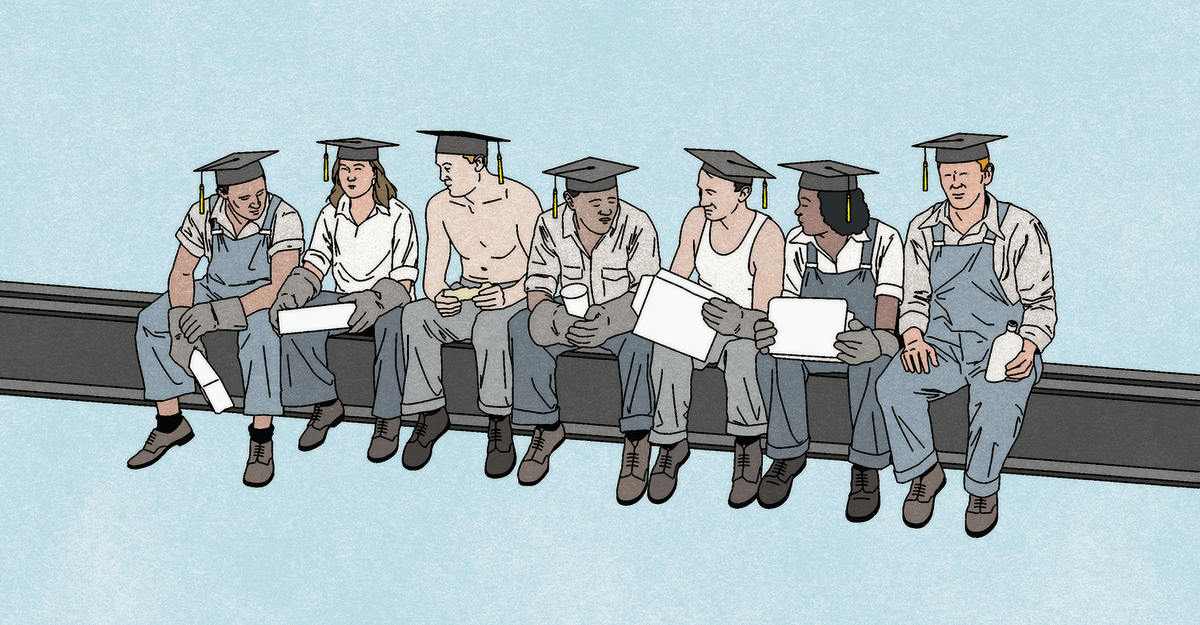
The College-Educated Working Class
Can a generation of graduates frustrated by their economic prospects change American labor politics?
This is an age of mutinies. For more than a decade in America, they’ve come so thick and fast that they trip over one another: the Tea Party, Occupy, Black Lives Matter, the Resistance, the anti-lockdown protests, the insurrection, the anti-ICE protests. The ur-mutiny, encompassing some of these, provoking and provoked by others, is MAGA. Even in full authoritarian control of the federal government, it still acts like a rioter laying dynamite at the foundation of a decayed establishment.
We understand these revolts in terms of the dominant political fact of our time, the forever war between red and blue. The mutinies are staged by one side or the other, and every high-profile trial, incendiary speech, and shooting caught on camera divides Americans instantly and predictably into two opposing camps, with apparently irreconcilable visions of what is true and of what the country is and should be: multicultural America versus heritage America. The former is inclusive, outward- and forward-looking; the latter is exclusive, inward-looking, and nostalgic for a past that it tries to recapture by tearing up traditions, norms, and the Constitution itself.
The obvious precedent for an age of mutinies is the decade before the Civil War—the years of Uncle Tom’s Cabin, Bleeding Kansas, Dred Scott, and John Brown—when pressure built up until it exploded in what future Secretary of State William H. Seward labeled “the irrepressible conflict.” The roll call of the present goes through the coronavirus pandemic, George Floyd, January 6, Project 2025, Charlie Kirk, Renee Good, and Alex Pretti. Now that President Trump’s masked militias are battling residents in the streets of blue cities, our own conflict seems to be coming to a head.
But if we unfasten our gaze long enough from the riveting prospect of another civil war, a different historical period comes to mind. The fundamental sources of our troubles, going back half a century, are economic inequality, political paralysis, corruption, mass immigration, and cultural and technological upheavals. These were exactly the country’s great problems at the start of the previous century. In 1914, Walter Lippmann wrote in his manifesto, Drift and Mastery: “No mariner ever enters upon a more uncharted sea than does the average human being born into the twentieth century.” Several decades of populism, progressivism, and reaction led to the emergence of a new order with the New Deal.
What is life like for someone born in the 21st century? Your everyday reality is disorienting change—but not the kind that freed Lippmann and his generation to shape their era. Instead, your overwhelming feeling is that the game is rigged against you. You see the old as at best indifferent, if not outright predatory, and lacking the ability or the desire to solve the problems they’ve inflicted on you. The electronic air you breathe crackles with vituperation. Political and media elites hoard status and wealth by keeping you in a perpetual fever of resentment and fury. Meanwhile, tech giants addict you from toddlerhood to devices that alienate you from other people and the natural world, trapping you in a hall of mirrors, until you give up on the idea that truth is even knowable and surrender to the wildest images of unreality. Your sense of your own existence grows fragile, and your job prospects are as precarious as your mental health. Whatever your race or gender, it feels like a liability. The system is a conspiracy against your chance at a decent life.
Anger and helplessness drive some young people to Nick Fuentes, others to Hasan Piker, and others still to fentanyl or 20-hour days of Fortnite. They might revile one another, but they exist in the same frame, where they suffer many of the same afflictions. From this perspective, the culture wars momentarily recede. Perhaps the most important arena of struggle isn’t the internet, where the wars are fought and nothing is achieved except division, but the physical world, where certain problems are common to all ordinary people. Perhaps the deepest conflict is not between red and blue, but between power and powerlessness.
Compared with a vicious online duel, this conflict is hard to dramatize. It seldom becomes the focus of politics, except in grand rhetorical gestures or small fixes for the deterioration of everyday life. A congresswoman denounces monopolistic oligarchy; a senator rails against Big Tech; another congresswoman drafts legislation against the nuisance of overly bright headlights and for the “right to repair” your own truck or washing machine. A movement of 20-somethings embraces dumb phones. And even now, amid the head-spinning events of Trump’s second term, there’s a sense that nothing fundamental changes. In Lippmann’s time, the relations among citizens, corporations, and government underwent a historic transformation; in our time, new laws and civic reforms hardly ever arise. We spend our energy on the mostly online battles of the red-blue war, stumbling down the path of the 1850s, while the powerful entities that control our lives grow bigger and more corrupt.
The subtitle of Noam Scheiber’s Mutiny: The Rise and Revolt of the College-Educated Working Class points to an unexpected group of young people who are toiling against concentrated wealth and power. A college-educated working class sounds like an oxymoron because socioeconomic status is generally defined by education and believed to rise with each academic degree. In recent years, a college education has become one of the most reliable indicators of both economic well-being and voting behavior. Americans with a college degree tend to make 75 percent more money over their lifetime than those without, and in the past three presidential elections, these better-educated, wealthier voters have moved steadily to the Democratic Party. In 2024, they voted for Kamala Harris over Donald Trump by 16 percentage points. As if according to some law of political dynamics, non-college-educated Americans have gone for Trump and the Republican Party by similar margins. The political alignment of the 20th century, when workers tended to favor Democrats and professionals Republicans, has been reversed in the 21st. The education divide is the most significant factor in American politics—sharpest among white voters, and increasing among Latino voters as well.
These trends are so glaring that the term working class is now used to describe both those without a college degree and the MAGA base. So in reporting on the college-educated working class, Scheiber, who covers labor for The New York Times, is like a zoologist whose fieldwork has revealed the existence of an animal that contradicts some long-standing theory of speciation.
His subjects, in their 20s or early 30s, came out of college with heavy debts and unrealistic expectations. A Grinnell grad, recipient of a prestigious postcollege fellowship, takes a job at a Chicago Starbucks to support himself while he tries to break into theater, only to find years later that the theater dream has died and he’s still making lattes, hectored by managers, hard up enough to apply for food stamps. After college, an “Apple fangirl” in Maryland is encouraged by a local Apple Store to think of her job in terms of passion and human potential. Hired to do one-on-one tech tutorials, she hopes to move up to designing the curriculum; instead, the company’s relentless focus on profit traps her as a glorified saleswoman in a retail mall, and she fails to keep up with her bills. Corporate America seduces these ambitious young people with exalted titles that bear scant relation to the reality of the work: Apple Store “creatives” and “geniuses” who have to wheedle customers into buying a $3,500 Vision Pro headset, Starbucks “partners” who prepare venti iced caramel macchiatos all day, Amazon “associates” whose moves around the warehouse are tracked to the minute, adjunct “professors” who earn sub-median pay with little hope of a career in their field.
It would be easy for an older, more comfortable reader, or a more truly impoverished one, to dismiss the grievances of Scheiber’s subjects. How sorry can you feel for an underemployed Hollywood scriptwriter who makes ends meet through a “sugar dating” app, as a companion for wealthy older men? These young graduates start out naive about the heartlessness of the corporate world and harbor illusory hopes for success in unforgiving professions. Culturally, they have little in common with meat packers or home health aides who never expect to do more than get by—who are toiling for their children’s futures, not their own. The college-educated are trained to expect that the world will make room for them, and when it doesn’t—when they suffer the indignities of wage work, with its unpredictable schedules and disrespectful bosses, and can see no way up or out—the blow isn’t just economic; it’s psychological. “They were often bourgeois in their tastes,” Scheiber writes. “They cradled sleek smartphones and expensive cups of coffee. They watched prestige TV on demand. But the previous decade and a half had bequeathed them the bank accounts—and the politics—of the proletariat.”
The individual stories Scheiber tells sometimes feel like cases of bad luck or poor decision making, but he’s writing more broadly about a generation of graduates whose prospects have unquestionably dimmed. The price of a college degree is soaring while its comparative benefit is shrinking. The pay gap between college and high-school grads has stopped growing over the past two decades, partly because of the Great Recession and the pandemic. The number of jobs in some of the most desirable careers has dropped, creating intense competition due to what the scholar Peter Turchin calls “elite overproduction.” Or, as Scheiber puts it, “too many people with expensive credentials chased too few jobs requiring those credentials.” When expectation and reality part ways for a cohort that’s been raised on the assumption of upward mobility—when elites start to sink, and reform is blocked—the political waters get very rough, often leading to social disintegration and unrest. Turchin’s historical examples include prerevolutionary France, Russia, and Iran; another is the United States in this decade.
Scheiber’s main interest is the development of a radical political consciousness in a generation of phone addicts and Netflix junkies. Mutiny follows a dozen or so employees at Starbucks, Apple, Amazon, Hollywood studios, and research universities who all come to the same epiphany: “They saw themselves as members of the rank and file. They grumbled about their supervisors and cursed their corporate overlords.” This new awareness, whether or not it qualifies them as bona fide members of the working class, leads them to join union-organizing drives, publicize corporate abuses, go on strike, and gradually find more purpose in labor activism than in their thwarted professional ambitions.
We remember the pandemic as a boiling point in the culture wars. The continuous battles over lockdowns, masking, police violence, expertise, conspiracy theories, and the outcome of the 2020 election have never really subsided. But the pandemic also exposed the grotesque unfairness of our economy and society in deeply personal ways, cutting across the red-blue divide. In the pandemic’s early days, before the crisis became completely subsumed by the cultural civil war, a memorable phrase appeared: essential workers, people whose livelihood required them to show up at work and risk their health. The difference between the fates of essential and nonessential workers was a profound injustice, and a healthy country would have made it a focus of public attention and policy. Jeff Bezos’s fortune increased by $24 billion in the pandemic’s first month. Meanwhile, his company’s treatment of its essential workers, and the firing of Chris Smalls, an outspoken employee in a Staten Island warehouse, triggered the creation of the first Amazon union—a milestone in the recent surge of labor activism in America.
But Amazon turned out to be a more difficult case for labor organizing in the early 2020s than Starbucks, Apple, or Disney. Disagreements over tactics and strategy led to a power struggle that divided the union, damaging the cause of labor at Amazon. Smalls, the union’s first president, framed the division along lines of race and class; his leadership faction claimed to speak for the warehouse’s Black and brown workers who never went to college (though Scheiber points out that the opposition to Smalls also included nonwhite, non-college-educated workers). In his forthcoming memoir, When the Revolution Comes, Smalls accuses white college-educated organizers at the Staten Island warehouse of trying to take power away from the authentic working class. He insists that the Amazon union must be led by workers of color—only they have the experience of hardship to understand and speak for the rank and file. “If there is any mistake I made, any regret I have,” Smalls writes, “it’s the fact that early on we let people who didn’t see the importance of race and culture the way we did get into positions of power within our movement.”
In a way, Smalls is challenging the thesis of Mutiny. He’s implying that there’s something inauthentic, maybe flatly contradictory, about a college-educated working class, especially a white one. He’s saying that “race and culture” matter more than an hourly wage. The fracturing of the Amazon union at the Staten Island warehouse plays a relatively small part in Mutiny. Though Scheiber occasionally questions the wisdom of his protagonists, he’s plainly on their side. He considers their oppression real, their struggles just, and their activism the best way to achieve more stable, dignified lives. But he isn’t sufficiently aware of the insularity and fragility of their project.
Mutiny includes no college grads in dead-end jobs whose grievances have turned them toward MAGA rather than union activism—young men and women recruited by Turning Point USA while still in college. Instead, most of the book’s protagonists would feel at home at a Democratic Socialists of America convention. They’re the kind of progressive Zoomers and Millennials who use gender-neutral pronouns and post online about Palestine. Within two days of October 7, a Starbucks organizer called on X for “solidarity with Palestine!,” and even though the post was soon taken down, Gaza created such controversy for Starbucks that the company and union sued each other over social-media posts about the war. Joe Biden’s efforts to be the most pro-labor president in history didn’t spare him the wrath of young Starbucks employees who accused him of complicity in genocide. The war galvanized them in a way that haggling over wages and hours no longer did.
The point isn’t that the Starbucks union should have taken a different position on Gaza, or that Smalls was wrong to insist on the centrality of “race and culture” at the Amazon warehouse. But these episodes show how easily the culture war can insert itself into a righteous cause. At the Apple Store in Maryland, Black and white workers in the union maintained cohesion and were able to negotiate a decent contract by focusing on corporate greed, which required a delicate balance between acknowledging the differences in their life experiences and resisting the centrifugal pull of identity.
This decade has seen more union activism than any other in almost half a century. The overweening power of corporations and plutocrats has turned much of the country in favor of labor, and Scheiber believes that it doesn’t matter whether workers assemble automobiles, make upscale coffee drinks, or write television scripts. He seems sanguine that the college divide is fading as more and more Americans experience the whip hand of a heartless economic order. Scheiber cites polls that show college graduates drawing closer to the more conservative views of the working class on immigration and crime, and he takes this as evidence that “there may be a basis for an alliance between the two groups after all.”
But other polls suggest real disagreements between those with and without a college degree. For example, on whether to deport all immigrants in the country illegally, one poll found that the gap is almost 20 percentage points among non-Hispanic white people. In general, I’m more skeptical than Scheiber is that progressive baristas—let alone newly unionized doctors and architects—are going to be eagerly embraced by their working-class brothers and sisters. Plenty of Americans will dislike the attitudes and styles of Mutiny’s activists. There are important cultural differences between an internist struggling to treat patients in a private-equity conglomerate and a John Deere machinist on strike because of layoffs. That both belong to a union might matter less than that one voted for Harris, the other for Trump, and each has some reason to fear and loathe the other. The culture war is burning too hot for a class war to snuff it out anytime soon.
The radicalization of college-educated Americans who have begun to live the unpleasant realities of their less privileged compatriots—who can hardly afford rent, much less to buy a house and start a family—is an encouraging turn. They could form part of a broader social movement that finally addresses our deepest problems instead of dissolving them in electronic bile. A professional class that identifies with America’s multitudes of have-nots and votes on that basis would be a powerful force for greater equality and opportunity.
But to succeed, such a movement has to be aware of the fault lines that could make it fail, and take care not to widen them. Tread lightly around the identity traits no one chose and the beliefs no one will give up; instead, emphasize a common economic fate. The ground that unites the powerless against the powerful is always about to collapse. Our irrepressible red-blue conflict is always ready to set Americans against Americans in every conceivable way: education, race, religion, age, gender, region, even views of foreign wars. It’s better to be honest about these differences, and try not to rub them raw until they destroy the chance for a better country, than to assume that they don’t matter or wish them out of existence.
This article appears in the April 2026 print edition with the headline “The College-Educated Working Class.”
When you buy a book using a link on this page, we receive a commission. Thank you for supporting The Atlantic.
Facts Only
A generation of college-educated young adults faces economic instability, often working in low-wage jobs despite their degrees.
Unionization efforts have surged at companies like Starbucks, Apple, and Amazon, led by college-educated workers frustrated with corporate practices.
The Amazon union in Staten Island fractured due to disputes over leadership, race, and class, with Chris Smalls arguing that non-college-educated workers of color should lead the movement.
College graduates earn 75% more over their lifetime than non-graduates, but the pay gap has stagnated in recent decades.
The political alignment of college-educated voters has shifted toward the Democratic Party, while non-college-educated voters increasingly support Republicans.
The pandemic exposed economic inequalities, with essential workers risking their health while corporate leaders like Jeff Bezos saw wealth surge.
Labor activism has increased, but cultural and political divisions—such as differing views on immigration, race, and foreign policy—complicate solidarity.
Some college-educated workers have turned to progressive activism, while others have embraced right-wing movements like MAGA.
The article cites historical parallels, comparing current economic and political tensions to the pre-Civil War era and the early 20th century.
The author suggests that economic grievances could bridge divides but acknowledges that cultural conflicts remain a significant barrier.
Executive Summary
Full Take
The narrative presents a compelling case for the rise of a college-educated working class as a potential force for labor activism and economic justice. The strongest version of this argument highlights the genuine grievances of young, educated workers trapped in precarious jobs, their disillusionment with corporate exploitation, and their turn toward unionization as a means of reclaiming agency. The piece effectively contextualizes this shift within broader economic trends—stagnant wages, elite overproduction, and the erosion of upward mobility—while acknowledging the cultural and political fractures that complicate solidarity.
However, the analysis risks oversimplifying the tensions between economic and identity-based grievances. The fracturing of the Amazon union, framed by Chris Smalls as a conflict over race and class authenticity, reveals a deeper pattern: the difficulty of reconciling materialist struggles with identity politics. The article nods to this tension but doesn’t fully interrogate how progressive labor movements might alienate working-class voters who prioritize cultural or nationalist concerns. This aligns with a broader pattern in left-wing discourse where economic populism is often subsumed by cultural battles, potentially undermining the very solidarity the piece champions.
The root cause of this dynamic lies in the paradox of modern capitalism: while economic precarity unites workers across educational lines, cultural and political identities remain potent divisive forces. The article’s historical parallels—comparing today’s unrest to the pre-Civil War era or the early 20th century—are apt but undersell the unique role of digital media in amplifying polarization. Social media doesn’t just reflect divisions; it weaponizes them, making economic solidarity harder to sustain.
The implications are profound. If labor movements fail to bridge these divides, the working class—both college-educated and not—will remain fragmented, leaving corporate power unchecked. The piece’s call for emphasizing "common economic fate" over identity traits is sound, but it’s unclear whether such a movement can resist the centrifugal pull of the culture war.
Bridge questions: How might labor organizers navigate the tension between economic and identity-based grievances without alienating key constituencies? What role does digital media play in either enabling or sabotaging cross-class solidarity? And if economic precarity is the great unifier, why do cultural conflicts so often override shared material interests?
Counterstrike scan: A bad actor seeking to exploit this narrative might amplify divisions within labor movements—pitting college-educated activists against traditional working-class voters—while framing economic grievances as secondary to cultural battles. The article itself avoids this trap, presenting a nuanced view of both the potential and pitfalls of labor activism. No structural alignment with a hypothetical attack playbook is detected.
Patterns detected: ARC-0024 Ambiguity (in the tension between economic and cultural grievances), ARC-0043 Motte-and-Bailey (potential for labor movements to retreat from cultural battles when convenient).
Sentinel — Human
The article exhibits strong human authorship signals, including stylistic idiosyncrasies, emotional depth, and complex argumentation inconsistent with AI generation.