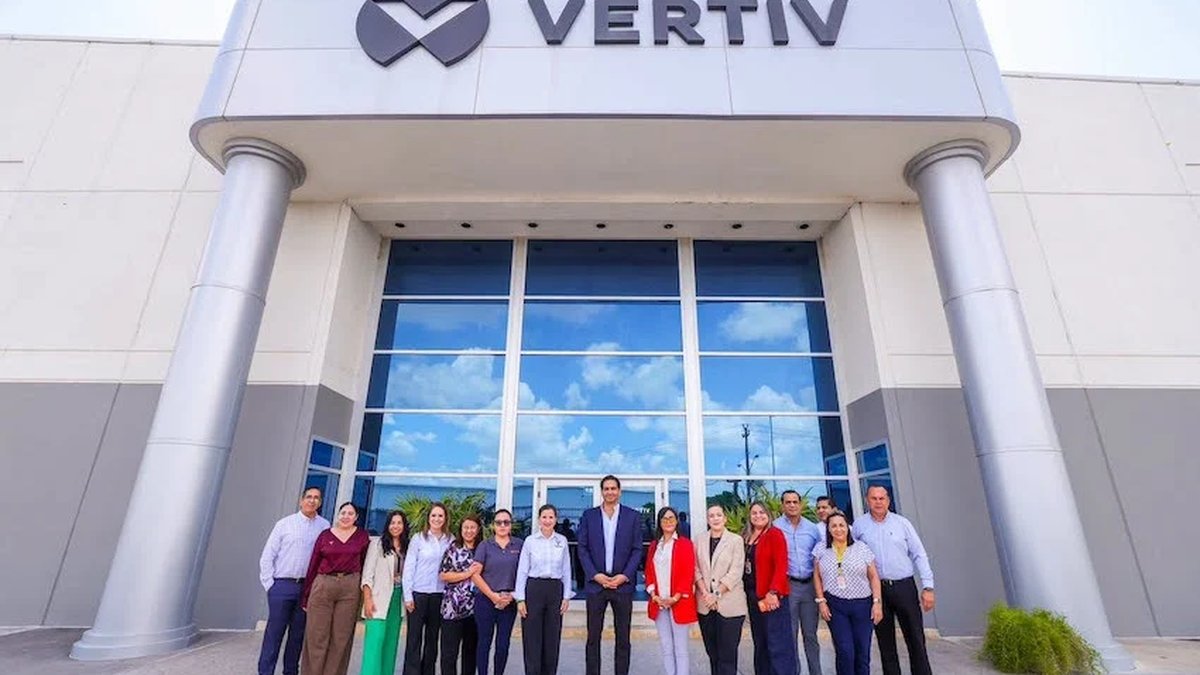
Data center infrastructure company Vertiv plans to expand operations at its Reynosa facility on the state of Tamaulipas’s border with the United States, investing US$ 150 million.
The firm made the announcement during a recent meeting at its Reynosa facilities, attended by state and municipal officials. The expansion is expected to create over 1,000 new jobs and help establish Reynosa as a leading hub for advanced manufacturing and an investment destination for high-value industries in northern Mexico.
La IA ya está aquí y lo está transformando todo. Vertiv proporciona la #InfraestructuraCrítica necesaria para que esta tenga éxito y permita cumplir los objetivos de los diferentes negocios. >> https://t.co/Mw0YxZKhFA pic.twitter.com/R7RvWKyOWb
— Vertiv (@VertivLATAM) November 25, 2024
Vertiv will expand manufacturing capacity for critical infrastructure for data centers, electrical systems, and technological applications, as it responds to the growing global demand for artificial intelligence.
“Vertiv’s expansion fosters confidence in attracting companies involved with data centers [and] artificial intelligence,” Rodolfo González Núñez, acting head of the Reynosa Municipal Ministry of Economic Development, told the gathering.
Reynosa’s municipal government has agreed to provide Vertiv with institutional support and facilitate coordination with the relevant agencies.
By 2030, Mexico is expected to have attracted around $18 billion in data center infrastructure investment since 2005, with several projects already established or under development, according to Vertiv’s Vice President of Sales for Latin America Alex Sasaki.
Companies that want to compete must start developing their data centers now, Sasaki said.
Mexico has become a major data center host in the Americas, with Querétaro, Monterrey, and Guadalajara dominating development.
Three major factors attract investors to the Mexican market: population density, a skilled technical workforce, and a geographic location that supports nearshoring strategies.
Vertiv has four Mexican plants in Tijuana, Mexicali, Reynosa and Monterrey, as well as a service center in Querétaro, which it opened last year. In June, the company opened the Vertiv Academy in Mexico City, which will enable it to train technicians to operate its facilities.
Sasaki stressed that flexibility and modularity are key to data center development.
“Data centers are no longer designed as fixed structures that last for decades without changes, but as systems that can scale, adapt, and absorb technologies that don’t yet exist,” he said. “You have to design something future-proof.”
With reports from Mexico Industry, Forbes México and Mexico Business News
Sentinel — Human
The text reads like a standard news report synthesizing a corporate announcement with relevant macroeconomic context; it exhibits the flow and complexity typical of human journalism.