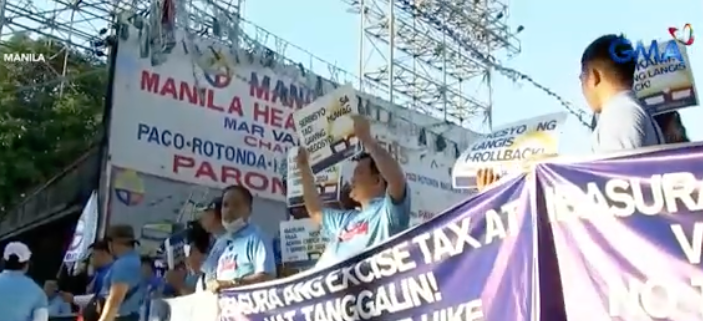
A coalition of transport groups started their two-day nationwide strike on Thursday to protest rising fuel prices due to tensions in the Middle East.
Transport workers from various sectors including jeepneys, transport network vehicle services (TNVS), motorcycle taxis, buses, and UV Express joined the mass action.
“Ramdam na ramdam ng mga drayber at ng kanilang mga pamilya ang krisis sa kanilang kumakalam na sikmura, at ramdam din ito ng bawat komyuter na wala nang masakyan sa kalsadang nagsisilagasan na ang mga pumapasadang tsuper,” PISTON said.
(Drivers and their families are feeling the crisis in their growling stomachs, and every commuter is also feeling it because no public transport vehicles are available.)
In Metro Manila, one of the main protest gatherings of the No To Oil Price Hike Coalition was along Aurora Boulevard in Cubao, Quezon City, where a program began at 6:00 a.m.
More strike centers across the National Capital Region and other regions were also set.
The group called for the removal of value-added tax (VAT) and excise taxes on petroleum products, rollback of fuel prices to P55 per liter, and scrapping of the Oil Deregulation Law.
They also demanded fare increases across all transport modes, P1,200 family living wage, and the nationalization of the oil industry to allow the government to directly procure and sell fuel at lower costs.
According to the group, wars should be stopped to end the rising fuel prices.
Due to the transport strike, different government agencies prepared free rides for affected commuters.
Facts Only
Actors: Transport groups (PISTON), commuters, government agencies
Events: Two-day nationwide strike, protest gatherings, demonstrations, provision of free rides
Actions: Initiated strike, began protests, offered free rides
Locations: Aurora Boulevard in Cubao, Quezon City (Metro Manila), other regions
Dates: May 19, 2022 (two-day strike)
Executive Summary
Transport groups across various sectors initiated a two-day nationwide strike on May 19, 2022, to protest escalating fuel prices due to Middle East tensions. The demonstrations involve jeepneys, transport network vehicle services (TNVS), motorcycle taxis, buses, and UV Express vehicles. Protests began in Metro Manila at Aurora Boulevard in Cubao, Quezon City, with additional centers planned across the National Capital Region and other regions.
The group demands include the removal of value-added tax (VAT) and excise taxes on petroleum products, a rollback of fuel prices to PHP 55 per liter, and the repeal of the Oil Deregulation Law. They also call for fare increases across all transport modes, a P1,200 family living wage, and nationalization of the oil industry to allow the government to procure and sell fuel at lower costs. Additionally, they assert that wars should be halted to address rising fuel prices.
In response to the transport strike, various government agencies have arranged free rides for affected commuters.
Full Take
Steelman: The transport groups' actions are a response to rising fuel prices due to Middle East tensions, aiming to pressure the government into removing taxes on petroleum products and implementing various reforms to lower fuel costs for consumers.
Patterns detected: ARC-0043 Motte-and-Bailey (demanding fare increases while calling for a nationalized oil industry), ARC-0024 Ambiguity (asserting that wars should end to address fuel prices without clarifying the connection).
Root Cause: The strike can be attributed to economic hardship and frustration caused by increasing fuel costs, which disproportionately affect transport workers and their families.
Implications: If successful, the demands could lead to reduced fuel prices for consumers and higher wages for transport workers. However, they may also strain government resources and potentially disrupt daily commuting routines.
Bridge Questions: What is the impact of Middle East tensions on global fuel markets? How can governments balance the needs of consumers and industries when setting fuel prices? What alternative energy solutions could mitigate the reliance on fossil fuels?
Counterstrike Scan: A bad actor might exploit public frustration over rising fuel prices to promote divisive or extremist ideologies, distract from other issues, or sow discord in society. However, the actual content does not align with a coordinated influence campaign.
Sentinel — Human
While the article shows some signs of human authorship, it's likely to be written by a human journalist.