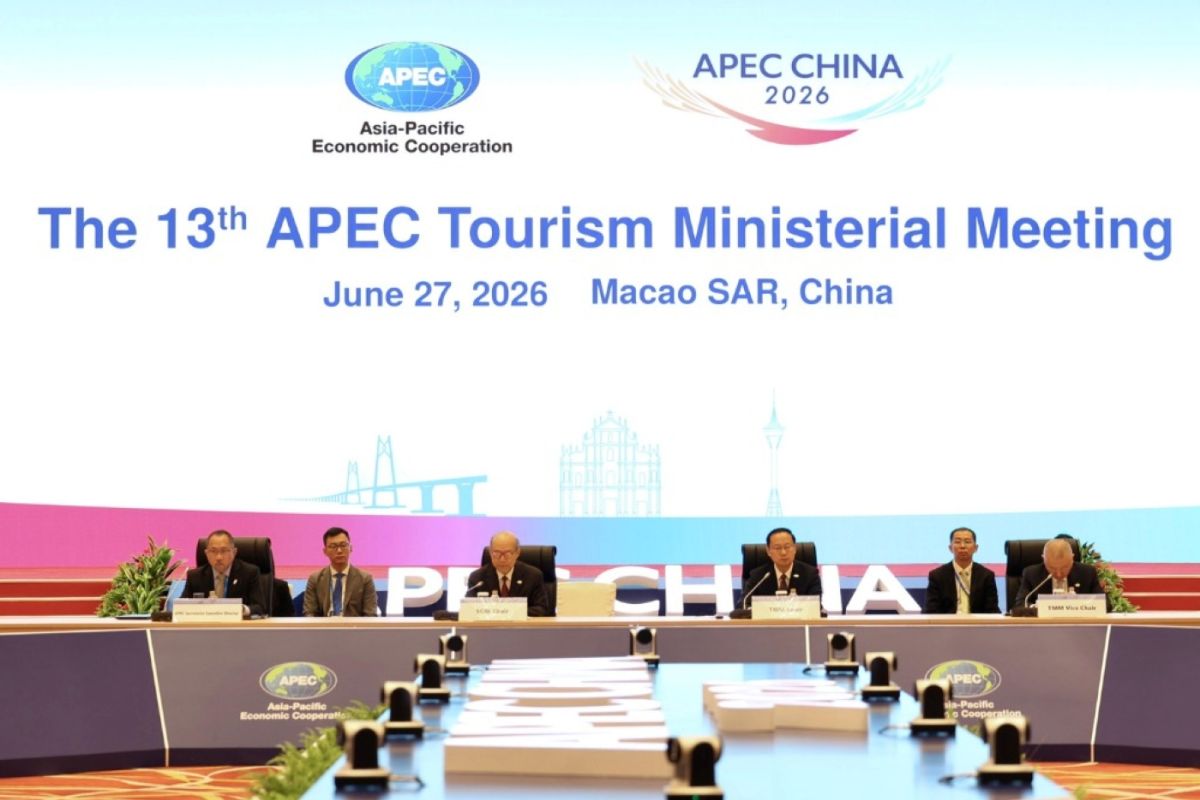
"The tourism sector is instrumental in meeting people's aspirations for a better life, driving economic growth, and promoting cultural exchanges, while playing a unique role in advancing the building of an Asia-Pacific community," China's Minister of Culture and Tourism, Sun Yeli, said in a statement published on the APEC website on Sunday.
Sun made the remarks while opening the APEC Tourism Ministerial Meeting in Macao.
He outlined three priorities to deepen regional tourism cooperation, accelerating digital innovation, strengthening practical collaboration to make travel more seamless, and ensuring that the benefits of tourism are shared more broadly across communities.
"We need to enrich the visitor experience by harnessing new technologies such as real-time translation glasses, exoskeleton devices, and virtual reality to break down language barriers, facilitate travel, and strengthen cultural connections," he said.
"We also need to support enterprises in jointly developing tourism products, designing cross-border travel routes, and increasing direct flights and cruise services across the region to better meet the diverse needs of travelers," he added.
According to the statement, improving travel facilitation was another key focus of the meeting.
Research by the APEC Policy Support Unit shows that replacing traditional visas with electronic visas could increase bilateral travel flows by up to 15 percent, highlighting how digital reforms can complement broader efforts to facilitate cross-border mobility.
During the meeting, tourism ministers discussed how digital innovation could support the sector's recovery, stimulate economic growth, and ensure that the benefits of technological transformation extend beyond travelers to communities across the Asia-Pacific.
The discussions build on the ongoing work of APEC's Tourism Working Group to modernize the tourism sector. Current initiatives include exploring artificial intelligence-based solutions for tourism and hospitality, streamlining border procedures to improve connectivity, and advancing digital tools for destination management and sustainable tourism.
"Win-win cooperation has proven to be the right way forward," Sun said.
"I sincerely hope that all member economies will take this meeting as an opportunity to elevate APEC tourism cooperation to new levels and broader areas, bring our peoples even closer together, and contribute to the success of the APEC Economic Leaders' Meeting to be held in China," he added.
Tourism remains a major driver of economic growth across the Asia-Pacific. In 2024, APEC economies welcomed 439 million international visitors, including 359 million travelers from other APEC member economies.
Before the COVID-19 pandemic, tourism contributed 10.4 percent of the region's gross domestic product and supported 334 million jobs.
Related news: APEC ministers push for open trade amid global uncertainty
Related news: Indonesia supports China's APEC push on digital transformation
Reporter: Asri Mayang Sari
Editor: Primayanti
Copyright © ANTARA 2026
Facts Only
* China's Minister of Culture and Tourism, Sun Yeli, made remarks at the APEC Tourism Ministerial Meeting in Macao on Sunday.
* Sun outlined three priorities for deepening regional tourism cooperation: accelerating digital innovation, strengthening practical collaboration to make travel more seamless, and ensuring benefits of tourism are shared more broadly across communities.
* He proposed using new technologies such as real-time translation glasses, exoskeleton devices, and virtual reality to break down language barriers and strengthen cultural connections.
* Sun called for supporting enterprises in jointly developing tourism products, designing cross-border travel routes, and increasing direct flights and cruise services.
* Research suggests replacing traditional visas with electronic visas could increase bilateral travel flows by up to 15 percent.
* APEC economies welcomed 439 million international visitors in 2024, including 359 million travelers from other APEC member economies.
* Before the COVID-19 pandemic, tourism contributed 10.4 percent of the region's gross domestic product and supported 334 million jobs.
* Current initiatives by APEC's Tourism Working Group include exploring artificial intelligence-based solutions for tourism and hospitality, streamlining border procedures, and advancing digital tools for destination management.
Executive Summary
Full Take
The narrative presented frames technological innovation and regional cooperation as the primary mechanisms for achieving broader social and economic goals. This pattern—where digital solutions (e-visas, VR translation) are positioned as seamless facilitators of cultural exchange and economic growth—serves to establish a unified developmental agenda where cross-border mobility and shared benefits are inherently linked to technological adoption.
The focus on "win-win cooperation" and the emphasis on sharing benefits across communities functions as a strategic framing that legitimizes large-scale infrastructural and digital shifts. This approach subtly shifts the conversation from national interests or specific equity concerns toward a regional, collective mandate, potentially obscuring the distribution of costs and gains among various stakeholders.
The reliance on technological solutions to "break down barriers" (language, borders) requires scrutiny regarding who controls these technologies and how they are implemented. The move toward electronic visas and AI-based solutions, while offering efficiency, raises questions about data sovereignty, digital divide impacts, and the potential for centralized control over cross-border mobility. Furthermore, linking tourism's economic recovery directly to technological transformation implies a systemic assumption that innovation inherently translates into equitable development rather than merely optimizing existing flows.
Patterns detected: ARC-0043 Motte-and-Bailey, ARC-0024 Ambiguity, ARC-0011 Authority Games
Sentinel — Human
The text exhibits the structure, tone, and specific attribution markers of human-authored diplomatic reporting, relying on documented facts and contextualizing them within a formal multilateral framework.