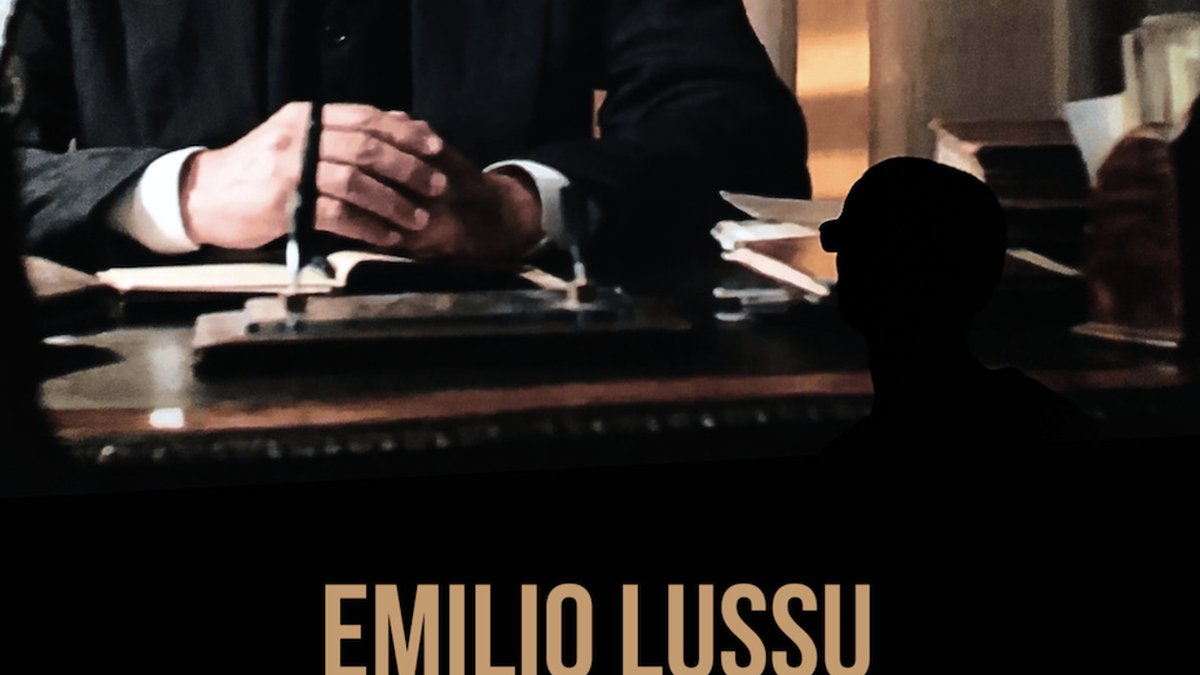
For audiences outside Italy, Emilio Lussu remains a relatively overlooked figure compared to contemporaries such as Antonio Gramsci or Carlo Rosselli. Yet Lussu’s life encompassed many of the defining struggles of the twentieth century: a decorated soldier in the First World War, a founder of Sardinian autonomism, one of the most uncompromising opponents of Fascism, a political exile, Resistance leader, writer, and later a parliamentarian in republican Italy. The film’s focus on his 1926 trial therefore becomes more than a historical reconstruction—it becomes an examination of how democratic institutions respond when confronted with authoritarian violence.
Filippo Medas‘ soundtrack for Emilio Lussu: Il Processo succeeds precisely because it refuses the temptations of historical drama. Rather than reaching for patriotic grandeur or sentimental heroism, Medas approaches Emilio Lussu’s story as a moral and political inquiry whose relevance extends far beyond 1926. The result is a score that is psychologically charged and quietly unsettling.
The film reconstructs the events surrounding Lussu’s acquittal for the killing of a Fascist squadrista who attempted to break into his home during a violent assault, while also drawing attention to the extraordinary courage of the judges who initially upheld the principle of self-defence before political interference overturned their decision. Crucially, the film avoids turning Lussu into a solitary hero, instead foregrounding collective acts of resistance and integrity.
Medas mirrors this approach in his music. Tracks such as “Pedinamento” [Tailing], “Interrogatorio” [Interrogation] and “L’Arresto” [The Arrest] point towards institutional pressure through sparse textures and a persistent sense of unease. Even when tension rises, the score never lapses into melodrama. The emphasis is not on spectacle but on the mechanisms of power.
The most striking cue is undoubtedly “L’Ordine Fascista” [The Fascist Order]. Built around pounding rhythms, distorted textures and fragments of Mussolini’s own voice hidden within the mix, the piece feels deliberately anachronistic. Drawing more from industrial music than from conventional period scoring, it presents Fascism not as a relic of the past but as a recurring force of manipulation and collective rage. As Medas notes, these are not disciplined soldiers but “rabid dogs on a leash,” unleashed by opportunists who channel frustration and resentment for political ends.
That perspective reaches its clearest expression in “Cos’è il fascismo?” [What is fascism?], a title that echoes one of the film’s central questions. Here the score resonates with the film’s invocation of Pasolini and his famous metaphor of the disappearance of the fireflies: Fascism is not simply a historical regime but a process of cultural homogenisation, obedience and the suppression of critical thought. Medas wisely avoids offering a musical answer, preferring ambiguity and reflection.
Throughout the album, contemporary electronics, experimental textures and subtle thematic motifs replace historical reconstruction. In doing so, Medas was inspired by composers such as Trent Reznor as he points out in the following interview about the production process for the soundtrack.
The score never tells the audience what to feel; instead it creates a space in which Lussu’s ethical steadfastness and the fragility of democratic institutions can be contemplated. In an era when the question “What is fascism?” remains disturbingly relevant, Emilio Lussu: Il Processo offers a soundtrack that understands history not as something finished, but as something still unfolding.
Hi Filippo, thank you for joining us. The film Emlio Lussu: Il Processo is directed by Gianluca Medas, with whom you share not only a long-standing artistic connection but also a family connection. How did that relationship influence the creative dialogue between director and composer on the film?
The way my father works on his projects is often by simply letting things be. When starting a new project he always has a clear intention in mind, but working in the theatre sector with a small sized performing arts company will give anyone a masterclass in flexibility and scope adjustment! This project suffered from the sudden arrival of Covid 19, which severely risked shutting the project (yes, this movie had been in the works for five years, and waited another 3 years before coming out).
Instead of getting demoralized, he rewrote the project from the ground up, into a blend of biopic, documentaristic reality show, and magical realism. From the beginning, he allowed me to express my natural musical inclinations, while being clear about the tone he intended to set for his work.
Much of the soundtrack avoids conventional historical reconstruction. Rather than attempting to recreate the sound world of the 1920s, the music often feels contemporary and psychologically charged. How did you approach the challenge of scoring a historical film while keeping it relevant to present-day audiences?
There’s this expectation, which is conditioned by the practices of the movie industry itself, that the soundtrack should be as historically accurate as possible. But as with everything in the arts, most of it is an impression, a white lie. In the end, it all has to do with the habits of the listener and genre conventions. For example, movies set in the 18th century will have a full scale orchestra played with modern classical instruments, which they did not have at the time. And what about late romantic harmonies and instrumentations for movies set in medieval times, or fantasy genres? What should we say, then, about older sci-fi music set in the distant future that uses the most advanced synthesizers of their time? Not only would that instrumentation be retroactively obsolete in the time frame of the movie, but it surely turned out to be by today’s standards.
Each musician, composer and producer has their own signature style. For some reason, when movie directors call in musicians who work in genres other than orchestral classical music, they will still end up writing a soundtrack that follows the conventions of Hollywood movie music. It was particularly evident when Daft Punk composed the OST for TRON Legacy. I always found that a missed opportunity. Trent Reznor, on the other hand, immersed himself completely in his club music roots with TRON Ares, and avoided any classical music cliché. As one might have noticed, his music was and still is of great inspiration for me, so I took his lead and made music that made sense with my background and inclinations, without forcing myself to follow the conventions of movie soundtracks. There are many other great examples, like Peter Gabriel’s The Last Temptation of Christ, which is one of my most formative listens.
One of the most intriguing tracks is “L’Ordine Fascista.” Its pounding rhythms and mechanical textures feel almost anachronistic, recalling industrial music more than a period soundtrack. Was this deliberate? Were you trying to portray fascism not as a historical phenomenon confined to the past, but as a recurring system of discipline, control, and dehumanisation?
I won’t hide that a bit of the repetitiveness of the fascist theme comes from my hardware limitations at the time. My PC could not handle the projects, so I had to make do with what I had in my hands! But this was a fortunate case of limitations espousing artistic intentions almost perfectly. Even if I had Hans Zimmer’s studio in my hands, I would have followed the same basic intent.
When I first read the screenplay, and watched the test footage, I knew immediately that representing Fascism with a clean, disciplined, martial theme would not capture its essence. Lussu saw his home assailed by an horde of young men, chanting to his death (“With Lussu’s little moustache we’ll make little brushes to wash up the boots of Mussolini, our Dux”, I couldn’t help myself from translating it in this way, it came out spontaneously like that).
It became immediately clear to me that I needed to convey that these men were rabid dogs on a leash. Barely under control, and unleashed against the enemy as needed by a few cold headed opportunists.They were not a paramilitary force, mere members of a party. They were primal, unconscious anger personified. The music needed to convey it.
Nearly all of the tracks played while fascists are on screen have one quirk: many of them present a “secret” thematic element. Mussolini’s own voice. I sampled a short clip of one of his speeches and used it on several tracks as a sort of ghostly “wail to action,” symbolizing how Mussolini channeled the destructive force of his followers through his speeches. You can hear it at the very beginning of this track.
The title “Cos’è il fascismo?” (“What Is Fascism?”) inevitably invites reflection beyond the film itself. After immersing yourself in Lussu’s story, how would you answer that question today? Do you see parallels between the mechanisms of fascism depicted in the film and contemporary political or social realities?
The movie cites a quote by Mussolini, after he was asked precisely that question, which I would like to quote in full:
“Who are the Fascists? When Mussolini spoke to a gathering for the first time, the 6th of October 1919, he surprised everyone by admitting his difficulty in defining Fascism. He explains that Fascists are not republicans, socialists, democrats, conservatives, nationalists. Instead, Fascism represents the synthesis of all negations. Of all the issues of democracy. He adds that Fascism has drawn together all those who are troubled by outdated ways of thinking. That Fascism rejects all political parties. That it embodies a unique mindset that encompasses a thousand anxieties and a thousand frustrations. And by caring little about the past, it uses the present to move toward the future.”
Essentially, it is an admission that fascism was merely a ploy to seize power by any means necessary. The underlying philosophy was a secondary motive. A mask used to justify its existence to the world.
Many dictatorships began with despotic control from above. But many began from below. Fascism is an example of this.
Several pieces—such as “Pedinamento,” “Interrogatorio,” and “L’Arresto”—evoke surveillance, intimidation, and institutional pressure. How did you translate these themes into sound, and what role does music play in conveying the atmosphere of fear surrounding the trial?
In that sense, I went exclusively by instinct. I had a few themes and sounds that presented themselves organically. I explored and fiddled with the instruments at my disposal until I felt I was going in the right direction. And by checking the reactions of the audience at the (small!) test screenings, I knew when I struck the right chord.
Emilio Lussu remains one of the most important anti-fascist voices in Italian history, yet to an international audience he is perhaps less widely known today than figures such as Gramsci or the Rosselli brothers. What aspects of Lussu’s life, thought, or moral example do you think remain most relevant today, and what do you hope audiences take away from the film and its music?
I think that one of the most admirable aspects of Lussu’s character, and possibly the ironic aspect of the whole ordeal, is that he somewhat embodied the archetype of the valiant knight.
While the Fascists preoccupied themselves with the image of the strong man and the exemplary soldier while acting like the opposite of principled warriors, Lussu held a specific set of moral convictions with unwavering resolve. He refused to leave his home even when he knew that the fascists sought to chase him into his own home, because he did not want to show fear. When the Fascists surrounded his house, he first warned them that he would defend himself if they were ever to trespass his property. Once they did, he fired a single shot at the one person that breached his balcony. Once the police arrived, he did not fight. He let himself be arrested, to show he believed in the rule of law and the judicial process. He only escaped from prison once the Trial determined that he acted in self defense, and the government disregarded the sentence and kept him in prison.
He acted out a moral code until its logical end. He followed the rules until the other players dropped the facade and broke them explicitly. And even during the war, and after, he acted out with this inherent sense of justice and truth-seeking.
Those who want to be warriors and fight for what is “good and true in this world” should disregard the pandering of charlatans and wannabes. Instead, they should follow the concrete example of someone like Emilio Lussu. (Gianmarco Del Re)
Sentinel — Human
LIKELY_HUMAN (confidence: 0.15)